

CBD Lotion for Arthritis: What Patient Testimonials Reveal
Table of Contents
- What Patients Report: Real Experiences With CBD Lotion for Arthritis
- How to Apply CBD Lotion for Joint Pain: Techniques That Matter
- CBD and CBC Benefits for Inflammation: What the Evidence Shows
- CBD vs NSAIDs for Arthritis: Why Patients Switch
- Choosing a High-Quality CBD Lotion: What Matters Most
- Safety, Side Effects, and Who Should Avoid Topical CBD
- Common Misconceptions About CBD Topicals for Joint Pain
- Frequently Asked Questions
Last Updated: September 18, 2026
What Patients Report: Real Experiences With CBD Lotion for Arthritis
Patient testimonials about CBD lotion arthritis reveal a consistent pattern: people are turning to topical cannabinoid products as an alternative to traditional pain management. What emerges from these real-world accounts isn't a miracle cure, but rather a tool that works for some people in specific situations. At Railroad Remedies (RXR), customer feedback on CBD lotion arthritis products often centers on three key themes: ease of application, speed of relief, and the appeal of a non-greasy formula.

Many users report that topical CBD lotions fit naturally into their daily routine. Unlike oral medications that require timing and water, a lotion can be applied directly to the affected joint whenever discomfort arises. Patients with osteoarthritis in their hands, knees, and shoulders describe applying the product multiple times per day without hassle. The anecdotal evidence suggests that people appreciate having control over when and how often they use the product.
What patients don't typically report is complete pain elimination. Instead, testimonials describe reduced stiffness, improved mobility for short periods, and enough relief to make daily activities more manageable. These are modest but meaningful improvements for people managing chronic conditions.
How to Apply CBD Lotion for Joint Pain: Techniques That Matter
The way you apply CBD lotion for joint pain directly affects how well it works. This isn't just about rubbing it on and waiting. Proper application technique can influence absorption and the duration of any relief you experience.
Start with clean, dry skin. Wash the affected area with mild soap and water, then pat dry completely. Moisture on the skin can create a barrier that slows absorption. Apply a small amount of lotion, roughly the size of a dime for a joint like a knee or ankle, slightly less for smaller joints like fingers or wrists. The product should cover the joint and surrounding area without excess.
Massage the lotion into the skin using gentle, circular motions for 2-3 minutes. This accomplishes two things: it helps the formula penetrate deeper through the skin layers, and the physical massage itself can reduce tension in the surrounding muscles. Move your fingers slowly in small circles, then gradually expand outward from the joint. Don't rub aggressively, firm but gentle pressure works better.
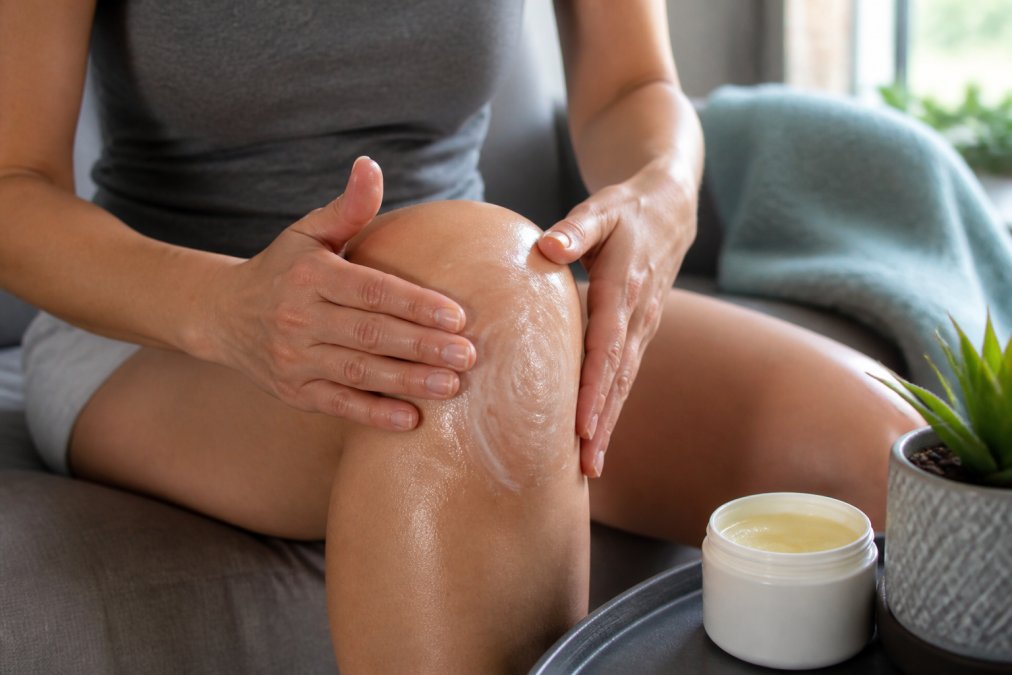
Allow the lotion to fully absorb before covering the area with clothing or bandages. This typically takes 5-10 minutes. Some formulas absorb faster than others depending on their base ingredients. Once absorbed, the lotion shouldn't leave visible residue on your clothes. If it does, you've likely applied too much product.
Timing matters. Many users find that applying the lotion before activities they know will cause discomfort, morning stiffness, exercise, or work that stresses certain joints, produces better results than waiting until pain is severe. Think of it as preventive rather than reactive application.
CBD and CBC Benefits for Inflammation: What the Evidence Shows
CBD and CBC are two cannabinoids found in hemp plants, and they work through different mechanisms in the body. Understanding what distinguishes them helps explain why some formulas combine both compounds.
Cannabidiol (CBD) interacts with the body's endocannabinoid system, which plays a role in regulating pain perception and inflammatory responses. When applied topically, CBD may help reduce localized inflammation by interacting with receptors in the skin and underlying tissues. The mechanism isn't fully understood in humans, but research suggests CBD has anti-inflammatory properties that could contribute to pain relief.
Cannabichromene (CBC) is a lesser-known cannabinoid that some research indicates may have its own anti-inflammatory and analgesic properties. Where CBD focuses on broad regulatory effects, CBC appears to work through different pathways in the inflammatory response. When combined, CBD and CBC may provide complementary benefits, each addressing inflammation through slightly different mechanisms. This is why some premium formulations include both compounds.
The evidence for topical CBD's effectiveness in arthritis comes primarily from anecdotal reports and preliminary research rather than large-scale clinical trials. Patient experiences suggest that topical application can provide localized relief, particularly for osteoarthritis affecting joints close to the skin's surface. The scientific community emphasizes that more rigorous clinical trials are needed to establish efficacy definitively.
What the current evidence does support is that CBD is generally well-tolerated when applied topically. Adverse effects are rare, and the compound doesn't penetrate deeply enough systemically to cause the same effects as oral CBD. This makes topical application a low-risk option for people exploring alternatives to oral medications.
CBD vs NSAIDs for Arthritis: Why Patients Switch
The comparison between CBD lotion and NSAIDs (nonsteroidal anti-inflammatory drugs) reveals why some patients experiment with topical cannabinoids. These are fundamentally different approaches to managing arthritis pain, each with distinct trade-offs.
CBD/CBC 2000mg Pain Relief Lotion 3.3oz →
NSAIDs like ibuprofen and naproxen work systemically, they enter the bloodstream and reduce inflammation throughout the body. They're fast-acting, well-studied, and effective for many people. However, long-term NSAID use carries documented risks, particularly for the gastrointestinal system. Patients who've taken NSAIDs for years often develop stomach sensitivity, acid reflux, or more serious complications. This is why many people in their 50s, 60s, and beyond begin looking for alternatives.
Topical CBD lotion works only at the site of application. It doesn't enter the bloodstream in meaningful amounts, so it can't reduce systemic inflammation. This is both a limitation and an advantage. The limitation is obvious, it won't help with widespread arthritis affecting multiple joints simultaneously. The advantage is that it eliminates the systemic side effects entirely. There's no risk to your stomach, liver, or kidneys from topical CBD application.
Patients switch to CBD lotion when they want to reduce their reliance on oral medications, manage localized pain in specific joints, or avoid the side effects of long-term NSAID use. It's not typically a complete replacement for NSAIDs in severe arthritis cases, but rather a complementary strategy. Someone might use topical CBD lotion for their knee pain while taking a lower dose of NSAIDs for systemic relief, reducing their overall medication burden.
The trade-off is acceptance of more modest pain relief. NSAIDs can reduce pain significantly for many people. CBD lotion typically provides partial relief, enough to improve function and reduce stiffness, but not complete elimination of discomfort. Whether that trade-off makes sense depends on your individual tolerance for medication side effects and your pain management goals.
Choosing a High-Quality CBD Lotion: What Matters Most
Not all CBD lotions are created equal. The difference between a premium formula and a generic product comes down to ingredient quality, concentration, and manufacturing transparency.
Start with CBD concentration.
Railroad Remedies (RXR)'s CBD Relief Lotion 500mg ($39.99) and CBD/CBC 2000mg Pain Relief Lotion ($69.99) both feature organic coconut oil, shea butter, and kukui nut oil as their base. The 2000mg formula adds CBC, known for its enhanced anti-inflammatory and analgesic properties. Both products are formulated to absorb quickly without greasiness, a practical advantage that affects whether people use the product consistently.
Safety, Side Effects, and Who Should Avoid Topical CBD
Topical CBD is generally considered safe for most people, but certain situations warrant caution or avoidance.
Common Misconceptions About CBD Topicals for Joint Pain
Several myths circulate about CBD lotion that deserve clarification.
Misconception 1: Topical CBD will get you high. This is false. CBD doesn't produce intoxication, and topical application doesn't allow enough THC to enter the bloodstream to cause any psychoactive effects. You can apply CBD lotion without worrying about impairment.
Frequently Asked Questions
Does CBD lotion really help with arthritis pain?
Patient testimonials and emerging research suggest CBD lotion may help manage arthritis discomfort, particularly for osteoarthritis. However, individual results vary, some patients experience noticeable relief within days, while others see gradual improvement over weeks. The endocannabinoid system plays a role in pain signaling, and topical application allows cannabidiol to interact with receptors near affected joints. Third-party testing ensures potency and purity, making quality products more reliable than untested alternatives.
How long does it take for CBD lotion to work on joints?
Most patients report feeling initial relief within 15 to 30 minutes of application, though peak effects typically emerge after 1 to 2 hours. Consistent daily use over 2 to 4 weeks often produces more pronounced symptom relief as CBD accumulates in the skin and joint tissues. Factors affecting timeline include lotion potency, application technique, skin thickness at the affected area, and individual metabolism. Starting with regular applications at the same time each day helps establish a routine and allows you to track when relief becomes most noticeable.
What makes a CBD lotion effective for arthritis compared to other pain creams?
High-quality CBD lotions contain verified cannabidiol concentrations backed by third-party testing and certificates of analysis. Unlike generic pain creams, premium formulations combine CBD with complementary ingredients, such as organic coconut oil, shea butter, and anti-inflammatory botanicals, that enhance absorption and skin nourishment. Some advanced formulas include CBC (cannabichromene), known for its enhanced anti-inflammatory and analgesic properties. Non-greasy, easily absorbed bases ensure comfort during daily wear, and organic sourcing reduces exposure to pesticides and heavy metals that can irritate sensitive skin.
Can I use CBD lotion if I'm taking arthritis medications like NSAIDs?
Topical CBD lotion is generally considered safe to use alongside oral medications because it absorbs locally into skin and joints rather than entering the bloodstream significantly. However, consult your rheumatologist or primary care provider before combining treatments, especially if you take blood thinners or have liver concerns. Some patients find that consistent CBD lotion use reduces their need for oral pain relievers over time, though this transition should be managed with medical guidance. Keeping a symptom log helps you and your doctor track whether combining therapies improves overall pain management.
