

How Often to Apply CBD Cream for Arthritis Relief
Table of Contents
- How CBD Cream Works for Arthritis Pain
- Recommended Topical CBD Dosage for Joint Pain
- How Often Should You Apply CBD Cream for Arthritis?
- How Long Does CBD Cream Last on Skin?
- CBD vs CBD/CBC for Inflammation: Which Works Better?
- How to Apply CBD Cream for Arthritis Correctly
- Tracking Your Results: A Trial-and-Error Log for CBD Cream
- Conclusion
- Frequently Asked Questions
Last Updated: September 14, 2026
How CBD Cream Works for Arthritis Pain
CBD cream for arthritis delivers cannabinoids through the skin to local pain and inflammation receptors. Unlike ingested CBD, which passes through the digestive system and liver, a topical keeps most of its activity near the application site.
This guide from Railroad Remedies (RXR) covers application timing, dosage, and technique.
The Role of Cannabinoid Receptors in Joint Inflammation
The endocannabinoid system includes CB1 and CB2 receptors in skin, connective tissue, and immune cells.
When you massage a topical cannabinoid product into a painful knee or hand, the cannabinoids bind to these receptors in the epidermal layer and underlying tissue. The result is localized relief rather than a whole-body effect. NIH overview of the endocannabinoid system
That distinction matters for arthritis: you're calming one specific joint, not sedating your entire nervous system.
Recommended Topical CBD Dosage for Joint Pain
With no FDA-approved topical CBD dosage, the practical approach is titration: start low, track your response, and adjust upward in small increments. A common starting point is a pea-sized amount (roughly 0.1 to 0.15 mL) of a mid-potency lotion twice daily (Help).
Watch the milligram concentration, not the tube size. To compare fairly, divide total milligrams by pumps or grams: a 500mg/100mL lotion delivers about 5mg per mL; a 2000mg/100mL lotion about 20mg per mL. That four-fold difference is why switching products without recalculating feels like the cream 'stopped working.'
Milligram Dosage and Potency: Finding Your Therapeutic Window
The therapeutic window is the range where you get meaningful relief without wasting product or overshooting into unnecessary cost. For most people, it sits between a low-potency daily moisturizer and a high-potency targeted formula.
A simple way to think about it:
- 500mg formulas: best for broad areas, daily maintenance, or first-time users testing tolerance
- 1000mg formulas: a middle ground for moderate, recurring joint pain in larger joints like knees or hips
- 2000mg formulas: best for stubborn joints, acute flare-ups, or users who've already confirmed topicals work for them
If a 500mg product does nothing after two weeks of consistent use, step up in concentration rather than applying more of the weaker product. Doubling a 5mg/mL lotion gives 10mg per application; a 20mg/mL lotion gives 20mg at the same pea-sized dose, with less residue.
A Practical Titration Schedule
Most practitioners suggest a structured ramp:
- Week 1: one pea-sized application per affected joint, twice daily. Log pain before and one hour after.
- Week 2: if relief is partial, keep the dose but add a midday application.
- Week 3: if relief is still partial, increase concentration (not volume) one step (e.g., 500mg to 1000mg).
- Week 4: if nothing changes after three weeks at a higher concentration, topicals may not suit that joint; discuss other options with your doctor.
How Much to Use by Joint Size
Dose volume should scale with surface area:
- Fingers and wrists: a grain-of-rice amount per joint
- Elbows, ankles, and feet: a pea-sized amount
- Knees and shoulders: two pea-sized amounts, one for the joint and one for surrounding tissue
- Hips and lower back: three to four pea-sized amounts, since the target tissue sits deeper under thicker skin and muscle
A knee-sized dose on a knuckle wastes product; a knuckle-sized dose on a hip never reaches meaningful tissue concentration.
Why Topical Dosing Is Different From Oral Dosing
Oral CBD loses a meaningful fraction to first-pass liver metabolism, so oral doses are measured in tens of milligrams (pubmed.ncbi.nlm.nih.gov). Topicals target local tissue concentration, not blood levels. A 5mg topical application over a specific joint can feel comparable to a much larger oral dose there, with far lower systemic exposure. The two are not interchangeable.
When to Stop Increasing
More is not always better. Signs you have passed your therapeutic window:
- The same relief at a higher concentration
- New skin irritation, redness, or warming
- Cost per relief-hour climbing without matching benefit
If any appear, step back down one concentration level and hold for a week before deciding your next move.
How Often Should You Apply CBD Cream for Arthritis?
For most people, applying CBD cream for arthritis two to three times per day produces the most consistent results. Morning and evening cover the stiffest periods; a midday application helps during active hours. Consistency beats intensity: one heavy morning application rarely outperforms three moderate ones spaced through the day.
A practical schedule many users settle into:
- Morning: after showering, when skin is warm
- Midday or post-activity: after physical work, exercise, or long periods on your feet
- Evening: before bed, letting it absorb without rubbing against clothing
During acute flare-ups, some users add a fourth application. That's fine short-term, but needing four or more daily for weeks signals you should reassess potency or talk to your doctor about your broader pain management plan.
How Long Does CBD Cream Last on Skin?
Most topical CBD lotions provide localized relief for roughly two to four hours, depending on formula, concentration, and skin absorption. That's why how long does CBD cream last on skin is a common new-user question: the answer shapes your application schedule.
Factors that shorten or extend the window:
- Body part: thin skin on wrists and hands absorbs faster but holds less; thicker skin on knees and hips absorbs slower but sustains longer
- Formula base: oil-heavy lotions sit on the surface longer; lighter bases penetrate quickly but need more frequent reapplication
- Activity: sweating, swimming, or showering shortens the window considerably
- Circulation: joints with good blood flow clear topicals faster
If relief fades within an hour, your formula may be too light for that joint. If it lasts six hours, you've found a good match.
CBD vs CBD/CBC for Inflammation: Which Works Better?
For inflammation specifically, formulas pairing CBD with CBC are available. CBC, or cannabichromene, has been studied for its own anti-inflammatory properties, and combined with CBD the two appear to work on overlapping but distinct receptor targets.
That's the reasoning behind Railroad Remedies' 2000mg CBD/CBC blend: if CBD handles one part of the inflammatory cascade and CBC another, a combined formula can offer a superior wellness experience.

Which should you choose?
- CBD-only formulas: a solid starting point, gentler on the wallet, and enough for mild or occasional joint discomfort
- CBD/CBC formulas: better suited for chronic pain, stubborn inflammation, or users who've plateaued on CBD alone
If you've been using a CBD-only lotion and find relief plateaus after a few weeks, a CBC-inclusive formula is a logical next step.
The Interaction Question Most Guides Skip
If you take prescription arthritis medication, the more important question is how a topical cannabinoid fits alongside what you already take.
NSAIDs (ibuprofen, naproxen, celecoxib, diclofenac): Topical CBD is not known to interfere with how NSAIDs are metabolized, because very little CBD from a topical reaches the bloodstream. The main practical caution is additive skin irritation if you are already using a topical NSAID gel on the same joint. Space the two applications apart by at least an hour, and do not layer them.
DMARDs (methotrexate, hydroxychloroquine, sulfasalazine, leflunomide): These are monitored with regular bloodwork for liver and immune effects. Topical CBD is unlikely to move those markers, but oral CBD plus methotrexate is the combination to flag with your rheumatologist. If you only use a topical, systemic exposure is low, but mention it at your next visit.
Biologics (adalimumab, etanercept, secukinumab): No known topical interaction. The relevant caution is infection risk: do not apply any topical to skin that is broken, actively infected, or near an injection site.
Corticosteroids (prednisone, prednisolone): No known topical interaction, but if you are on long-term steroids, your skin may be thinner and more reactive. Patch-test any new topical on your inner forearm for 24 hours first.
Blood thinners (warfarin, apixaban, rivaroxaban): This is the interaction to take most seriously. Oral CBD can affect how warfarin is metabolized, and while topical exposure is much lower, anyone on a blood thinner should clear any new cannabinoid product with their prescriber before starting. Do not assume 'topical' means 'no interaction.'
How to Bring It Up With Your Doctor
What This Means for Your Routine
How to Apply CBD Cream for Arthritis Correctly
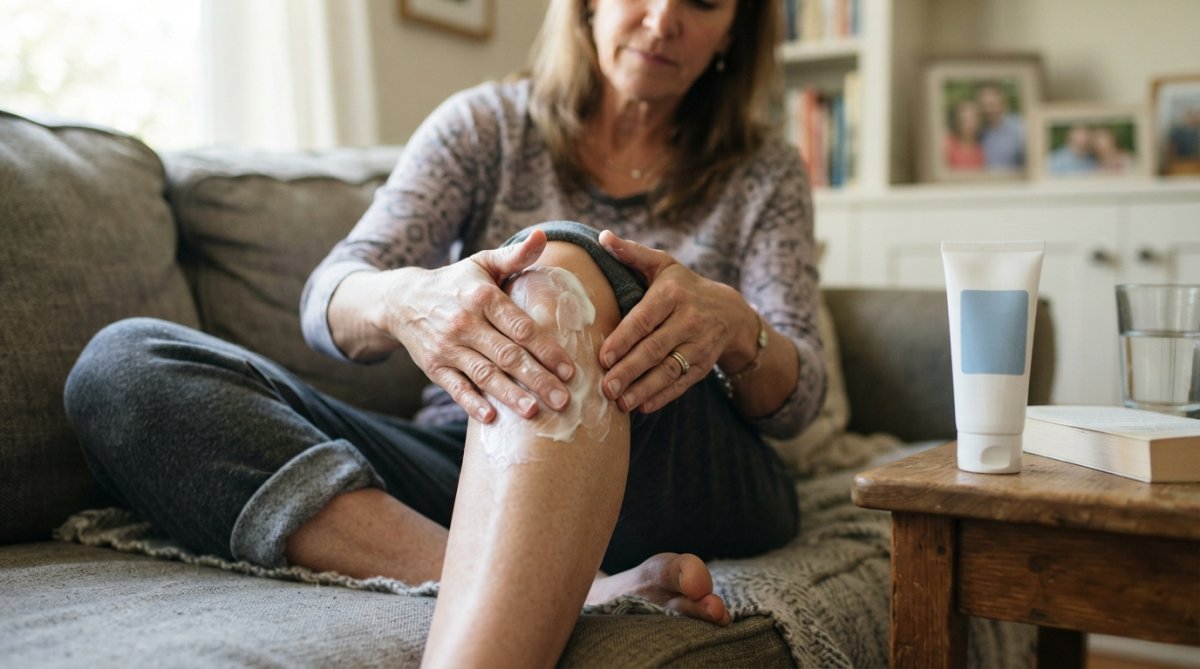
Correct application is the difference between a product that works and one that seems to do nothing. Start with clean, dry skin. Warm a pea-sized amount between your fingertips, then apply in slow, circular motions over the joint and surrounding tissue. Work it in for at least 60 seconds rather than smearing and moving on: you're aiming for absorption, not coverage.
For hands and wrists, massage from the base of the palm outward toward the fingers. For knees, work around the kneecap in widening circles, then up the quadriceps and down the calf.
Massage Technique and Skin Penetration Tips
Massage increases local blood flow and works the cannabinoids deeper into the dermal barrier, improving transdermal absorption and the odds of reaching inflamed tissue.
Technique notes that make a measurable difference:
- Use firm but not painful pressure
- Massage toward the heart on limbs
- Apply after a warm shower or bath when possible; warm skin absorbs more readily
- Don't layer under occlusive bandages unless the label says it's designed for that
Tracking Your Results: A Trial-and-Error Log for CBD Cream
The biggest mistake with topical CBD is failing to track what you're actually doing. Without a log, you can't tell whether a product is failing or your routine is inconsistent. A simple log takes 30 seconds per entry:
| What to Track | Why It Matters | Example Entry |
|---|---|---|
| Date and time | Reveals your real application frequency | 9/14, 7:30am |
| Product and strength | Lets you compare formulas fairly | 2000mg CBD/CBC |
| Amount used | Catches under- or over-application | Pea-sized, both knees |
| Pain level before | Baseline for measuring change | 6/10 |
| Pain level 1 hour after | Shows onset of action | 4/10 |
| Duration of relief | Tells you if reapplication timing is right | ~3 hours |
| Notes | Captures sleep, activity, weather, flare-ups | Long walk, cold morning |
Run this log for two full weeks before changing anything. Patterns emerge fast: whether your morning dose carries you to lunch or fades by 10am, and whether the 500mg formula is genuinely too weak or just applied too seldom.
Conclusion
Managing arthritis pain is a long game, and topicals only help when applied consistently and correctly. Control frequency, technique, potency, and tracking, and you'll know within weeks whether a product deserves a permanent spot in your routine.
Railroad Remedies (RXR) formulates its lotions with this in mind. The 500mg CBD Relief Lotion uses full-spectrum CBD with organic coconut oil and shea butter for daily, broad-area use; the 2000mg CBD/CBC Pain Relief Lotion adds cannabichromene for stubborn inflammation and chronic flare-ups. Both are non-greasy and absorb quickly, so you can apply them morning, midday, and evening without residue.

Get started with Railroad Remedies and build an application routine your joints will actually notice.
Frequently Asked Questions
Does CBD cream work on arthritis pain?
CBD cream may help with arthritis pain by interacting with cannabinoid receptors in the skin to reduce localized inflammation and discomfort. Many users report relief, but results vary based on the product's potency, your skin's absorption rate, and how consistently you apply it. Full-spectrum formulas with additional cannabinoids like CBC may offer enhanced anti-inflammatory properties. For best results, apply it regularly to affected joints.
How long does it take for CBD cream to kick in?
Most people feel the onset of relief within 15 to 30 minutes after applying CBD cream. The exact time depends on factors like skin thickness, blood flow to the area, and the formula's absorption rate. If you're using it for chronic pain, apply it before the pain peaks to stay ahead of discomfort. Keep track of your onset times to find what works best for your body.
Can you apply too much CBD cream?
Applying too much CBD cream is unlikely to cause serious harm, but it can waste product and increase the risk of skin irritation. Start with a pea-sized amount per joint and increase gradually if needed. If you experience redness or itching, reduce the frequency or switch to a gentler formula. Always follow the product's suggested dosage and consult a doctor if you have sensitive skin.
How many times a day can you safely use topical CBD?
You can safely apply topical CBD 2 to 4 times per day, depending on your pain levels and the product's concentration. For ongoing arthritis management, twice daily is often enough. Monitor your skin for any adverse reactions and adjust as needed.
