

CBD Pain Cream Side Effects to Know Before You Apply
Table of Contents
- What Is CBD Pain Cream and How Does It Work?
- Common Side Effects of CBD Pain Cream
- How to Patch Test CBD Cream Before Regular Use
- CBD and Medication Interactions: What to Watch For
- CBD for Inflammation: Benefits and Limits of Topical Use
- Concentration, Storage, and Skin Conditions That Raise Reaction Risk
- When to See a Doctor About CBD Cream Side Effects
- Frequently Asked Questions
Last Updated: September 11, 2026
What Is CBD Pain Cream and How Does It Work?
CBD pain cream is a topical lotion infused with cannabidiol, a hemp-derived compound applied directly to the skin for localized discomfort. Unlike oral CBD, which passes through the digestive system, a topical product works at the application site, targeting muscles and joints without entering the bloodstream in meaningful amounts (peer-reviewed research).

That distinction matters more than most buyers realize. The side effects people worry about with CBD, such as drowsiness or gastrointestinal distress, are largely tied to ingestion. When you rub a CBD pain cream into a sore knee, the cannabidiol interacts primarily with local skin receptors rather than flooding your system.
Still, "topical" does not mean "risk-free." The skin is a living organ, and anything you put on it can provoke a reaction. Understanding the side effects of a cbd pain cream before you apply it is the difference between smart use and an avoidable rash.
Below, we break down what can go wrong, how to test safely, and when a reaction signals something more serious.
Common Side Effects of CBD Pain Cream
The most frequently reported side effects of CBD pain cream are skin-level: redness, itching, and mild irritation at the application site (PubMed). Most people tolerate topicals well, but reactions happen, and they usually trace back to either the CBD concentration or the other ingredients in the formula.
Here are the side effects worth knowing, in rough order of how often they appear:
- Contact dermatitis - redness, burning, or a rash where the cream was applied
- Pruritus (itching) - often the first sign your skin dislikes something in the formula
- Erythema - persistent redness that lingers after application
- Dryness or flaking - more common with high-concentration or alcohol-based products
- Allergic response - hives or swelling, rare but possible with any topical
- Folliculitis - clogged hair follicles, typically from heavy or greasy bases
Notice that every item on that list is local. Systemic effects like fatigue, dry mouth, or drowsiness are associated with oral CBD, not with a properly applied topical. A cbd pain cream side effects profile looks very different from a tincture's.
Skin Irritation and Allergic Reactions
Skin irritation from topical CBD usually shows up within minutes to a few hours of application. The cause is rarely the cannabidiol itself. More often, it's a carrier oil, a preservative, or a fragrance added to make the product feel and smell better.
A true allergic response is different from simple irritation. Irritation stays at the application site and fades when you stop using the product. An allergic response can spread, intensify, or come with hives. If you've ever reacted to essential oils, botanical extracts, or certain nut oils, you're in a higher-risk group for a topical reaction.
Carrier Oil Sensitivities
This is the side effect angle most guides skip, and it's the one that catches people off guard. The base of your cream matters as much as the CBD in it.
Common carrier oils include coconut, jojoba, shea butter, and MCT oil. Coconut derivatives are generally well-tolerated but can clog pores in acne-prone skin. Nut-based oils carry an obvious risk for anyone with a tree nut allergy. Essential oils added for scent are a frequent trigger for contact dermatitis on their own.
How to Patch Test CBD Cream Before Regular Use
A patch test is the single most effective way to catch a reaction before it becomes a problem. The process takes about 48 hours and requires no special equipment, just a small amount of product and a little patience.
Total time: 48 hours (about 5 minutes of actual effort)
Here's how to patch test cbd cream correctly:
- Choose the right spot. Apply to the inner forearm or the side of your neck, areas with thin skin that react quickly.
- Clean and dry the area. Remove lotions or oils so nothing interferes with absorption.
- Apply a pea-sized amount. Use the same concentration you plan to use on your joints.
- Wait 24 hours. Do not wash the area. Watch for redness, itching, or swelling.
- Reapply and wait another 24 hours. A second application catches delayed reactions the first one might miss.
- Check for spreading. If irritation extends beyond where you applied the cream, that's a red flag.
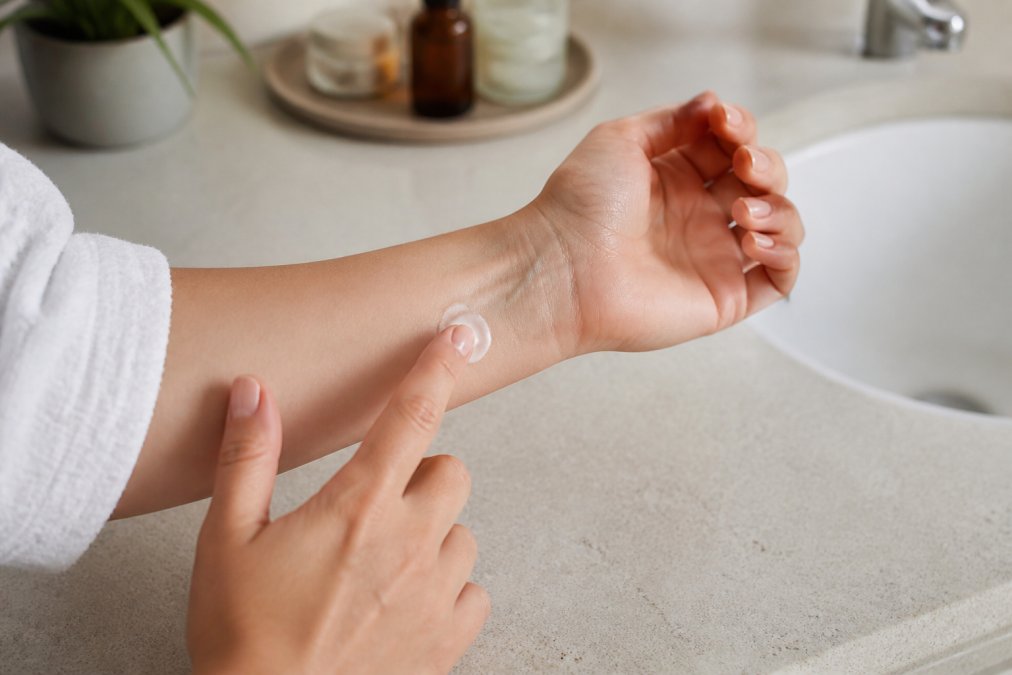
If both applications pass without a reaction, you can move to regular use. If you notice anything beyond mild, fleeting warmth, stop and reassess.
CBD and Medication Interactions: What to Watch For
Topical CBD carries a much lower interaction risk than oral CBD, because very little of it reaches the bloodstream. That said, "lower" is not "zero," and anyone on prescription medication should understand the mechanism.
When CBD does enter circulation, it's metabolized by the same liver enzymes, the cytochrome P450 family, that process many common drugs (peer-reviewed research). Oral CBD can therefore slow the breakdown of certain medications, raising their levels in the body. This is the basis of most documented cbd and medication interactions.
With a topical, systemic absorption is minimal under normal use. The risk climbs if you apply a cbd pain cream to large areas of skin, use it under an occlusive bandage, or apply it to damaged skin, all of which increase how much crosses into the bloodstream.
If you take blood thinners, anti-seizure medication, or drugs with a narrow therapeutic window, talk to your doctor or pharmacist before regular topical use. This is a conversation, not a panic.
CBD for Inflammation: Benefits and Limits of Topical Use
CBD for inflammation is where topicals show their clearest advantage: you can target a specific joint or muscle without sending the compound through your whole body. For osteoarthritis, nerve pain, or post-exercise soreness, that localized approach is often exactly what's needed.
The honest limitation is depth. A topical cream works on the tissue it can reach, which means skin, superficial muscle, and the joint capsule to a degree. It won't penetrate to deep nerve roots or address inflammation far below the surface. If your pain originates deep in the spine or a major joint, a lotion is a support tool, not a cure.
Bioavailability matters here too. Transdermal absorption varies widely by formula, and a cream built on quality carrier oils will deliver more usable CBD to the application site than a thin, watery product. This is why formulation, not just milligram count, drives results.
Concentration, Storage, and Skin Conditions That Raise Reaction Risk
Three variables change how your skin responds to a CBD pain cream: how much CBD is in it, how the product has been stored, and the condition of your skin barrier. Each one is manageable once you know what to look for.
Concentration vs. Reaction Risk
Higher CBD concentration does not automatically mean higher reaction risk, but it changes the math in two ways.
First, more cannabinoid per application means any sensitivity you have will show up faster and stronger. A higher milligram product delivers more CBD per pump, so a borderline reaction to a low-dose product can become an obvious one at a higher dose.
Second, high-milligram products often lean on supporting ingredients to carry the load: more solvent, more penetration enhancer, more essential oil for scent. Those additives, not the CBD, are frequently what stings.
A practical ramp:
- Start low. A 250-500 mg product is a reasonable starting point for a first-time topical user.
- Use one pump or a pea-sized amount on a single area for the first week.
- Step up only after a clean week at the lower concentration. Move to the next tier (roughly double the milligrams) rather than jumping straight to the strongest jar.
- Do not chase milligrams. If 500 mg works on your knee, a 3000 mg jar is not a better product for you; it is a higher-irritation-risk product with the same job.
Storage and Degradation
Cannabinoids and carrier oils both degrade. Heat, light, and oxygen are the three accelerants, and a degraded cream can irritate skin even if the fresh version never did.
What to watch for:
- Texture changes: separation, graininess, or a watery layer on top.
- Smell changes: a rancid, crayon-like, or sour odor. Rancid carrier oil is a classic irritant.
- Color shifts: darkening or a mottled appearance.
- Consistency: a cream that has thinned out or turned tacky.
Storage basics: keep the jar capped, in a cool dark cabinet, away from the bathroom windowsill and away from the shower's steam. A bathroom medicine cabinet is fine; a car glovebox in summer is not. If a product has been open for more than about a year, or has been sitting in heat, treat it as expired and replace it rather than risk a reaction on skin you are trying to soothe.
Existing Skin Conditions That Raise Reaction Risk
Eczema, psoriasis, and rosacea all involve a compromised skin barrier, which means the same formula that is gentle on healthy skin can sting, burn, or trigger a flare on yours. The general rule is to treat any active flare as a no-apply zone and wait for the barrier to recover before testing a new product.
Condition-specific notes:
- Eczema (atopic dermatitis): the barrier is leaky and the skin is already inflamed. Fragrance and essential oils are the most common triggers. Look for fragrance-free, short-ingredient formulas, and patch test on a clear patch of skin, not on a flare.
- Psoriasis: plaques are thick and scaly, and broken skin around them absorbs more. Avoid alcohol-based or menthol-heavy products, which sting on cracked plaques. Patch test on unaffected skin first.
- Rosacea: facial skin is the usual concern, and heat, fragrance, and strong actives are common flare triggers. If you use a CBD cream on the face, choose a fragrance-free formula and apply to a small area at the jawline before going anywhere near the cheeks.
- Sensitive skin without a diagnosis: treat yourself as a patch-test-first user. Start at the lowest concentration you can find and give each new product a full 48-hour test.
If you are managing a chronic skin condition with prescription topicals, ask your dermatologist before layering a CBD cream on top. Some prescription treatments and CBD formulas do not play well together on the same patch of skin, and the interaction is easier to avoid than to unwind.
Reaction risk comes from three places: the concentration, the carrier oils, and the condition of your skin barrier. Address all three before blaming the CBD.
When to See a Doctor About CBD Cream Side Effects
Most topical reactions resolve on their own within a few days of stopping the product. Contact your doctor if a reaction spreads beyond the application site, blisters, or persists longer than a week after you stop using the cream.
Seek prompt care for signs of a serious allergic response: swelling of the face, lips, or throat, difficulty breathing, or hives covering a large area. These are rare with topicals, but they warrant immediate attention.
Also loop in your doctor if you're using a cbd pain cream alongside prescription medication and notice new symptoms, or if you're applying it to skin that's healing from a medical treatment. A clinician who knows your full history can flag interactions a label won't.
Navigating cbd pain cream side effects comes down to knowing your skin, your medications, and your formula. Railroad Remedies (RXR) offers lotions with organic ingredients like coconut oil, shea butter, and kukui nut oil, a non-greasy texture that absorbs cleanly, and a 2000mg CBD/CBC blend that adds cannabichromene for enhanced anti-inflammatory support. If you want relief you can apply with confidence, explore the Railroad Remedies (RXR) lineup and find the formula that fits your routine.

Frequently Asked Questions
Does topical CBD cream get into your bloodstream?
Topical CBD cream absorbs mostly into the skin and underlying tissue, so very little reaches the bloodstream compared with oral CBD. That limited systemic absorption is one reason topical CBD pain cream is generally well-tolerated and rarely causes the drowsiness, dry mouth, or gastrointestinal distress linked to ingested CBD. Transdermal formulas, designed to cross the skin barrier into circulation, behave differently, but standard lotions and creams stay largely local to the application site.
Who should not use CBD cream?
Skip CBD cream if you are pregnant or breastfeeding, under 18, or allergic to any ingredient on the label, including carrier oils like coconut or jojoba. People taking medications processed through cytochrome P450 enzymes, such as blood thinners or certain seizure drugs, should talk to a doctor first because of possible drug-drug interactions. Anyone with active dermatitis, broken skin, or a flare of an existing skin condition should wait until the area heals before applying.
Can CBD cream cause skin irritation or allergic reactions?
Yes, though reactions are uncommon. Contact dermatitis, marked by erythema, pruritus, or a mild rash at the application site, is the most reported issue. The culprit is often a carrier oil, essential oil, or preservative rather than CBD itself. A patch test on your inner forearm, checked at 24 and 48 hours, is the simplest way to catch a hypersensitivity before you apply cream to a larger area.
What happens if you use too much CBD cream?
Applying more cream than directed rarely causes serious harm because topical absorption is limited, but it can increase the chance of skin irritation, redness, or a greasy residue that clogs pores. Stick to the label's recommended amount, typically a thin layer over the sore area two to three times daily. If you notice persistent burning, swelling, or a spreading rash, stop use and contact a healthcare provider.
