

CBD Dosage for Localized Joint Pain: 2026 Guide
Table of Contents
- Why Localized Joint Pain Needs a Different Dosing Approach
- Topical vs Systemic Dosing: Where CBD Actually Goes
- How to Calculate Your Starting CBD Dose for Joint Pain
- CBD Topical Application Frequency: Building a Daily Routine
- How Long Does CBD Topical Relief Last?
- CBD vs CBD/CBC for Inflammation: What Changes With CBC
- Tracking Your Dose, Managing Interactions, and Knowing When to Adjust
- Frequently Asked Questions
Last Updated: September 24, 2026
Why Localized Joint Pain Needs a Different Dosing Approach
A throbbing knee or stiff wrist doesn't respond to the same CBD dosage logic as full-body anxiety or sleep support. CBD dosage for localized joint pain is a different calculation entirely, and treating it like a general wellness dose is the most common mistake people make. At Railroad Remedies (RXR), we offer targeted topical solutions for localized discomfort.
The reason is simple: a joint is a small, specific destination. You don't need CBD circulating through your entire bloodstream to calm the tissue around one inflamed knee. You need it delivered to that knee, at a concentration high enough to matter, applied consistently enough to build up.
That changes everything about how you dose. Where a general CBD routine might start at a single daily serving and build over weeks, a localized approach focuses on milligrams per application, surface area, and frequency of reapplication. Get those three variables right and most people find their therapeutic window in days, not months.
Below, we'll break down exactly how to calculate your starting dose, how topical and systemic delivery differ, and how to track what's working so you're not guessing.
Topical vs Systemic Dosing: Where CBD Actually Goes
Topical CBD stays largely in the tissue where you apply it; systemic CBD travels through your bloodstream to affect the whole body. That distinction drives every dosing decision that follows.
When you rub a CBD lotion into a sore knee, the cannabinoids interact primarily with local cannabinoid receptors in the skin and surrounding tissue. Very little crosses into systemic circulation.
| Delivery Method | Where It Acts | Onset | Best For |
|---|---|---|---|
| Topical | Local tissue at application site | 15-45 minutes | One specific joint, surface inflammation |
| Sublingual | Systemic, via bloodstream | 15-30 minutes | Whole-body concerns |
| Oral (edible) | Systemic, slower absorption | 60-90 minutes | Long-lasting systemic support |
How to Calculate Your Starting CBD Dose for Joint Pain
Start low, apply to a small test area, and increase concentration before you increase frequency. That's the framework. But "start low" is only useful if you know what number you're starting from, and for a localized joint, that number is not the same one you'd use for an oral tincture.
The Two Dosing Languages: Systemic vs. Localized
Systemic CBD (oral, sublingual) is dosed in total milligrams per day, because the cannabinoid has to reach a serum concentration that scales with body weight and metabolism. Localized CBD (topical) is dosed in milligrams per application per unit of skin, because the cannabinoid acts in the tissue directly under the application site. Conflating the two is the single most common calculation error.
A Practical Starting Framework for a Localized Joint
For most adults, a reasonable starting point is:
- One application of a lower-concentration lotion to the affected joint
- Once daily, for three to four days
- A pea-to-dime-sized amount, enough to cover the joint and a margin of surrounding tissue, not enough to leave a visible film
If that produces no change after three to four days, step up to a higher-milligram formula rather than applying the weaker one more often. Increasing concentration is the cleaner variable to test; increasing frequency muddies the signal.
Why Body Weight Matters Less for Topicals
Body weight is a reliable guide for oral and sublingual dosing because the cannabinoid distributes through total blood volume. For a topical, the more useful measures are:
- Concentration of the formula (mg of cannabinoid per fluid ounce or per gram)
- Surface area treated (a knee needs more product than a knuckle)
- Skin condition (thin, warm, well-hydrated skin absorbs differently than thick, dry, or calloused skin)
Reading Product Labels: mg per oz vs. Total mg
To compare two products fairly, divide total milligrams by container size in ounces. A 2000mg lotion in a 3.3 oz bottle delivers roughly 600mg per ounce; a 500mg lotion in a 1 oz bottle delivers 500mg per ounce. The headline numbers look far apart; the per-ounce concentrations are close. That per-ounce figure, not the bottle total, is what determines how much cannabinoid lands on your knee per application.
A Worked Example
Suppose you're treating one knee. You apply a pea-sized amount of a 500mg-per-ounce lotion, roughly 0.05 oz, or about 25mg of cannabinoid, to an area the size of your palm. That's your starting dose: 25mg per application, once daily. If three to four days pass with no change, move to a 600mg-per-ounce formula and repeat the same application size.
CBD Topical Application Frequency: Building a Daily Routine
Most people get better results from consistent, moderate application than from one large dose. A steady routine beats sporadic heavy use.
CBD + CBC Relief Lotion 2000mg →
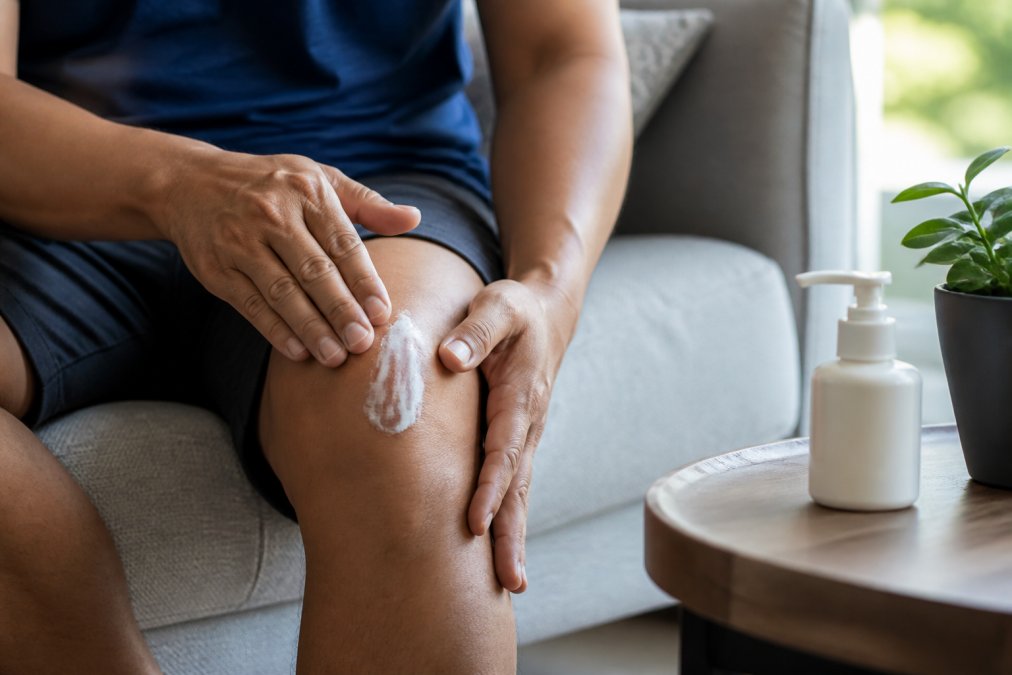
A practical daily structure looks like this:
- Morning: one application to the affected joint before activity
- Midday (optional): reapply if the area is under load, such as during work or exercise
- Evening: one application after activity to support overnight comfort
How Long Does CBD Topical Relief Last?
CBD topical relief typically lasts two to four hours for most people, though this varies with formula concentration, skin type, and how active the joint is. A more concentrated lotion often extends the window; a thin, fast-absorbing one may need more frequent reapplication.
Why Topical Duration Is Shorter Than Oral Duration
When you apply CBD to a joint, the cannabinoids interact primarily with local receptors in the skin and surrounding tissue. Very little crosses into systemic circulation. That's the feature that makes topicals joint-specific, and it's also why the effect fades faster than an edible.
| Delivery Method | Typical Onset | Typical Duration | Where It Acts |
|---|---|---|---|
| Topical | 15-45 minutes | 2-4 hours | Local tissue at application site |
| Sublingual | 15-30 minutes | 2-4 hours | Systemic, via bloodstream |
| Oral (edible) | 60-90 minutes | 4-8 hours | Systemic, slower absorption |
What Actually Extends the Window
Three variables move the duration needle more than anything else:
- Concentration per application. A higher-mg-per-ounce formula delivers more cannabinoid to the tissue, which generally means a longer local effect. This is the variable to adjust first.
- Occlusion and skin condition. Warm, hydrated, intact skin absorbs more efficiently than dry or calloused skin. Applying after a shower, when the joint is warm, tends to improve uptake.
- Joint activity. A knee under load, walking, stairs, exercise, will burn through relief faster than a resting joint. This is why a mid-day reapplication is often the difference between a comfortable afternoon and a stiff one.
How to Tell If Your Formula Is Too Weak
If you find yourself reapplying every hour, the formula is probably too weak for your needs. If relief comfortably lasts through a workday, you've found a workable concentration. The goal is fewer, better applications, not constant reapplication.
CBD vs CBD/CBC for Inflammation: What Changes With CBC
Adding CBC to a CBD formula changes the anti-inflammatory profile, not just the strength. Cannabichromene (CBC) is a hemp-derived cannabinoid valued for its soothing properties and balanced, calming experience, and it's often paired with CBD because the two appear to work together.
Tracking Your Dose, Managing Interactions, and Knowing When to Adjust
You can't optimize what you don't measure. A simple log turns guesswork into a repeatable routine.
Drug Interaction Checklist
- Are you taking blood thinners such as warfarin?
- Are you on any anti-seizure medication?
- Do you take prescription pain or anti-inflammatory drugs daily?
- Are you managing a liver condition or taking liver-metabolized medication?
- Are you pregnant, nursing, or under a doctor's care for a chronic condition?
If you checked any box, talk to your healthcare provider before starting. The NIH information on cannabidiol and drug interactions outlines why CBD can affect how the liver processes certain medications.
Simple Tracking Log Template
| Date | Product & Strength | Amount Applied | Time | Relief (1-5) | Duration | Notes |
|---|---|---|---|---|---|---|
| 9/24 | CBD/CBC 2000mg | Pea-sized, knee | 8:00 AM | 4 | 3 hrs | Felt after morning walk |
| 9/24 | CBD 500mg | Pea-sized, knee | 9:00 PM | 3 | 2 hrs | Mild stiffness |
Run this for two weeks before changing anything. Patterns emerge fast: which strength works, what time of day matters, and whether CBC makes a measurable difference for you.
Frequently Asked Questions
How do I determine the right amount of CBD for joint pain?
Start with a low dose and increase slowly. For topicals, apply a pea-sized amount to the painful joint and wait 30-60 minutes. If relief is mild, add another application. Keep a log of dose, time, and pain level to find your personal therapeutic window.
Is there a standard dosage for CBD topicals?
No universal standard exists because topical absorption depends on formula concentration, skin thickness, and the size of the area treated. A 500mg lotion and a 2000mg lotion deliver different amounts per application. Instead of a fixed number, focus on consistent application: use the same amount each time and track how long relief lasts to adjust your CBD topical application frequency.
How long does it take for CBD lotion to work on joints?
Most people notice effects within 15-30 minutes after applying CBD lotion to a joint. The relief from a single application typically lasts 2-4 hours, depending on the formula and your metabolism. For chronic joint pain, applying 2-3 times daily maintains steady cannabinoid levels in the local tissue. If you feel nothing after 45 minutes, you may need a higher concentration or more frequent application.
What is the difference between CBD and CBD/CBC blends for pain?
CBD and CBC are both hemp-derived cannabinoids, but CBC works alongside CBD to extend the overall effect. A CBD/CBC blend like Railroad Remedies' 2000mg lotion pairs broad-spectrum CBD with full-spectrum CBC isolate. CBC works alongside CBD to extend the overall effect, creating a steady, comforting sensation for those seeking a relaxing addition to their routine.
