

CBD Lotion for Knee Arthritis Reviews: What Works
Table of Contents
- How CBD Lotion for Knee Arthritis Actually Works
- CBD vs CBC for Pain Relief: What the Research Shows
- How to Apply CBD Lotion for Knee Pain: A Step-by-Step Guide
- How Long Does CBD Lotion Take to Work?
- Choosing a Quality CBD Lotion: Reviews and Red Flags
- Ingredient Synergy: Why Carrier Oils and Terpenes Matter
- Frequently Asked Questions
Last Updated: September 13, 2026
How CBD Lotion for Knee Arthritis Actually Works
CBD lotion for knee arthritis works by delivering hemp-derived cannabinoids through the skin to interact with local cannabinoid receptors, which may help calm joint inflammation and ease stiffness. At Railroad Remedies (RXR), we explain this process often because the mechanism matters when you're deciding whether a topical is worth your money. Understanding the basics separates a product that might help from one that simply smells pleasant.
The Endocannabinoid System and Joint Inflammation
The endocannabinoid system is a network of receptors throughout the body that helps regulate inflammation, pain signaling, and immune response. Cannabinoid receptors sit in skin tissue and joint-adjacent areas, which is why a well-formulated topical can act locally rather than systemically. Many researchers believe this local interaction is what gives topicals their therapeutic potential for musculoskeletal relief.
Transdermal Absorption and Dermal Penetration
Transdermal absorption is the process by which a compound crosses the skin barrier and reaches deeper tissue. Dermal penetration depends heavily on the carrier formula: lotions built on oils like coconut, shea, and jojoba tend to carry cannabinoids further than watery creams. This is why ingredient quality matters as much as milligram count when you compare products.
CBD vs CBC for Pain Relief: What the Research Shows
CBD gets the headlines, but cannabichromene (CBC) is the cannabinoid worth understanding if you're comparing topicals for knee arthritis. The two compounds are chemically distinct, act on overlapping but different targets, and behave differently when you combine them. Here's what the research actually supports, and where it runs out.
How CBD and CBC Differ at the Receptor Level
CBD's best-documented interaction is as a negative allosteric modulator of CB1 and CB2 receptors, plus inhibition of fatty acid amide hydrolase (FAAH), the enzyme that breaks down anandamide. Slowing FAAH raises anandamide levels, which is one proposed route to CBD's anti-inflammatory effect. CBD also activates TRPV1, a receptor involved in pain signaling and heat sensation.
CBC works through a different set of doors. It shows high affinity for TRPV1 and TRPA1, activates CB2 (which is heavily expressed on immune cells), and inhibits anandamide reuptake. That CB2 activity is the key detail for arthritis: CB2 activation is associated with reduced cytokine release in inflamed tissue, which is the mechanism most relevant to a swollen, stiff knee.
| Cannabinoid | Primary Receptor Targets | Proposed Role in Joint Pain |
|---|---|---|
| CBD | CB1/CB2 (negative allosteric modulator), TRPV1, FAAH inhibition | Broad anti-inflammatory, calming, daily baseline |
| CBC | TRPV1, TRPA1, CB2 agonist, anandamide reuptake inhibitor | Analgesic, anti-inflammatory, immune-cell modulation |
| CBD + CBC | Overlapping TRPV1 activity, complementary CB2 and FAAH effects | Layered relief for stubborn or chronic inflammation |
What the Evidence Actually Shows (and What It Doesn't)
Be skeptical of any article that claims strong human trial data for CBC. It doesn't exist yet at scale. The NIH overview of cannabinoid research summarizes preclinical work showing cannabinoids interact with receptors involved in pain perception, but most CBC-specific findings come from animal models and in-vitro studies. A frequently cited 2010 study in the British Journal of Pharmacology (Izzo et al.) found CBC reduced inflammation in rodent models, but rodent results don't translate cleanly to human knees.
What this means practically: CBC is a reasonable bet based on mechanism, not a proven one based on human trials. If you're buying a CBC blend, you're buying a plausible hypothesis with supportive early data, not a guarantee.
Why a Blend Often Beats CBD Alone
The 'entourage effect' is the popular term, but the more precise explanation is receptor coverage. CBD and CBC hit overlapping TRPV1 pathways while CBC adds CB2 activation that CBD doesn't strongly drive on its own. In a topical applied to a knee, that means the formula may address both the sensory side of pain (TRPV1) and the immune/inflammatory side (CB2) rather than just one.
Reading a Label: What 'CBC' Should Actually Mean
A CBC claim on a label is only meaningful if the Certificate of Analysis lists CBC as a separate, quantified cannabinoid, not lumped into a 'total cannabinoids' figure. Look for a COA that reports CBD and CBC in milligrams per container. If a brand markets CBC but the lab report shows only CBD, you're paying a premium for a marketing word.
How to Apply CBD Lotion for Knee Pain: A Step-by-Step Guide
Most articles tell you to 'rub it in.' That's not a technique, and for a joint as mechanically complex as the knee, it matters. The knee has a shallow fat layer, a large synovial capsule, and a patella that sits over the most sensitive structures. How you apply a topical determines how much of it reaches the tissue that actually hurts. Here's the method, with the reasoning behind each step.
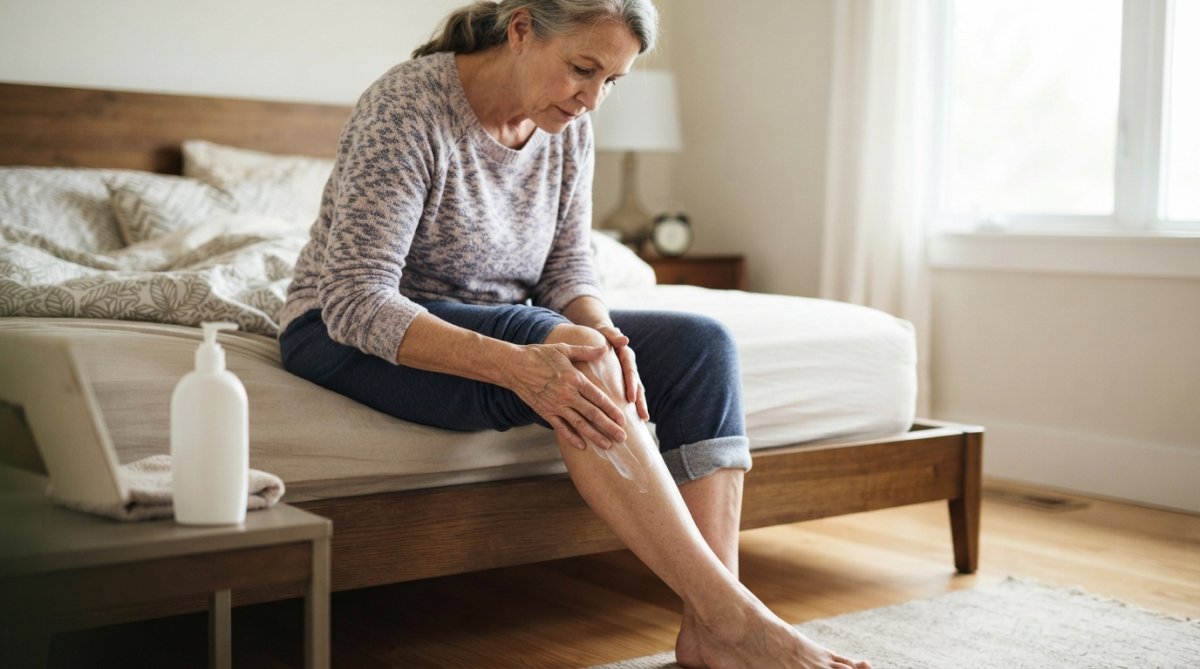
The 6-Step Knee Application Protocol
- Cleanse and warm the area. Shower first, or wipe the knee with a warm damp cloth. Warm, hydrated skin has a more permeable stratum corneum, and removing dead cells and surface oils lets the carrier absorb instead of sitting on top.
- Start with a pea-sized amount, roughly 0.25 to 0.5 mL. That's about the size of a small almond, not a fingertip. You can always add more; over-applying wastes product and leaves residue that never absorbs.
- Massage in slow circles for 60 to 90 seconds. Friction generates mild heat and mechanically pushes the carrier into the skin. Rushing this step is the single most common mistake, 15 seconds of rubbing does almost nothing.
- Cover the whole joint, not just the sore spot. Work around the perimeter of the kneecap (the patellar border), then down both sides of the joint line. Arthritis pain often originates in the synovial lining and joint capsule, which sit around the patella, not directly under it.
- Reapply every 4 to 6 hours as needed. Topical effects fade as the product is absorbed and metabolized locally. A morning and evening routine, with an optional mid-day reapplication on flare days, is a common pattern.
- Wash hands after. Residual cannabinoids and terpenes can irritate eyes and mucous membranes. This is non-negotiable if you wear contact lenses.
Why the Knee Is Different From Other Joints
The knee has very little subcutaneous fat over the patella and tibial plateau, which means a topical doesn't have to travel far to reach innervated tissue, a genuine advantage over, say, the hip or shoulder. But the joint capsule is deep, and no lotion penetrates to the synovial fluid itself. The realistic target is the surrounding soft tissue, nerve endings, and superficial receptors. Setting that expectation correctly is why 'it didn't cure my arthritis' is the wrong test, 'did it reduce my day-to-day ache' is the right one.
Patch Testing for Skin Sensitivity
Patch testing is a quick safety step: apply a small amount to your inner forearm and wait 24 hours. If you've had radiation therapy, have a history of eczema or psoriasis, or are over 65 with thinning skin, this step is not optional. Watch for redness, itching, or irritation before using it on a larger area. Elderly skin has a thinner stratum corneum and reduced barrier lipids, which means both faster absorption and higher irritation risk, a double-edged sword worth respecting.
Techniques for Specific Joints: Knees, Hands, and Feet
Different joints need different approaches. For knees, massage in wide circles around the patella, then sweep down the medial and lateral joint lines. For hands, work lotion between each knuckle and along the palm, where the skin is thicker and needs more product. For feet, focus on the arch and heel, and consider applying after a warm soak. Neuropathic pain in hands and feet may respond differently than joint pain, so track what actually helps, a simple note on your phone works better than memory.
How Long Does CBD Lotion Take to Work?
CBD lotion typically takes 15 to 45 minutes to produce noticeable effects, depending on your skin, the formula, and how much you apply. Peak relief often arrives within an hour. Unlike oral CBD, topicals don't need to pass through digestion, so onset is faster but tends to be shorter-lived. Reapply as effects fade.
Choosing a Quality CBD Lotion: Reviews and Red Flags
Product purity separates legitimate CBD lotions from overpriced moisturizers. When you read reviews, look past star ratings and check whether the brand publishes testing data. Red flags include vague milligram claims, no sourcing information, and ingredient lists full of synthetic fillers.
Certificate of Analysis and Third-Party Testing
A certificate of analysis (COA) is a lab report confirming a product's cannabinoid content and screening for contaminants. Reputable brands test for heavy metal testing, pesticide screening, and microbial safety. If a company won't show you a COA, walk away.
Full-Spectrum vs. Broad-Spectrum vs. Isolate
Full-spectrum CBD contains all naturally occurring cannabinoids and terpenes, including trace THC. Broad-spectrum removes THC but keeps other cannabinoids. Isolate is pure CBD alone. For joint inflammation, many users prefer full-spectrum or broad-spectrum because of the entourage effect, where compounds work together. Hemp-derived isolates are purer but may offer less synergy.
Ingredient Synergy: Why Carrier Oils and Terpenes Matter
Carrier oils and terpenes are not filler; they shape how well a lotion works and how it feels. Oils like coconut, shea, and kukui nut improve dermal penetration while hydrating skin. Terpenes such as beta-caryophyllene may support anti-inflammatory activity. A formula built on quality carrier oils delivers cannabinoids more effectively than a cheap base.
Railroad Remedies (RXR) formulates its lotions around organic coconut oil, shea butter, and kukui nut oil, and the 2000mg CBD/CBC blend adds cannabichromene for enhanced anti-inflammatory support. The non-greasy, easily absorbed texture addresses the greasiness complaint that turns many people off topicals entirely.
Knee arthritis rarely offers a single perfect fix, and topicals work best as part of a broader routine. If you're ready to try a formula built for real absorption, Railroad Remedies (RXR) offers the CBD/CBC 2000mg Pain Relief Lotion for advanced relief and the CBD Relief Lotion 500mg for everyday comfort. Both are made with organic ingredients and a non-greasy finish designed to absorb quickly. Get started with Railroad Remedies (RXR) and find a topical routine that fits your day.


Frequently Asked Questions
What is the best CBD cream for arthritic knees?
The best CBD cream for arthritic knees contains full-spectrum or broad-spectrum hemp extract, third-party testing results, and ingredients like shea butter or coconut oil that support skin absorption. Look for a product with a certificate of analysis confirming cannabinoid content and no heavy metals or pesticides. A 2000mg CBD/CBC formula offers higher concentration for chronic joint inflammation, while a 500mg option suits daily maintenance.
How long does CBD lotion take to work for knee arthritis?
Most people notice initial relief within 15 to 30 minutes of applying CBD lotion for knee arthritis, with effects lasting 2 to 4 hours. Factors include formula concentration, transdermal absorption quality, and individual metabolism. A 2000mg CBD/CBC blend may provide longer-lasting relief than lower-dose options. For chronic pain management, consistent daily use over 2 to 4 weeks often yields more noticeable cumulative benefits.
What is the difference between CBD and CBC for pain relief?
CBD and CBC are both hemp-derived cannabinoids that interact with the endocannabinoid system. CBC shows particular promise for anti-inflammatory and analgesic properties in early research. A CBD/CBC blend may offer broader therapeutic potential than CBD alone because the two cannabinoids work through different pathways. Full-spectrum formulas also include terpenes and minor cannabinoids that create an entourage effect, enhancing overall relief.
Are there side effects to using CBD topicals for joint pain?
CBD topicals rarely cause systemic side effects because they act locally on cannabinoid receptors in the skin. Some users experience mild skin irritation, redness, or dryness, especially with sensitive skin. Patch testing on a small area before full application helps identify adverse reactions. Unlike oral CBD, topicals do not typically interact with medications or cause drowsiness, making them a safer option for those avoiding drug interactions.
