

Best CBD Lotion Brands for Hand Arthritis in 2026
Table of Contents
- What Makes a CBD Lotion Work for Hand Arthritis
- How to Use CBD Cream for Arthritis in Hands and Fingers
- The Benefits of CBC in Pain Relief Lotion
- How Long Does CBD Lotion Take to Work?
- Cost Per Milligram: What You Actually Pay for Potency
- Safety, Side Effects, and Medication Interactions
- Conclusion
- Frequently Asked Questions
Last Updated: September 20, 2026
What Makes a CBD Lotion Work for Hand Arthritis
Finding the best CBD lotion brands for hand arthritis starts with understanding what separates a formula that reaches sore joints from one that just sits on the skin. Cannabidiol, or CBD, is a hemp-derived compound that interacts with the body's endocannabinoid system, a network of receptors involved in regulating pain and inflammation. Applied topically, CBD works locally rather than systemically, which means the formula's ability to carry it through the skin barrier matters as much as the milligram count on the label.
Full-Spectrum, Broad-Spectrum, and Isolate: Which Matters for Joints
Full-spectrum extract keeps all the plant's naturally occurring compounds, including trace THC, terpenes, and minor cannabinoids. Broad-spectrum removes THC while preserving most other compounds. Isolate is purified CBD alone.
Ingredients That Support Dermal Penetration and Localized Relief
Bioavailability in topicals comes down to formulation. A lotion built on organic coconut oil, shea butter, and kukui nut oil delivers deep hydration while helping cannabinoids absorb through the skin barrier. Look for supporting ingredients like allantoin and aloe, which calm irritated skin, and hyaluronic acid, which pulls moisture into the tissue.
How to Use CBD Cream for Arthritis in Hands and Fingers
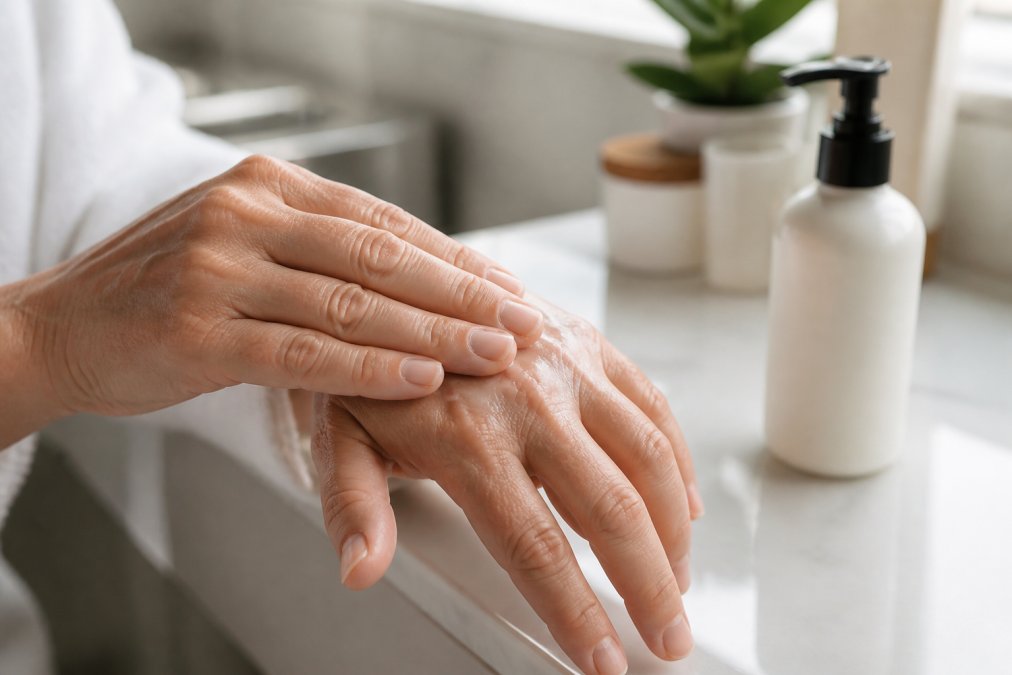
Applying CBD cream for arthritis in hands and fingers takes about a minute, but technique affects how well it works. Start with clean, dry hands. Dispense a pea-sized amount per joint area and massage it in using slow, circular motions for 30 to 60 seconds. The massage itself supports circulation and helps the formula absorb.
Dexterity-Focused Application for Stiff, Swollen, or Painful Hands
Most guides assume you can pinch a pump and rub your knuckles without trouble. If your fingers are stiff, swollen, or locked into a partial fist, that assumption breaks down. Here is how to work around it.
- Use a pump or wide-flip cap, not a screw-top jar. Twisting a small lid is one of the hardest motions for an arthritic thumb. A pump bottle or a flip-top with a textured tab requires only a press.
- Apply with the back of the hand or a flat palm. If you cannot form a grip, squeeze the lotion onto the back of one hand and rub the two backs together, then work the product into the fingers with your palms.
- Try a silicone lotion applicator or a long-handled back-lotion wand. These tools are sold for reaching the back, but the same handle lets you apply cream to knuckles without bending your fingers.
- Use a soft makeup brush or a foam sponge on a stick. A wide, soft brush lets you paint lotion onto each joint without pressing or gripping.
- Warm the product first. Run the closed bottle under warm tap water for 30 seconds. Warmer lotion spreads with less rubbing pressure, which matters when friction on a swollen joint is painful.
- Work proximal to distal. Start at the wrist and move toward the fingertips, one joint at a time, rather than rubbing the whole hand at once. This follows the direction of lymphatic drainage and avoids dragging skin over an inflamed knuckle.
- Pair with a gentle range-of-motion pass. After the lotion is in, slowly open and close the hand five times. The motion distributes product into the creases and gives you a light stretch without added load.
How Often to Reapply
Reapply every four to six hours as needed. For most people, that means once in the morning, once mid-afternoon, and once before bed. Wash your hands after handling pets or before touching your eyes, since trace cannabinoids and essential oils can irritate mucous membranes.
The Benefits of CBC in Pain Relief Lotion
Cannabichromene, or CBC, is a lesser-known cannabinoid gaining attention for its anti-inflammatory properties. CBC binds weakly to CB1 and CB2 receptors but interacts with other receptors tied to pain perception, which is why formulators pair it with CBD rather than replacing it.
How Long Does CBD Lotion Take to Work?
Most people notice effects within 15 to 30 minutes of application, with relief building over the first hour. How long CBD lotion takes to work depends on three factors: your skin's thickness at the application site, the formula's absorption quality, and how consistent you are with reapplication.
| Factor | Faster Onset | Slower Onset |
|---|---|---|
| Skin thickness | Thin skin over joints | Thick, calloused areas |
| Formula base | Coconut oil, MCT oil | Heavy wax or balm |
| Application method | Massaged in for 60 seconds | Rubbed in briefly |
| Reapplication | Every 4-6 hours | Once daily |
Cost Per Milligram: What You Actually Pay for Potency
Price per bottle tells you almost nothing. Cost per milligram of CBD does. Divide the total milligrams by the price, then compare that number across products.
CBD + CBC Relief Lotion 2000mg →
Safety, Side Effects, and Medication Interactions
Topical CBD is generally well tolerated, and because it is non-psychoactive, it will not produce a high. The most common adverse reactions are skin-level: redness, dryness, or mild irritation, usually from fragrance or added cooling agents like menthol and camphor rather than CBD itself. Patch-test on the inside of your wrist for 24 hours before using a new formula on your hands.
What the Research Says About Topical CBD
Human trials on topical CBD for joint pain are still limited. The most-cited work comes from small studies on topical CBD for knee osteoarthritis, which reported reduced pain scores over a few weeks with no serious adverse events. That is encouraging but not the same as a large, long-term trial on hand arthritis specifically. Treat topical CBD as a comfort tool that may help, not a replacement for a treatment plan your rheumatologist has prescribed.
CBD and Common Arthritis Medications
This is the question most guides skip. If you take prescription arthritis medication, here is how topical CBD fits in.
- NSAIDs (ibuprofen, naproxen, celecoxib). No well-documented interaction with topical CBD. Oral CBD can compete for some of the same liver enzymes (CYP2C9, CYP2C19), but topical absorption into the bloodstream is low, so the practical risk is small. Tell your doctor you are using it anyway.
- DMARDs (methotrexate, leflunomide, hydroxychloroquine, sulfasalazine). Methotrexate and leflunomide are hard on the liver, and oral CBD is processed by the same liver enzymes. Topical use is far less likely to matter, but if you are on either drug, ask your rheumatologist before adding any cannabinoid product, topical or oral.
- Biologics (adalimumab, etanercept, tocilizumab). No known direct interaction with CBD. The bigger consideration is infection risk: if you are immunosuppressed, do not apply lotion to any cut, scrape, or injection site.
- Blood thinners (warfarin, apixaban, rivaroxaban). CBD can inhibit CYP2C9, the enzyme that clears warfarin. Topical absorption is low, but warfarin has a narrow therapeutic window, so check with your prescriber and consider an INR check if you use CBD lotion daily.
- Thyroid medication (levothyroxine). Take levothyroxine on an empty stomach as directed, and keep CBD lotion use separate from your dosing routine. No documented topical interaction, but the timing rule is easy to follow.
- Seizure medication (clobazam, valproate). Oral CBD is known to raise levels of some anti-seizure drugs (pubmed.ncbi.nlm.nih.gov). Topical risk is much lower, but tell your neurologist if you use it regularly.
- Opioid pain relievers. CBD may modestly affect how the liver processes some opioids. If you take them for arthritis pain, mention CBD lotion at your next appointment.
Third-Party Testing and What to Look For
A certificate of analysis (COA) from an independent lab confirms potency, product purity, and heavy metal screening, so you know the label matches the bottle. Ask any brand for it before you buy. A useful COA shows the batch number, the cannabinoid breakdown (CBD, CBC, trace THC), and a pass on heavy metals, pesticides, and microbials. If a brand will not send one, that is your answer.
Conclusion
If you take one thing from this guide, make it this: potency and formulation decide whether a CBD lotion helps your hands, not the label's marketing. Check the milligram count, look for absorption-friendly ingredients, and do the cost-per-milligram math before you commit.
Frequently Asked Questions
Does CBD lotion actually help with hand arthritis?
CBD lotion for hand arthritis may help with localized discomfort because cannabinoids interact with receptors in the skin that influence inflammation and pain signaling. Topicals do not enter the bloodstream heavily, so effects stay concentrated where you apply them. Many users report reduced joint stiffness and swelling after consistent use. Clinical evidence is still developing, but existing studies on topical cannabinoids show measurable anti-inflammatory activity. Check for third-party testing and a certificate of analysis before buying.
What should I look for in a CBD cream for joint pain?
Prioritize third-party testing, a certificate of analysis, and clear potency labeling. Look for full-spectrum or broad-spectrum extract rather than isolate, since terpenes and minor cannabinoids like CBC can extend the therapeutic effect. Ingredients such as shea butter, coconut oil, and hyaluronic acid support skin hydration and dermal penetration. Avoid products that list hemp seed oil as the only active ingredient, because it contains little to no cannabidiol. A 500mg to 2000mg range gives you options for mild to intense hand pain.
How often can you apply CBD lotion for arthritis pain?
Most users apply CBD lotion two to three times daily, or as needed when joint stiffness flares. Start with one application and wait 30 to 60 minutes to gauge how your skin and joints respond. If you feel no change after several days, increase to twice daily. There is no established maximum frequency for topicals, but more is not always better. Track your results for a week to find the application frequency that works for your hands without wasting product.
What is the difference between CBD and CBC in pain relief lotions?
CBD and CBC are both hemp-derived cannabinoids, but they work through different receptor pathways. CBC shows strong anti-inflammatory properties in early research and may extend the duration of CBD's effects when combined. Products that pair CBD with CBC, like a 2000mg blend, aim to offer a balanced, calming experience. CBC works alongside CBD to extend the overall effect.
