

Where to Buy CBD Lotion for Arthritis Online in 2026
Table of Contents
- Why Buying CBD Lotion for Arthritis Online Beats In-Store Shopping
- The Best CBD Cream for Arthritis Pain: What Separates Effective Formulas from Hype
- How to Read Third-Party Lab Testing for CBD Before You Buy
- CBD Topical Dosage for Arthritis: How Much to Apply and How Often
- Application Techniques for Specific Joints: Hands, Knees, and Hips
- Cost-Per-Milligram Comparison: What You Actually Pay for Potency
- Safety, Drug Interactions, and Skin Sensitivity with Topical CBD
- Conclusion
- Frequently Asked Questions
Last Updated: September 16, 2026
Why Buying CBD Lotion for Arthritis Online Beats In-Store Shopping
If you're wondering where to buy CBD lotion for arthritis online, buy directly from the manufacturer's website, where you can review the certificate of analysis before checkout and confirm the product is in stock. This guide from Railroad Remedies (RXR) covers what separates a real formula from marketing, how to read lab reports, and what to expect to pay per milligram of cannabidiol.
The Best CBD Cream for Arthritis Pain: What Separates Effective Formulas from Hype
The best CBD cream for arthritis pain combines a broad cannabinoid profile with carrier oils and often a counterirritant that produces the cooling or warming sensation people associate with pain relief. Potency alone doesn't determine whether a topical works, what matters is how the formula delivers cannabidiol beneath the surface rather than sitting on top of the skin.
Cannabinoid profile: CBD, CBC, and full-spectrum extracts
Cannabidiol (CBD) is hemp's primary non-psychoactive cannabinoid, valued for its soothing, anti-inflammatory properties when applied topically. Cannabichromene (CBC) may interact with the endocannabinoid system in ways that complement CBD and extend the soothing effect. Cannabigerol (CBG) appears in smaller amounts in full-spectrum extracts and is studied for its own anti-inflammatory activity.
Carrier oils and penetration enhancers that matter
Carrier oils do more than moisturize. Organic coconut oil, shea butter, and kukui nut oil create an easily spreadable base; jojoba and sweet almond oil are lighter alternatives. Ingredients like dimethyl sulfoxide (DMSO) and hyaluronic acid help compounds move through the skin barrier, so formulas built on them absorb quickly instead of leaving a greasy film.
Active botanicals: menthol, camphor, arnica, capsaicin, and methyl salicylate
- Menthol activates TRPM8 cold receptors, producing a cooling sensation that distracts from pain signaling (pubmed.ncbi.nlm.nih.gov). It's the most common counterirritant in OTC pain creams.
- Camphor activates TRPV1 and TRPV3 warmth receptors, often paired with menthol for a cooling-then-warming effect. Avoid broken skin and tight bandages.
- Arnica montana is a botanical long used for bruising and muscle soreness, common in sports-recovery topicals.
- Capsaicin depletes substance P at nerve endings with repeated use. It works, but the first applications are uncomfortable, and hands must be washed thoroughly afterward.
- Methyl salicylate is a topical analgesic related to aspirin. It penetrates well and warms, but avoid it with salicylate sensitivity or blood thinners.
- MSM (methylsulfonylmethane) and glucosamine appear in joint creams as supporting ingredients, though evidence for topical absorption is limited.
Pairing CBD with one or two of these actives tends to produce a more noticeable effect than CBD alone: the counterirritant gives immediate sensory feedback while cannabinoids work.
What to skip
Synthetic fragrance, drying alcohols high on the ingredient list, and parabens are the most common causes of irritation in topical CBD products. If your skin is sensitive from medication or age, start with a fragrance-free formula and a short ingredient list.
How to Read Third-Party Lab Testing for CBD Before You Buy
Third-party lab testing sends each production batch to an independent lab that measures cannabinoid content, confirms the absence of THC where claimed, and screens for heavy metals, pesticides, and residual solvents. Reputable sellers publish these results as a downloadable certificate of analysis (COA) linked from the product page.
What a certificate of analysis should show
A complete COA includes a batch or lot number matching your jar, the cannabinoid breakdown by milligram, a THC result, and a contaminant panel. A generic lab report with no batch number is marketing material, not verification.
Checklist before you check out:
- Batch or lot number on the COA matches the product label
- Total CBD and CBC content listed in milligrams
- THC result stated as "not detected" or below the legal threshold
- Heavy metals, pesticides, and solvent screening included
- Lab name and testing date visible on the document
CBD Topical Dosage for Arthritis: How Much to Apply and How Often
CBD topical dosage for arthritis is not standardized. Start with a pea-sized amount worked into the affected joint two to three times daily, increasing gradually if nothing changes after a week. Because topicals act locally, you can adjust frequency without the concerns of swallowing a capsule.
A few guidelines:
- Start with a smaller amount and add more if needed
- Apply to clean, dry skin for better absorption
- Reapply during flare-ups rather than applying one large dose
- Give a new formula one to two weeks of consistent use before judging it
Application Techniques for Specific Joints: Hands, Knees, and Hips
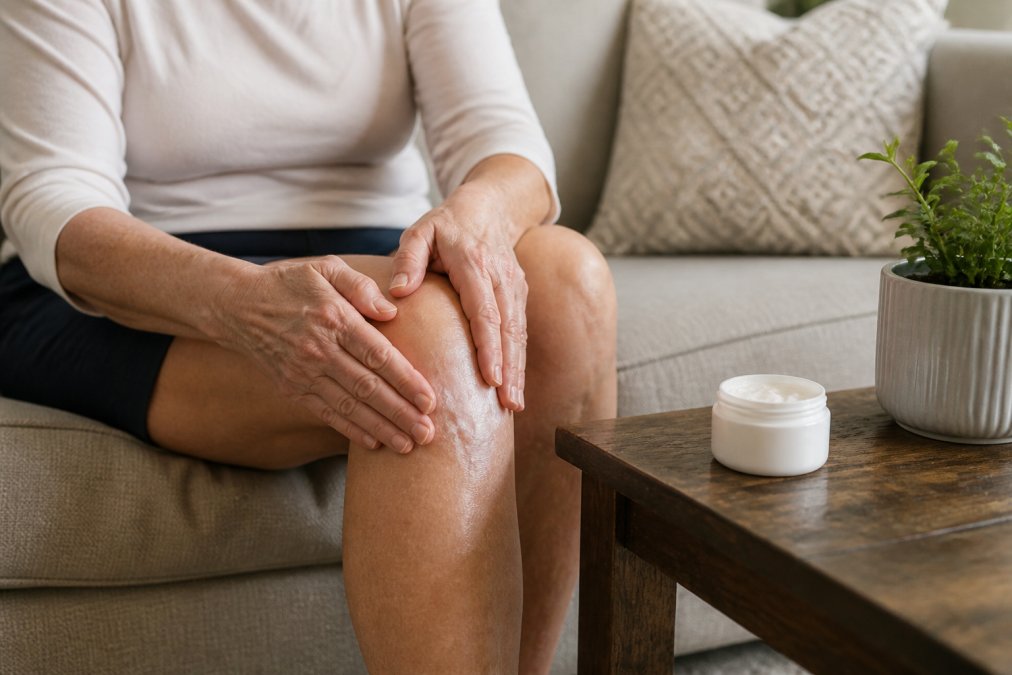
How you apply a topical changes how well it works. Massaging it into the joint and surrounding tissue, rather than dabbing the surface, helps distribute it and supports circulation.
Cost-Per-Milligram Comparison: What You Actually Pay for Potency
Cost per milligram is the price divided by the total milligrams of CBD. A larger jar with more milligrams is often the better value even when the sticker price is higher. Here's the math across two potency tiers.
| Product | Price | Total CBD | Cost per mg | Best For |
|---|---|---|---|---|
| CBD Relief Lotion 500mg | $39.99 | 500mg | About $0.08 | Daily maintenance, mild soreness |
| CBD/CBC 2000mg Pain Relief Lotion | $69.99 | 2000mg | About $0.03 | Chronic joint inflammation, targeted relief |
Safety, Drug Interactions, and Skin Sensitivity with Topical CBD
Topical CBD is generally well tolerated but not risk-free. The most common reactions are localized redness, itching, or irritation, usually from a carrier oil, preservative, or counterirritant rather than the cannabidiol itself. Patch-test on your inner forearm for 24 hours before applying to a large area.
How much CBD actually reaches your bloodstream
Most people assume a topical stays on the skin. In practice, a small fraction of cannabinoids crosses the barrier into circulation, depending heavily on where you apply it and what else is in the formula.
- Thin skin absorbs more. The wrists, inner elbows, neck, and behind the knees have thinner stratum corneum than the palms or soles. Applying to these areas increases systemic exposure.
- Penetration enhancers increase absorption. A formula built with DMSO or phospholipid carriers moves more CBD across the barrier than a simple oil-and-butter base.
- Occlusion increases absorption. Covering the area with a bandage, wrap, or tight clothing traps moisture and heat and can meaningfully raise how much gets through.
- Damaged skin absorbs more. Cuts, eczema flares, and radiation-treated skin all compromise the barrier.
Drug interaction warnings for topical use
Absorbed cannabinoids are metabolized by the same cytochrome P450 enzymes, particularly CYP3A4 and CYP2C19, that process many prescription drugs. When CBD and a medication compete for those enzymes, blood levels of the medication can rise. The interaction is dose-dependent and generally milder with topicals than oral CBD, but not zero.
- Blood thinners, including warfarin and direct oral anticoagulants such as apixaban and rivaroxaban. A change in metabolism can shift INR or bleeding risk.
- Anti-seizure medications, especially clobazam and valproate, which are known to interact with CBD.
- Immunosuppressants such as tacrolimus and cyclosporine, which have a narrow therapeutic window.
- Certain antidepressants and antipsychotics metabolized by CYP3A4.
- Thyroid medications such as levothyroxine, where small shifts in absorption matter.
Skin sensitivity and counterirritant reactions
If your formula contains menthol, camphor, capsaicin, or methyl salicylate, some reaction is expected. Cooling, warming, or tingling that fades within 15 to 30 minutes is normal. Stop using it and contact a clinician if you experience:
- Blistering, weeping, or a rash that spreads beyond the application site
- Swelling of the face, lips, or throat
- Intense burning that does not fade after washing the area
- New numbness or tingling in the hands or feet
Conclusion
Finding arthritis pain relief shouldn't require guesswork about what's in the jar. Railroad Remedies (RXR) formulates its lotions with organic coconut oil, shea butter, and kukui nut oil in a non-greasy, fast-absorbing base, and the 2000mg CBD/CBC blend pairs cannabidiol with cannabichromene for enhanced soothing support. Every product page links to batch-specific lab results, so you can verify potency before you buy.
Frequently Asked Questions
Is CBD cream safe to use for pain?
Topical CBD is generally well tolerated. Side effects are usually limited to skin irritation at the application site. Unlike oral CBD, topicals enter the bloodstream minimally, so systemic effects are rare. However, if you take blood-thinning medication or have a bleeding disorder, talk to your doctor before using CBD lotion for arthritis, because cannabinoids can interact with certain drugs. Always patch-test on a small area first, especially if you have sensitive skin or a history of reactions to topical products.
What should I look for when buying CBD lotion online?
Focus on four things: a current certificate of analysis from an independent lab, clear potency labeling (milligrams per container), a short ingredient list without synthetic additives, and transparent sourcing. Avoid products that do not publish lab results or use vague terms like 'proprietary blend' without milligram amounts. Reputable sellers make third-party lab testing for CBD easy to find.
What is the difference between CBD and CBD/CBC blends for pain?
CBD and CBC are both hemp-derived cannabinoids, but they work differently. CBD is well studied for its anti-inflammatory properties and is the base of most arthritis creams. CBC shows promise for enhancing the effects of other cannabinoids, potentially extending relief duration. A blend like a 2000mg CBD/CBC lotion pairs the two for a more sustained effect. If you have not responded to standard CBD creams, a CBD/CBC formula is worth trying. Start with a lower-potency product and increase if needed.
How do I verify the quality of CBD products purchased online?
Check the seller's website for a batch-specific certificate of analysis (COA) from an ISO-certified third-party lab. The COA should list cannabinoid content, confirm THC-free or low-THC status, and show passing results for heavy metals, pesticides, and microbials. Match the batch number on the COA to the product you receive. If the COA is missing, outdated, or does not match, do not buy. Reliable vendors also provide contact information for customer support and clear return policies.
If daily joint discomfort has you cycling through products that never quite deliver, Railroad Remedies (RXR) was built for exactly this. The 2000mg CBD/CBC Pain Relief Lotion combines organic botanicals with a broad cannabinoid profile, and the 500mg CBD Relief Lotion offers a gentler entry point for daily maintenance. Get started with Railroad Remedies (RXR) and give your joints a formula you can actually verify.
