

Topical CBD for Localized Muscle Pain: How to Apply
Table of Contents
- How Topical CBD Works for Localized Muscle Pain
- Choosing a CBD Cream for Muscle Pain
- How to Apply CBD Cream for Muscle Pain
- How Long CBD Cream Takes to Work
- Topical CBD Safety and Side Effects
- When Muscle Soreness Needs a Doctor
- Conclusion
- Frequently Asked Questions
Last Updated: October 4, 2026
How Topical CBD Works for Localized Muscle Pain
Topical CBD for localized muscle pain is a cannabinoid-infused cream, balm, or lotion applied directly to the skin over a sore muscle or aching joint.
Here's the honest version: the science is still catching up to the demand.
What we can say with confidence is that application technique, product concentration, and realistic expectations separate people who get results from people who don't.
What Topical CBD Can and Cannot Do
Topical CBD can soothe localized discomfort in muscles and joints, support exercise recovery, and hydrate the skin over an irritated area.
The distinction comes down to how far a topical product travels. A cream sits in the skin and the tissue just beneath it.
That also explains the ceiling. If your pain originates in a compressed nerve or an inflamed joint capsule deep under muscle, a surface application has limited reach.
Choosing a CBD Cream for Muscle Pain
The best CBD cream for muscle pain is one with a clearly stated CBD concentration, a short ingredient list you recognize, and third-party testing you can actually view. Everything else is marketing.
Most disappointing experiences trace back to one of three problems: too little CBD per application, a formula that never absorbs, or a product with no verifiable potency. Let's take those one at a time.
Reading the Label: Concentration, Ingredients, and Third-Party Testing
CBD concentration tells you how much cannabidiol is in the container, not how much reaches your skin per squeeze.
Look for these on any label:
- Total CBD in milligrams and the container size
- Whether it's full-spectrum, broad-spectrum, or CBD isolate
- Supporting ingredients like menthol, camphor, or arnica for cooling and warming sensations
- A certificate of analysis (COA) from an independent lab
Third-party testing is the single best signal of trustworthiness. A COA confirms the CBD content matches the label and screens for contaminants.
Formulation matters just as much as potency. A greasy balm that sits on top of your skin wastes product and ruins your clothes.
| Product Type | Typical Use | Absorption | Best For |
|---|---|---|---|
| CBD lotion | Daily, large areas | Fast, non-greasy | Ongoing joint stiffness |
| CBD balm | Targeted spots | Slower, occlusive | Sore muscles post-workout |
| CBD ointment | Stubborn areas | Heavy, long-lasting | Chronic localized discomfort |
| Transdermal patch | Steady delivery | Through the skin barrier | All-day coverage |
How to Apply CBD Cream for Muscle Pain
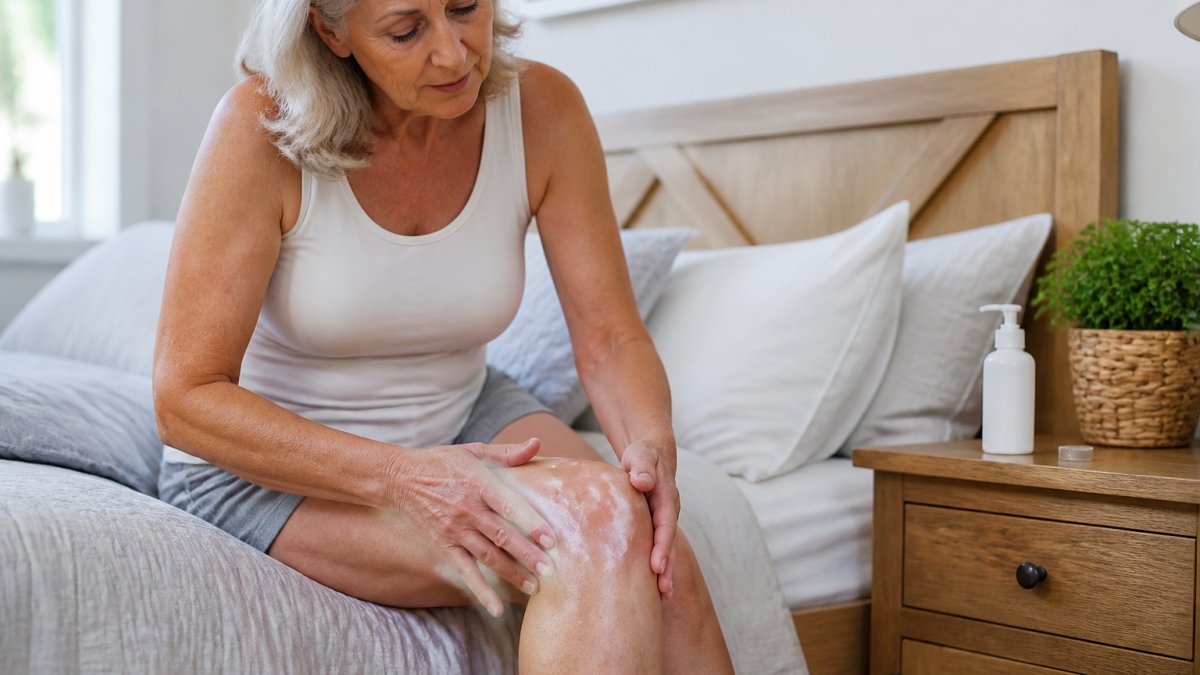
Applying CBD cream correctly takes about two minutes, but the details, how much, how often, and how to tell whether it's working, are where most people go wrong. This section walks through a repeatable protocol you can adjust to your own body and routine.
Step-by-Step Application
- Cleanse and dry the area. Remove sweat, sunscreen, or old product so the new layer can absorb. A quick wipe with a damp cloth is enough, you don't need soap every time.
- Warm a small amount between your fingers. A pea-sized amount covers roughly a palm-sized area. For a larger region like the lower back or both calves, use two to three pea-sized portions rather than one heavy blob.
- Massage it in for 30 to 60 seconds. Circular pressure helps the formula penetrate and adds a mild mechanical benefit for sore muscle. Work from the center of the sore area outward.
- Start with one application. Wait a full day before increasing frequency, especially if your skin is sensitive. This gives you a clean baseline to judge from.
- Reapply up to three times daily if your skin tolerates it, spacing applications several hours apart. More frequent application does not necessarily mean more relief, it mostly means more product used.
- Wash your hands afterward unless you're treating your hands, in which case avoid touching your eyes, mouth, or any mucous membrane for at least 15 minutes.
- Store the container away from heat and direct sunlight to protect the cannabinoids. A bathroom cabinet is fine; a windowsill or a hot car is not.
How Much to Use and How to Track Response
There is no universal dose for topical CBD. Concentration, carrier ingredients, and the size of the area you're treating all change how much product makes sense. A practical starting point is one pea-sized amount per palm-sized area, then adjust based on what you feel over the first week.
A simple tracking method that most people find useful:
- Day 1: Apply once. Note the time and rate any change in sensation at 30 and 60 minutes on a 0-10 scale.
- Days 2-7: Keep the dose and frequency steady. Changing two variables at once makes it impossible to know what helped.
- Week 2: Adjust one variable, concentration, amount, or frequency, and give it another week before judging.
Many people quit a topical after two rushed applications. A consistent routine for at least a week is a more honest test.
Layering With Other Topicals
If you also use menthol gels, arnica creams, or NSAID topicals like diclofenac, apply them at different times rather than stacking them. Layering multiple products on the same patch of skin increases the chance of irritation and makes it hard to tell which product is doing what. A common pattern is CBD cream in the morning and evening, with a cooling gel in between if you need a quick sensory reset.
Distinguishing Sensation From Relief
Cooling ingredients like menthol or camphor register almost immediately, which is a sensation rather than a CBD effect. That tingle can feel like it's working even when the cannabinoid hasn't had time to act. When you track response, try to separate the two: note the cooling sensation separately from any change in soreness, tightness, or how easily the muscle moves.
For our own lineup, the FDA guidance on cannabis-derived products is worth reading before you buy anything, since it clarifies what companies can and cannot legally claim.
CBD + CBC Relief Lotion 2000mg →
How Long CBD Cream Takes to Work
Most people notice something within 15 to 45 minutes of application, with effects typically lasting two to four hours. Individual results vary widely based on concentration, formulation, and how much you applied.
Cooling ingredients like menthol can register almost immediately, which is a sensation rather than a CBD effect. The cannabinoid itself works on a slower timeline.
Here's the practical framework we suggest:
- First application: note the time and any change at 30 and 60 minutes
- First week: keep the dose steady to establish a baseline
- Second week: adjust concentration or frequency, one variable at a time
Many people quit a topical after two rushed applications. Give a consistent routine at least a week before you judge it.
Topical CBD Safety and Side Effects
Topical CBD is generally well tolerated, and the most common complaints are skin-level: redness, dryness, or mild irritation at the application site. Because absorption into the bloodstream is limited with creams and lotions, systemic side effects are uncommon. That said, a few precautions are worth taking seriously, and the details matter more than the headlines.
Patch Testing: How to Do It Properly
A patch test is only useful if you run it correctly. Apply a small amount, about the size of a pencil eraser, to your inner forearm, cover it loosely with a bandage if you like, and leave it undisturbed for 24 hours. Check the site at 24 and 48 hours. A little pinkness that fades within an hour is usually not a concern. Raised bumps, itching that persists, or spreading redness means stop using that product.
Medications and Interactions
CBD can interact with certain medications by affecting how the liver processes them, particularly drugs metabolized by cytochrome P450 enzymes (Contemplating cannabis? The complex relationship between cannabinoids and hepatic...). Common examples include blood thinners like warfarin, some anti-seizure medications, and certain antidepressants. Topical absorption is limited, so the interaction risk is lower than with oral CBD, but it is not zero, especially if you apply a large amount over a broad area or use a transdermal product.
Skin Conditions and Sensitive Areas
People with eczema, psoriasis, rosacea, or a history of contact dermatitis should be cautious. Fragrances, preservatives like methylisothiazolinone, and botanical extracts trigger reactions more often than CBD itself.
Keep product away from eyes, mucous membranes, and any area with an active rash or broken skin unless a clinician approves it. If you are recovering from radiation therapy, ask your oncology team before applying anything to treated skin, the skin barrier is often compromised and reacts differently.
When to Stop and Call a Clinician
Stop use and seek medical advice if you notice:
- A rash that spreads beyond the application site
- Swelling of the face, lips, or throat
- Difficulty breathing
- Severe burning or blistering
- Any new symptom that concerns you
These are uncommon, but they are the signals that a topical is not the right fit for your skin.
People with sensitive skin should look for short ingredient lists built on gentle carriers. Our CBD Relief Lotion 500mg uses organic coconut oil, shea butter, and kukui nut oil, which is the kind of base that tends to suit reactive skin better than heavily fragranced formulas.
When Muscle Soreness Needs a Doctor
See a clinician if pain follows a specific injury, lasts more than a week or two, comes with swelling, numbness, weakness, or tingling, or wakes you at night. Those signs point to something a topical can't address.
Delayed-onset muscle soreness after exercise is normal and typically peaks 24 to 72 hours after activity. It fades on its own. Nerve pain, joint instability, and radiating pain down a limb are different stories, and no cream should delay that evaluation.
Conclusion
Sore muscles respond well to consistent, well-applied topicals, but the results depend on choosing a formula you'll actually use and applying it correctly. At Railroad Remedies (RXR), our lotions are built for exactly that: organic coconut oil, shea butter, and kukui nut oil in a non-greasy base that absorbs quickly, with our CBD + CBC Relief Lotion 2000mg adding cannabichromene for a fuller soothing effect. Browse the full lineup and find the strength that fits your routine.
Frequently Asked Questions
Is CBD cream better than Voltaren for muscle pain?
They work differently. Voltaren (diclofenac gel) is an FDA-approved topical NSAID with clinical trials behind it for arthritis pain. Topical CBD has far less human trial evidence, and most of what exists focuses on localized discomfort rather than head-to-head comparisons. Some people use CBD cream when NSAIDs upset their stomach or irritate their skin. If you take blood thinners or have kidney issues, talk to your doctor before switching from a topical NSAID to CBD.
How long does CBD cream take to work for muscle pain?
Most users report a cooling or warming sensation within 15 to 30 minutes, which comes from ingredients like menthol or camphor rather than CBD itself. A deeper calming effect, if it happens, tends to build over 1 to 2 hours. Reapply every 4 to 6 hours as needed, and stop if your skin becomes irritated. Effects vary widely, so track what you feel over the first week rather than judging a single application.
Can topical CBD cause side effects or interact with medications?
Topical CBD is generally well tolerated, and because little enters the bloodstream, drug interactions are less likely than with oral CBD. Skin reactions are the most common complaint: redness, itching, or contact dermatitis from carrier oils or preservatives. Patch-test on your inner forearm for 24 hours first. If you take blood thinners, especially warfarin, or have a liver condition, check with your doctor before regular use, since even small systemic absorption can matter.
What should you look for in a topical CBD product?
Check the label for the total CBD in milligrams and the container size, so you can calculate concentration per ounce. Look for third-party testing with a certificate of analysis, which confirms cannabinoid content and screens for pesticides and heavy metals. Note whether it is full-spectrum, broad-spectrum, or isolate, and scan for skin-friendly ingredients like shea butter or aloe. Avoid products that list hemp seed oil as the CBD source, since that oil contains almost no cannabinoids.
