

THC-Free High Strength CBD for Pain: What Works
Table of Contents
- Why THC-Free High Strength CBD for Pain Is Different
- CBD vs CBD/CBC for Pain: How the Blend Changes Relief
- How to Read a CBD Certificate of Analysis Before You Buy
- High-Strength CBD for Chronic Pain: Dosage and Titration
- Bioavailability of High-Strength CBD Lotions and What Slows Absorption
- Drug Interactions, Adverse Reactions, and Who Should Ask a Doctor First
- Choosing a THC-Free High Strength CBD Lotion: What to Look For
- Frequently Asked Questions
Last Updated: October 2, 2026
Why THC-Free High Strength CBD for Pain Is Different
Most people searching this topic have already tried something that did not work. A drugstore cream that felt like menthol and nothing else. A low-dose tincture that did nothing for a flare.
Three things separate products that help from products that sit in a drawer:
- Potency that matches the complaint. Surface muscle soreness and deep joint inflammation need different milligram ranges.
- A verified THC-free status. "THC-free" is a claim until a lab report proves it.
- A delivery method that reaches the tissue. Lotions and tinctures absorb at very different rates.
Below, we break down each of these so you can choose with confidence rather than hope.
CBD vs CBD/CBC for Pain: How the Blend Changes Relief
CBD/CBC blends target pain through two cannabinoid pathways instead of one. CBD (cannabidiol) is the well-known non-psychoactive cannabinoid. CBC (cannabichromene) is a lesser-known phytocannabinoid studied for its own anti-inflammatory and analgesic properties. Together they may produce a broader effect than either alone.
The Entourage Effect and Why CBC Extends CBD
The entourage effect is the theory that cannabinoids, terpenes, and other plant compounds work better together than in isolation. CBC does not simply add to CBD; it may extend how long the effect lasts and how steadily it builds. That is why a 2000mg CBD/CBC formula can feel different from a 2000mg CBD-only product at the same dose.
Broad-Spectrum, Isolate, and What THC-Free Really Means
Broad-spectrum CBD contains multiple cannabinoids and terpenes but has THC removed or reduced below detectable limits. Isolate is purified CBD alone, with no other plant compounds. THC-free means the finished product tests at or below the detection threshold on a lab report, not just that the label says so.
How to Read a CBD Certificate of Analysis Before You Buy
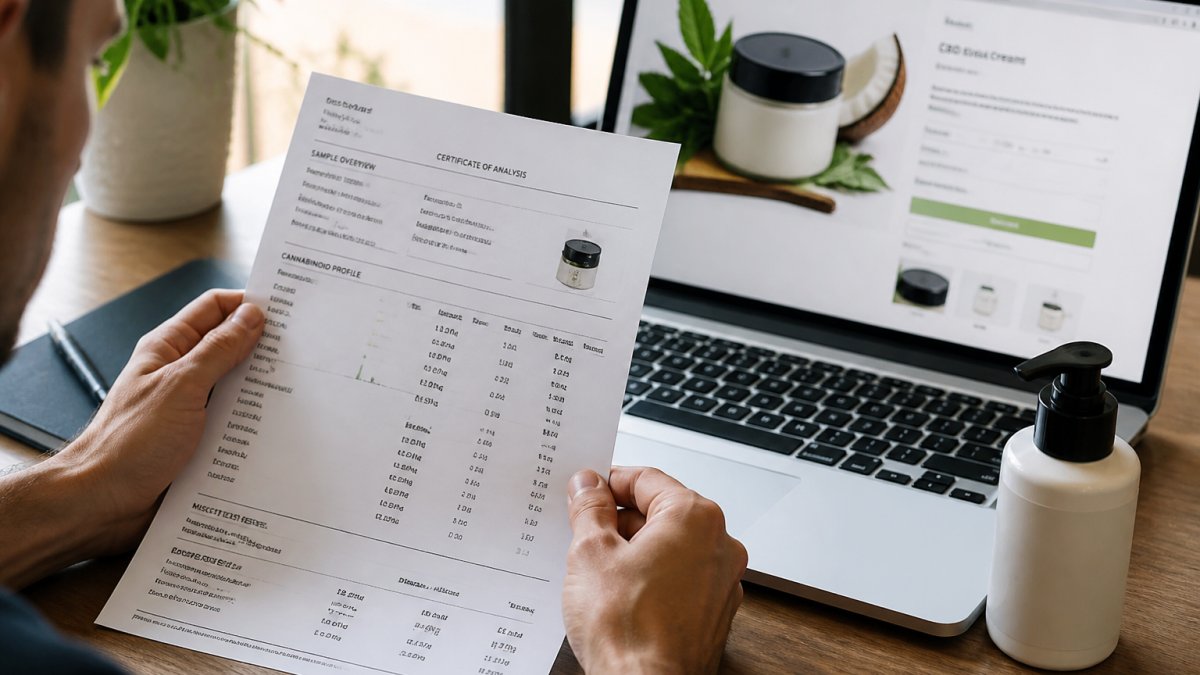
A certificate of analysis (COA) is a third-party lab report that documents the cannabinoid content, purity, and contaminant screening of a specific batch.
Step 1: Match the Batch Number
Every COA is tied to one production run. Find the lot or batch code on the bottom of your bottle or on the box, then find the same code on the report. If the numbers do not match, the report tells you nothing about the product in your hand, even if the brand swears it is the same formula.
Step 2: Read the Cannabinoid Panel Line by Line
This is the table most people skim past. Here is what each column actually means:
- Analyte, the specific compound being measured (CBD, CBC, CBG, THC, THCA, CBN, and so on).
- Result, the amount the lab detected in that sample.
- LOQ (Limit of Quantification), the smallest amount the lab's equipment can reliably measure. Anything below this is reported as "ND" (not detected) or "<LOQ."
- Method, the test used. HPLC (high-performance liquid chromatography) is the standard for cannabinoid potency.
When you see THC: ND or THC: <LOQ, that is what "THC-free" actually means in practice. It does not mean zero molecules exist, it means the lab could not detect any at its reporting threshold, which is typically in the parts-per-million range. That is the standard the industry uses, and it is the number you want to see.
Step 3: Do the Milligram Math Yourself
Labels love round numbers. Lab reports tell you the real ones. If a 3.3 oz lotion is labeled "2000mg CBD," the COA should show roughly 2000mg of CBD across the tested sample, plus or minus a small variance. If the report shows 1,100mg, the label is overstated, walk away.
Step 4: Confirm the Contaminant Panels Are Present
A potency panel alone is not enough. A complete COA includes:
- Pesticides, screens for dozens of compounds banned in agricultural use.
- Heavy metals, lead, arsenic, cadmium, mercury.
- Residual solvents, leftover extraction chemicals like butane or ethanol.
- Microbials, mold, yeast, and bacteria, especially important for topicals applied to broken or sensitive skin.
- Mycotoxins, mold byproducts that can survive processing.
If any of these panels is missing, the report is incomplete. "Passed potency" is not the same as "safe."
Step 5: Verify the Lab, Not Just the Logo
The lab named on the report should be independent of the brand, not a sister company or a white-label in-house operation. Look up the lab's name and confirm it is a real analytical testing facility. Many states require hemp and cannabis labs to hold specific licenses, and some publish their accreditation.
Red Flags That Should End the Conversation
- A COA with no batch number or test date
- A lab that cannot be identified or verified
- Potency listed as "per container" with no per-serving breakdown
- No contaminant panel for pesticides, heavy metals, or solvents
- A report dated older than the product on the shelf
- A "THC-free" claim with no THC line on the report at all
The FDA guidance on cannabis-derived products is a useful starting point for understanding what regulators do and do not verify. Independent testing standards matter because no single agency currently certifies every CBD product on the market, which is exactly why reading the COA yourself is the most reliable check you have.
High-Strength CBD for Chronic Pain: Dosage and Titration
Titration is the practice of starting at a low dose and increasing gradually until you find the smallest amount that provides relief.
A practical titration schedule for a topical looks like this:
- Days 1-3: Apply a pea-sized amount to the affected area once daily.
- Days 4-7: Increase to twice daily if relief is partial.
- Week 2: Add a second application site or increase amount slightly.
- Week 3+: Hold at the lowest effective amount. Track results in a simple log.
Milligram strength on the label describes the whole container, not each pump or squeeze. A 2000mg lotion spread across a 3.3oz bottle delivers a much smaller dose per application.
Topicals vs Tinctures for Neuropathic Pain and Joint Inflammation
Topicals and tinctures serve different jobs. A tincture is placed under the tongue (sublingual) and absorbed into the bloodstream, which makes it useful for widespread or systemic discomfort.
For neuropathic pain in the hands and feet, or joint inflammation in a specific knee or wrist, a topical puts cannabinoids where the problem is.
Bioavailability of High-Strength CBD Lotions and What Slows Absorption
Bioavailability describes how much of a compound actually reaches the tissue it is meant to affect.
Formulas built on organic coconut oil, shea butter, and kukui nut oil tend to absorb more completely than heavy petrolatum-based creams.
CBD + CBC Relief Lotion 2000mg →
What slows absorption:
- Thick occlusive bases that seal the skin rather than penetrate it
- Applying to cold, dry skin without warming the area first
- Layering over sunscreen or heavy moisturizer
- Very calloused skin on heels and palms
For high-strength formulas, this is the detail most guides skip.
Drug Interactions, Adverse Reactions, and Who Should Ask a Doctor First
Most CBD guides mention drug interactions in a single sentence and move on. That is a problem, because high-strength products are exactly where interactions become clinically relevant, the more cannabinoids you absorb, the more likely they are to interfere with how your body processes other medications.
Why CBD Interacts With So Many Prescriptions
The mechanism is the liver. A family of enzymes called cytochrome P450, especially the subtype CYP3A4 and CYP2C19, breaks down a large share of prescription drugs.
The practical result: a dose of a blood thinner or anti-seizure drug that was stable for years can behave differently once you add a high-strength CBD product.
Medications That Deserve Extra Caution
These categories are the ones most often flagged by clinicians and pharmacists:
- Blood thinners, warfarin, apixaban, rivaroxaban, clopidogrel. CBD may amplify the anticoagulant effect.
- Anti-seizure drugs, clobazam, valproate, and others. CBD is FDA-approved as an add-on for certain seizure disorders, and the interaction with clobazam is well documented.
- Immunosuppressants, tacrolimus, cyclosporine. Narrow therapeutic window; small shifts matter.
- Certain antidepressants and anti-anxiety drugs, those processed by CYP3A4 or CYP2C19.
- Opioid pain medications, both can cause sedation and respiratory depression; combining them raises that risk.
- Thyroid medication, levothyroxine absorption can be affected by timing and other factors.
- Some cardiac drugs, including certain antiarrhythmics with narrow safety margins.
This list is not exhaustive. If you take any prescription medication daily, assume there is a potential interaction until a pharmacist tells you otherwise.
What to Ask Your Doctor or Pharmacist
Bring the actual product, not a vague description. Say the milligram strength, the cannabinoid blend (CBD, CBC, or both), and how often you plan to use it. Then ask:
- Does this interact with anything I currently take?
- Should I adjust the timing, for example, spacing CBD several hours away from a specific medication?
- What symptoms would tell me the interaction is happening (unusual bruising, dizziness, drowsiness, changes in heart rate)?
- How often should we check levels if I am on a narrow-window drug?
A pharmacist is often the fastest resource here. They have interaction databases and can flag concerns in minutes without a full appointment.
Topical vs. Oral: The Interaction Difference
Here is a nuance most guides skip. A topical lotion delivers far less CBD into the bloodstream than an oral tincture or edible, because most of it stays in the skin and underlying tissue.
If you are on a narrow-therapeutic-window medication and want to try a high-strength topical, start with a small area, keep the rest of your routine unchanged, and tell your prescriber what you are doing.
Common Adverse Reactions
Topical reactions are usually mild and skin-related: redness, itching, dryness, or irritation at the application site. Oral products can cause drowsiness, changes in appetite, loose stools, or fatigue, usually at higher doses. Patch-test any new topical on a small area of inner forearm for 24 hours before first full use, especially if your skin is sensitive from radiation therapy or other treatment.
Who Should Not Start Without Medical Clearance
- Anyone taking prescription blood thinners or antiarrhythmics
- Anyone using seizure medication
- People who are pregnant, nursing, or planning pregnancy
- Anyone with liver or kidney conditions
- Anyone managing a condition that requires close medication monitoring
The NIH National Center for Complementary and Integrative Health maintains plain-language summaries on cannabinoid research that are worth reviewing before you start.
Choosing a THC-Free High Strength CBD Lotion: What to Look For
The best THC-free high strength CBD lotion for pain combines verified potency, a clean carrier oil base, and a formula that absorbs without residue. Here is the practical checklist:
| What to Check | Why It Matters | Red Flag |
|---|---|---|
| Batch-matched COA | Confirms potency and THC-free status | No batch number |
| Cannabinoid blend | CBC may extend CBD's effect | CBD-only at premium price |
| Carrier oils | Affects absorption and skin feel | Petrolatum-heavy base |
| Contaminant panel | Screens pesticides and heavy metals | No panel listed |
| Label clarity | Milligrams per unit, not per container | Vague dosing |
At Railroad Remedies (RXR), we built our CBD + CBC Relief Lotion 2000mg around this exact checklist.
One honest limitation: topicals work locally. If your pain is widespread, a lotion alone may not be enough, and you may want to pair it with a tincture or discuss other options with your doctor.
Frequently Asked Questions
How can you verify if a CBD product is truly THC-free?
Ask for the certificate of analysis (COA) from an ISO-accredited third-party lab. The COA should list cannabinoid potency by milligrams per gram, including THC and THCA. Truly THC-free products show a total THC result of 0.000% or "not detected." Check that the batch number on the COA matches the bottle you received, and look for a recent test date. A COA that only lists CBD with no THC line is a red flag.
What is the difference between CBD and CBD/CBC blends for pain?
CBD works with your endocannabinoid system to support comfort, while CBC (cannabichromene) is a minor cannabinoid studied for its own anti-inflammatory and analgesic properties. A CBD/CBC blend pairs both, and CBC is thought to extend CBD's effect rather than duplicate it. For chronic pain, a blend may offer more sustained relief than CBD alone because the two cannabinoids interact. Railroad Remedies' 2000mg CBD/CBC Relief Lotion is one example of this approach.
Is high strength CBD more effective for chronic pain?
Higher milligrams per dose give you more room to titrate, but more CBD is not automatically better. Start low, track your pain flare pattern for 7-10 days, and increase gradually. A 2000mg topical like Railroad Remedies' CBD/CBC Relief Lotion delivers more cannabinoids per application than a 500mg cream, which can matter for neuropathic pain and deep joint inflammation. The right strength is the lowest one that consistently reduces your pain.
Are topical CBD lotions better than oils for localized pain?
For localized pain (knees, hands, lower back), topicals keep cannabinoids close to the affected tissue and avoid the first-pass liver metabolism that reduces oral bioavailability. Tinctures under the tongue are better for whole-body or widespread pain. Many people use both: a high-strength CBD/CBC lotion on the joint and a tincture for overall inflammation. Topicals also avoid the stomach upset some people get from NSAIDs.
Chronic pain rarely has a single solution, and finding what works takes patience. If you have tried other CBD creams and been disappointed, the difference is often the formula and the testing behind it. Railroad Remedies (RXR) makes a 2000mg CBD/CBC relief lotion with organic coconut oil, shea butter, and kukui nut oil, a non-greasy finish, and a blend designed to extend relief beyond CBD alone. Start with a patch test, titrate slowly, and give it a full two weeks.
