

Soothe Dry Skin from Chronic Pain: A Complete Guide
Table of Contents
- Understanding Dry Skin and Chronic Pain: The Connection
- Best Moisturizers for Chronic Dry Skin
- Skincare Routine for Sensitive Skin Chronic Illness
- Nerve Pain Dry Skin Remedies: A Step-by-Step Approach
- Home Remedies for Dry Skin That Support Chronic Pain Management
- Common Mistakes to Avoid When Treating Dry Skin from Chronic Pain
- Conclusion: Building Your Personalized Dry Skin Relief Plan
Last Updated: July 29, 2026
When chronic pain becomes a daily reality, it affects your skin barrier, triggering inflammation, medication side effects, and persistent dryness that standard moisturizers can't address. At Railroad Remedies (RXR), we understand that soothing dry skin from chronic pain requires a specialized approach accounting for both dermatological and physiological challenges pain patients face. This guide covers managing xeroderma, choosing the right topical treatments, and building a skincare routine that works with your chronic pain management strategy.
Pain medications, reduced mobility, and inflammatory responses all compromise your skin barrier's ability to retain moisture. According to the American Academy of Dermatology, skin barrier dysfunction affects quality of life as significantly as the underlying condition causing it.
Understanding Dry Skin and Chronic Pain: The Connection
Dry skin, medically known as xeroderma, is a chronic condition characterized by insufficient moisture in the epidermis, leading to itching, tightness, and visible scaling. For chronic pain patients, xeroderma isn't cosmetic, it's a physiological consequence of how pain medications and reduced physical activity alter skin health.
Many pain medications, particularly opioids and certain antihistamines, reduce sebum production and increase transepidermal water loss (TEWL), the rate at which moisture evaporates from your skin. Limited mobility means less frequent bathing, reduced movement, and more time in temperature-controlled environments, all accelerating moisture loss. Chronic pain inflammation also diverts resources away from skin maintenance, leaving your epidermis vulnerable to dehydration.
Generic moisturizers designed for occasional dryness won't address the root cause. You need products that restore your skin barrier while being easy to apply with limited hand strength or dexterity.
How Chronic Pain Medications Affect Your Skin Barrier
Your skin barrier functions as a protective seal that traps moisture inside and keeps irritants out. Opioid medications reduce natural oil production by affecting hormonal signaling. Neuropathic pain medications like gabapentin and pregabalin reduce overall skin hydration by affecting sweat gland function. Antihistamines, often taken alongside pain medications, are notoriously drying because they reduce mucus and oil production throughout the body.
Chronic pain also reduces blood flow to the skin surface. When you're in pain, your body enters a protective state, muscles tense, blood vessels constrict, and circulation to non-essential areas like skin decreases. This means fewer nutrients and less oxygen reach your epidermis, slowing skin cell turnover and barrier repair.
Xeroderma and Transepidermal Water Loss Explained
Xeroderma involves actual structural damage to the epidermis, the protective layer regulating moisture. Transepidermal water loss (TEWL) is the mechanism behind xeroderma, when your skin barrier is damaged, water evaporates freely, leaving skin parched and irritated. For chronic pain patients, TEWL accelerates because pain medications impair the skin's natural repair processes.
Research from the American Academy of Dermatology indicates that patients with xeroderma experience itching intensity comparable to those with active eczema, even without visible lesions. The solution uses three types of active ingredients: humectants (which draw water into the skin), emollients (which soften and smooth the skin surface), and occlusives (which seal moisture in).
Best Moisturizers for Chronic Dry Skin
The right moisturizer for chronic dry skin must be non-greasy, easily absorbed, and formulated with ingredients that repair your skin barrier rather than just coating it temporarily.
For chronic pain patients, texture matters enormously. A thick cream might work for nighttime, but you need something that absorbs quickly if applying with limited hand mobility. Lotions with a smooth, lightweight consistency are ideal, they provide serious hydration without the drag that makes application frustrating when your hands hurt.
Railroad Remedies (RXR) offers two formulations designed specifically for this challenge. The CBD Relief Lotion 500mg ($39.99) combines full-spectrum CBD with organic coconut oil and shea butter, providing hydration and anti-inflammatory support. For advanced relief, the [CBD/CBC 2000mg Pain Relief Lotion 3.3oz](https://4ch1j6-1c.myshopify.com/products/cbd-cbc-2000mg-pain-relief-lotion-3-3oz) ($69.99) incorporates Cannabichromene (CBC), known for enhanced anti-inflammatory and analgesic properties. Both use a non-greasy, easily absorbed base that won't interfere with mobility or clothing.
Emollients, Humectants, and Occlusives: What You Need
Humectants like glycerin, hyaluronic acid, and propylene glycol draw water from deeper skin layers and the air into your epidermis. They work immediately but only if moisture is available to draw.
Emollients like jojoba oil, coconut oil, and shea butter fill gaps between skin cells and smooth the skin surface. They soften skin and reduce scaling but don't add water.
Occlusives like petroleum jelly, mineral oil, and beeswax create a seal over your skin to prevent transepidermal water loss. They're incredibly effective but often feel heavy, best reserved for nighttime.
The most effective moisturizers layer all three. Railroad Remedies (RXR)'s formulations use organic coconut oil and shea butter as their base, with full-spectrum CBD providing anti-inflammatory support.
Why Non-Greasy Formulas Matter for Chronic Pain Patients
When mobility is limited, every texture choice matters. A thick cream might hydrate effectively, but if it takes 10 minutes to absorb and leaves your hands too slippery to grip anything, you won't apply it consistently.
Non-greasy formulas absorb within 2-3 minutes, allowing you to dress immediately and maintain grip strength. They're also less likely to transfer onto clothing or bedding, reducing laundry frequency, a practical benefit when chronic pain makes household tasks exhausting.
Hypoallergenic, fragrance-free formulas are critical. Fragrance and harsh soaps trigger inflammation in compromised skin. Railroad Remedies (RXR)'s formulations use organic ingredients without artificial fragrances, reducing irritation risk.
Skincare Routine for Sensitive Skin Chronic Illness
Building a skincare routine that works with chronic pain requires simplicity and accessibility. A complex routine isn't realistic when chronic pain makes basic self-care exhausting.
The most effective routine has three steps: gentle cleansing, immediate hydration, and protective layering. Each step should take less than 2 minutes total, and each product should serve multiple purposes. Consistency matters more than complexity.
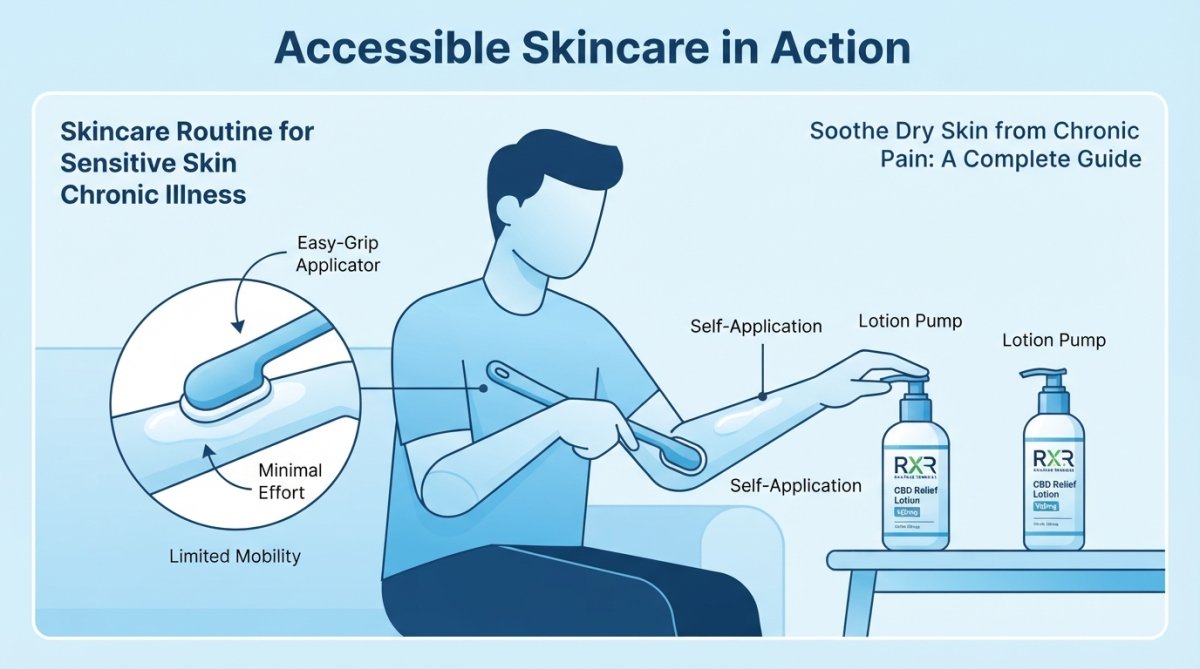
Mobility-Friendly Application Techniques
When chronic pain affects your hands, shoulders, or treatment areas, standard application methods become frustrating.
For hands and forearms, use a pump bottle rather than a jar. Pumps require minimal grip strength and one-handed operation. For legs and feet, sit down rather than standing. For hard-to-reach areas, use a long-handled applicator or ask for assistance rather than contorting your body.
For the face and neck, use your fingertips in upward strokes. This requires less pressure than back-of-hand application, reducing strain on arthritic joints. Pat gently rather than rubbing.
Sensory-Friendly Textures and Fragrance-Free Options
Chronic pain often comes with sensory sensitivities. Your skincare routine should soothe, not aggravate.
Fragrance-free products are non-negotiable. Fragrance molecules trigger inflammation in sensitive skin and can exacerbate pain conditions. Railroad Remedies (RXR)'s products use only organic ingredients without synthetic fragrance.
Most chronic pain patients tolerate lightweight lotions better than thick creams. Lotions have a smoother texture that absorbs faster, meaning less time spent applying product. Temperature sensitivity is real, some patients find cool lotion reduces inflammation and pain, while others prefer room-temperature application.
Nerve Pain Dry Skin Remedies: A Step-by-Step Approach
Neuropathic pain often comes with severe xeroderma because nerve damage affects both pain sensation and skin barrier function. This step-by-step approach addresses both simultaneously and takes approximately 5-10 minutes total.
Step 1: Cleanse with Lukewarm Water and Gentle Soaps
Start with lukewarm water, not hot. Hot water strips your skin barrier of natural oils and increases transepidermal water loss.
Use a gentle, fragrance-free cleanser or soap substitute. Harsh soaps contain surfactants that disrupt your skin barrier. Look for cleansers labeled "gentle" or "non-foaming." Cleanse for 30-60 seconds maximum and pat dry gently with a soft towel; don't rub.
Step 2: Apply Topical Treatment Within Minutes
This is critical: apply your moisturizer within 2-3 minutes of cleansing, while your skin is still slightly damp. Damp skin allows products to penetrate more effectively and locks in residual moisture.
Apply enough product to cover the affected area completely. Use your fingertips to press the product gently into your skin, working in upward strokes on the body.
For nerve pain specifically, consider products with CBD or CBC. Research from the National Institutes of Health indicates that cannabinoids have analgesic and anti-inflammatory properties that may reduce both pain sensation and inflammation driving xeroderma. Railroad Remedies (RXR)'s CBD/CBC blend at 2000mg provides maximum anti-inflammatory support for severe nerve pain-related dryness.
Step 3: Layer Protection with Occlusives
After your hydrating lotion absorbs (2-3 minutes), apply a light occlusive layer if your skin remains dry. This step is optional for daytime but recommended for nighttime.
Use petroleum jelly, mineral oil, or a product specifically formulated as an occlusive. Apply a thin layer; a little goes a long way. For nighttime, you can apply a heavier occlusive without worrying about greasiness.
| Step | Duration | Frequency | Best Time |
|---|---|---|---|
| Cleanse with lukewarm water | 1 minute | 1-2x daily | Morning, evening |
| Apply hydrating lotion | 2-3 minutes | 1-3x daily | After cleansing, as needed |
| Layer occlusive (optional) | 1 minute | 1x daily | Before bed |
Home Remedies for Dry Skin That Support Chronic Pain Management
Professional skincare products are important, but environmental adjustments and natural ingredients amplify their effectiveness.
Natural Ingredients: Shea Butter, Jojoba Oil, and Oatmeal
Shea butter is a plant-based emollient rich in fatty acids and vitamins. It softens skin and provides light occlusion without petroleum jelly's greasiness. Railroad Remedies (RXR) uses organic shea butter in both formulations for this reason.
Jojoba oil closely mimics human sebum, making it one of the most skin-compatible oils available. It absorbs quickly, doesn't clog pores, and provides both emollient and light occlusive benefits.
Colloidal oatmeal soothes inflammation and itching. Add it to lukewarm baths or mix with water to create a paste for targeted application. Oatmeal contains avenanthramides that reduce inflammation and itching.
Environmental Adjustments: Humidifiers and Bathing Habits
Your environment directly affects your skin's hydration. Indoor heating, air conditioning, and low humidity all accelerate transepidermal water loss.
A humidifier adds moisture to the air, reducing evaporation from your skin. Aim for 40-50% humidity. Run a humidifier in your bedroom overnight and in your main living space during dry seasons.
Limit showers to 5-10 minutes in lukewarm water. Bathe no more than once daily unless you have specific hygiene needs. After bathing, apply moisturizer immediately while your skin is still damp. Avoid chlorinated pools and hot tubs if possible. If you must use pools, shower immediately afterward and apply moisturizer while your skin is still damp.
Common Mistakes to Avoid When Treating Dry Skin from Chronic Pain
Most chronic pain patients treat dry skin as a cosmetic issue rather than a barrier dysfunction, leading to ineffective product choices.
The first mistake is using products with fragrance or harsh soaps. Fragrance triggers inflammation, worsening both pain and dryness. The second mistake is applying moisturizer to completely dry skin, always apply within minutes of cleansing, while your skin retains residual water.
The third mistake is using only one ingredient type. You need all three categories: humectants to draw water in, emollients to soften and smooth, and occlusives to seal. The fourth mistake is abandoning your routine during pain flares. When pain is severe, consistent hydration matters most, inflammation during flares drives xeroderma.
The fifth mistake is expecting overnight results. Skin barrier repair takes 2-4 weeks of consistent treatment. Commit to your routine for at least 3 weeks before evaluating effectiveness.
Conclusion: Building Your Personalized Dry Skin Relief Plan
Chronic pain creates a specific type of xeroderma that standard moisturizers can't address because they ignore medication side effects, inflammation, and mobility limitations. The most effective approach combines barrier-repairing products, environmental adjustments, and a routine simple enough to maintain during pain flares.
Railroad Remedies (RXR) addresses this gap with formulations specifically designed for pain patients. The [CBD Relief Lotion 500mg](https://4ch1j6-1c.myshopify.com/products/cbd-relief-lotion-500mg) ($39.99) provides essential hydration with anti-inflammatory support, while the CBD/CBC 2000mg Pain Relief Lotion 3.3oz ($69.99) delivers maximum relief for severe xeroderma. Both use organic coconut oil, shea butter, and kukui nut oil, ingredients that hydrate without greasiness that makes application difficult. Start with whichever matches your pain severity, apply consistently within minutes of cleansing, and expect meaningful improvement within 3-4 weeks.
The challenge with chronic pain is managing pain while protecting your body from medication side effects. Your skincare shouldn't add to that burden. Railroad Remedies (RXR) lotions are formulated so you can address both pain and dry skin with one application, using products that absorb quickly and work with your body's limitations. Get started with Railroad Remedies (RXR) and reclaim skin comfort without compromising your pain management strategy.
Frequently Asked Questions
Can chronic pain medications like NSAIDs cause dry skin, and will a topical lotion actually help?
Yes, many chronic pain medications, including NSAIDs, antihistamines, and certain nerve pain treatments, can compromise your skin barrier and increase transepidermal water loss, leading to xeroderma. While topical treatments won't replace oral medication, they directly address the resulting dry skin by replenishing moisture and restoring the epidermis. A non-greasy lotion with emollients like shea butter and humectants works at the site of irritation, making it a practical complement to your pain management routine.
What ingredients should I look for in a moisturizer for dry skin from chronic pain?
Look for three key ingredient types: humectants (draw water into the skin), emollients (smooth and soften), and occlusives (seal moisture). Effective options include jojoba oil, shea butter, and petroleum jelly for occlusion; glycerin and hyaluronic acid for hydration. Avoid harsh soaps, fragrances, and alcohol-based products that worsen skin inflammation. For chronic pain patients, choose fragrance-free and hypoallergenic formulas to prevent additional irritation, especially if you have sensitivity from radiation therapy or other treatments.
How do I soothe dry skin from chronic pain if I have limited mobility or hand strength?
Mobility-friendly skincare routines prioritize ease of application. Use pump bottles or spray applicators instead of jars requiring grip strength. Apply lotion to damp skin immediately after lukewarm (not hot) showers to lock in hydration. Consider sensory-friendly textures like lightweight, non-greasy lotions that absorb quickly, you won't need to rub vigorously. A humidifier in your bedroom reduces environmental dryness overnight, reducing daily application burden. If dressing or reaching certain areas is difficult, ask a caregiver to help with back or lower-leg applications.
What home remedies for dry skin work best alongside chronic pain treatment?
Effective home remedies include using a humidifier (especially at night) to combat transepidermal water loss, adjusting bathing habits to lukewarm water and shorter showers, and applying colloidal oatmeal baths for itchy skin relief. Natural ingredients like shea butter, jojoba oil, and coconut oil provide emollient support. Avoid hot showers and harsh soaps that strip the skin barrier. These lifestyle changes work synergistically with topical treatments to improve skin health and reduce inflammation, supporting your overall chronic pain management strategy.
EXTERNAL SOURCES:
This guide draws on research from [EXTERNAL_LINK: American Academy of Dermatology clinical guidelines on xerosis and barrier dysfunction | aad.org], [EXTERNAL_LINK: National Institutes of Health research on cannabinoid analgesic properties | nih.gov], and [EXTERNAL_LINK: Mayo Clinic guidance on medication side effects affecting skin health | mayoclinic.org].
This article was written using GrandRanker
