

How to Maximize the Entourage Effect With Topicals
Table of Contents
- What the Entourage Effect Means in a Topical
- Why Full-Spectrum Hemp Extract Beats Isolate for the Entourage Effect
- How CBD for Inflammation Works Through the Skin
- The Benefits of a CBD and CBC Blend in Pain Relief Lotions
- Best Practices for Applying CBD Lotion to Maximize Absorption
- Storage, Shelf Life, and Product Interactions That Affect Results
- Conclusion
- Frequently Asked Questions
Last Updated: September 10, 2026
What the Entourage Effect Means in a Topical
The entourage effect is the theory that cannabinoids, terpenes, and other hemp compounds work together more effectively than any single isolated compound alone (peer-reviewed research). In a topical, this means a full-spectrum hemp extract can deliver broader support than purified cannabidiol by itself.
That distinction matters more than most product labels admit. This guide from Railroad Remedies (RXR) breaks down how to maximize the entourage effect with topicals, from choosing the right extract to applying it correctly so more cannabinoids actually reach the tissue that hurts.
For anyone managing joint inflammation or chronic nerve pain, the goal isn't just slathering on a lotion. It's understanding formulation, potency, and absorption well enough to get consistent results.
Why Full-Spectrum Hemp Extract Beats Isolate for the Entourage Effect
Full-spectrum hemp extract contains the full range of naturally occurring cannabinoids and terpenes, while isolate is purified cannabidiol with everything else stripped out. For topical use, full-spectrum is the better choice because the minor compounds appear to support how the primary cannabinoids interact with the skin and underlying tissue.
Broad-spectrum sits in between: it keeps most cannabinoids and terpenes but removes THC. Isolate is the least complex option and the least aligned with the entourage effect premise.
| Extract Type | Cannabinoids Present | Terpenes | Entourage Effect Potential |
|---|---|---|---|
| Full-spectrum | Full range, trace THC | Retained | Highest |
| Broad-spectrum | Most, no THC | Retained | Moderate to high |
| Isolate | CBD only | Removed | Minimal |
A common mistake is assuming higher milligram counts always win. Potency matters, but so does what's alongside it. Potency matters, but so does what's alongside it.
How CBD for Inflammation Works Through the Skin
CBD for inflammation works by interacting with receptors in the endocannabinoid system, a signaling network involved in regulating pain and immune response (PubMed). When applied topically, cannabinoids bind to receptors in the skin and nearby tissue rather than entering the bloodstream in meaningful amounts.
The skin barrier is the real bottleneck. The outermost layer, the stratum corneum, is designed to keep foreign substances out. That's why carrier oils and formulation quality matter so much: they influence how much of the cannabinoid actually crosses into deeper tissue versus sitting on the surface.
A common mistake is expecting instant, systemic relief from a topical. Topicals act locally. For surface-level muscle soreness and joint discomfort, that's often exactly what you want.
The Benefits of a CBD and CBC Blend in Pain Relief Lotions
The benefits of a CBD and CBC blend come down to complementary activity. Cannabichromene (CBC) is a lesser-known cannabinoid studied for its own anti-inflammatory and analgesic properties, and pairing it with CBD appears to broaden the range of discomfort a lotion can address (PubMed).
This is where formulation separates good products from forgettable ones. Railroad Remedies (RXR) builds its 2000mg formula around a CBD/CBC blend, using organic MCT oil, shea butter, and jojoba oil as the base. The non-greasy texture matters too: a lotion you'll actually reapply beats a thick balm you avoid.

CBC products typically cost more than standard CBD creams.
Best Practices for Applying CBD Lotion to Maximize Absorption
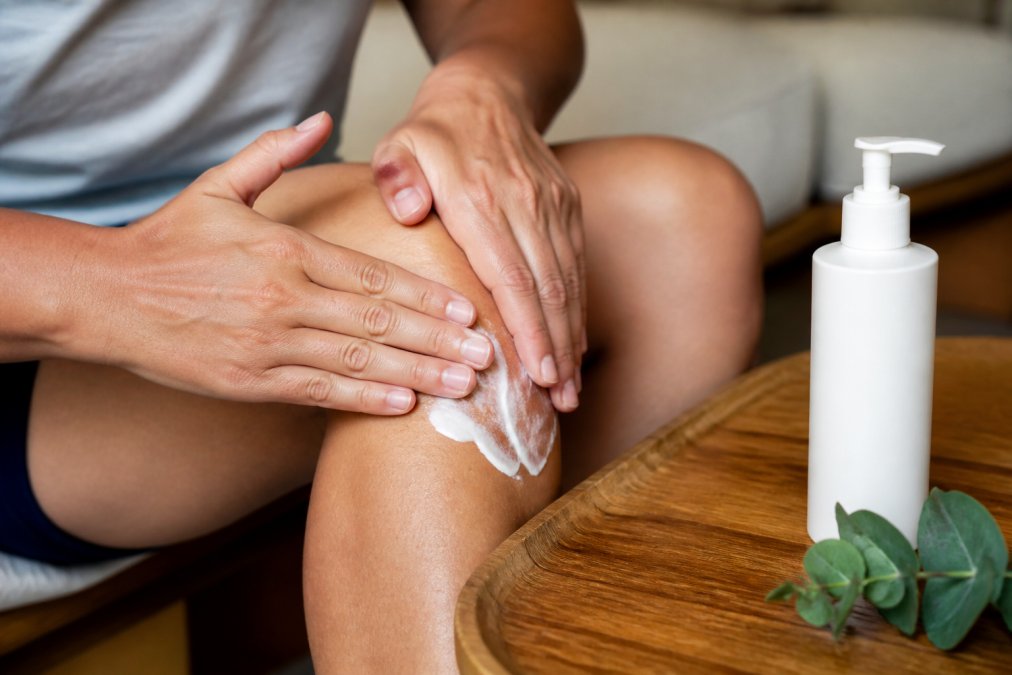
The best practices for applying CBD lotion start with clean skin, a small amount, and consistent timing. Massage the lotion in fully rather than letting it sit on the surface, and reapply on a schedule instead of only when pain spikes.
Why technique changes how much cannabinoid reaches the tissue
The stratum corneum, the outermost layer of dead, flattened skin cells bound in a lipid matrix, is the rate-limiting barrier for any topical. Cannabinoids like CBD and CBC are lipophilic, meaning they dissolve in oil, not water. That has three practical consequences:
- Hydration first, then application. Slightly damp skin (not soaking wet) has a more fluid lipid matrix and a temporarily looser stratum corneum. Pat the area dry, then apply within a minute or two. A common pattern is to apply right after a warm shower once the skin has cooled and been towel-dried, not while it is still dripping.
- Massage is not cosmetic. Rubbing for 30-60 seconds raises local skin temperature and blood flow, which increases the diffusion gradient pulling cannabinoids from the vehicle into the dermis. A quick smear leaves most of the dose sitting in the vehicle on top of the skin.
- Less is more per application. A pea-sized amount per palm-sized area spreads evenly and fully absorbs. Over-applying creates a thick film that never crosses the barrier and just transfers to clothing.
A practical application routine
- Clean and dry the area completely; remove any occlusive lotion or sunscreen already on the skin.
- Dispense a small amount (roughly a pea per palm-sized area) and warm it between your palms.
- Massage in circular motions for 30-60 seconds until the product is no longer visible on the surface.
- Reapply two to three times daily for the first week, spacing doses roughly 6-8 hours apart.
- Track results for at least two weeks before judging effectiveness.
Application frequency matters more than most people expect. A single application rarely tells you whether a product works. Consistency over days is what reveals whether the entourage effect is doing anything for you.
Patch test protocol for sensitive skin
Before applying to a large area, run a two-stage patch test. On day one, apply a small amount to the inner forearm and leave it uncovered for 24 hours. If there is no redness, itching, or swelling, repeat on day two on a small patch near the target area (for example, the side of the knee rather than the whole knee). Fragrance, essential oils, menthol, and preservatives, not cannabinoids, are the most common culprits in topical reactions, so a reaction usually points to the base formula, not the hemp extract.
Storage, Shelf Life, and Product Interactions That Affect Results
Storage and shelf life quietly determine whether your lotion still works months after purchase. Cannabinoids and terpenes degrade with heat, light, and oxygen exposure, so a bottle left on a sunny windowsill loses potency faster than one stored in a cool, dark cabinet.
What actually degrades, and how fast
CBD and other cannabinoids oxidize when exposed to oxygen and UV light, converting over time into related breakdown products that are not what you paid for. Terpenes are more volatile still, the aromatic compounds that contribute to the entourage effect evaporate and rearrange faster than the cannabinoids themselves. The practical result is that an older or poorly stored lotion can still contain CBD on the label's stated milligram count while delivering a flatter, less complex effect.
A few grounded rules:
- Temperature. Store below room temperature, a cool, dark cabinet is ideal. A hot car or a steamy bathroom accelerates degradation.
- Light. Amber or opaque packaging is not marketing; UV-blocking containers slow cannabinoid breakdown.
- Air. Every time you open the jar, oxygen enters. Pump dispensers and tubes limit headspace exposure better than wide-mouth jars.
- Time. Follow the manufacturer's stated use-by window, and treat the batch or manufacture date on the label as the clock's starting point. Buy what you'll use within a few months rather than stockpiling.
Rotate stock so the oldest bottle is used first.
Layering with other skincare products
This is the angle most guides skip, and it matters more than ever as CBD topicals move into routines that already include retinols, alpha-hydroxy acids (AHAs), and heavy moisturizers. Order of application changes how much cannabinoid crosses the skin barrier.
- Apply CBD lotion before, not after, thick occlusive creams. Occlusives like petrolatum or heavy butters form a film that traps whatever is beneath them, but they also block new product from getting in. If you apply the occlusive first, the CBD sits on top of the film.
- Be cautious layering over exfoliating acids. AHAs and BHAs strip the outer stratum corneum and can leave skin temporarily more permeable and more reactive. Applying a cannabinoid topical immediately after an acid increases both absorption and the risk of stinging or irritation. A common pattern is to separate them by several hours, or use them on alternating days.
- Retinols are a timing issue, not a chemistry issue. Retinoids increase skin turnover and can cause dryness and flaking, which makes the barrier less predictable. Applying CBD lotion in the morning and retinol at night avoids stacking two actives on the same skin at the same time.
- Menthol and camphor-based products. These create a cooling sensation that can mask discomfort but also drive vasodilation and a mild irritant response. They are useful for acute soreness but are not a substitute for a cannabinoid-forward formula, and they should not be layered on broken or freshly exfoliated skin.
Conclusion
Getting real results from a topical comes down to choosing a full-spectrum or blended formula, applying it consistently, and storing it properly. The entourage effect isn't magic; it's a formulation and application discipline.
Railroad Remedies (RXR) builds its lotions around that idea, with organic ingredients, a non-greasy easily absorbed base, and a 2000mg CBD/CBC blend that incorporates cannabichromene for enhanced anti-inflammatory and analgesic support. If you've been disappointed by other creams, the difference is often in what's inside the bottle and how you use it.
Continue shopping with Railroad Remedies (RXR) and find the lotion that fits your routine.
Frequently Asked Questions
What is the entourage effect in CBD topicals?
The entourage effect is the idea that cannabinoids like CBD, CBC, and trace THC work better together than alone. In topicals, full-spectrum hemp extract keeps those compounds intact, so they can interact with skin receptors and each other. This may improve how well a lotion supports comfort and calm. Products that list full-spectrum extract on the label are more likely to deliver this effect than isolate-based creams.
Does combining CBD and CBC enhance pain relief?
Research on CBC is still growing, but early findings suggest it may boost the body's natural endocannabinoid activity. When paired with CBD in a topical, CBC could add to the anti-inflammatory and analgesic effects. A 2000mg CBD/CBC lotion, for example, delivers both cannabinoids in one application. Users often report that blends feel more supportive than CBD alone, though individual results vary.
How do carrier oils like shea butter and kukui nut oil affect absorption?
Carrier oils do more than moisturize. Shea butter and kukui nut oil create a protective layer that slows water loss and helps cannabinoids stay on the skin longer. They also make the formula spread easily without a greasy feel. Oils high in fatty acids can support the skin barrier, which may improve how well CBD and CBC penetrate over time. Look for organic oils in the ingredient list.
How often should you apply CBD topicals to maintain the entourage effect?
Most people apply a CBD topical two to three times a day, or as needed for flare-ups. Consistency matters more than quantity. Reapplying every 4 to 6 hours can keep cannabinoids present in the skin. If you're using a 2000mg CBD/CBC lotion, start with a pea-sized amount per area and adjust based on how your skin responds. Always follow the product label.
