

How to Choose CBD Lotion for Back Pain: 2026 Guide
Table of Contents
- Why Back Pain Needs a Different CBD Lotion
- Full Spectrum vs Isolate CBD Lotion: Which Works for Back Pain?
- Benefits of CBD and CBC for Inflammation and Joint Discomfort
- How to Apply CBD Lotion for Back Pain: Techniques That Work
- How Long Does CBD Lotion Take to Work?
- Reading a COA: Potency, Third-Party Testing, and What to Verify
- Sensitive Skin, Radiation Therapy, and Pet Use: Safety Considerations
- Matching Formula Strength to Your Pain Level
- Frequently Asked Questions
Last Updated: September 27, 2026
Why Back Pain Needs a Different CBD Lotion
Back discomfort comes from distinct sources, muscle strain, joint inflammation, and nerve irritation, each responding differently to cannabinoids, carrier oils, and application depth.
Full Spectrum vs Isolate CBD Lotion: Which Works for Back Pain?
Full-spectrum CBD lotion contains CBD plus other hemp compounds like terpenes and minor cannabinoids, while isolate CBD lotion contains only purified cannabidiol. For back pain, full-spectrum and broad-spectrum formulas are the better starting point.
The distinction matters:
- Full-spectrum: CBD plus trace THC and other cannabinoids; often used for deeper, longer-lasting support
- Broad-spectrum: CBD plus other cannabinoids with THC removed; a middle ground for those avoiding THC
- Isolate: Pure CBD only; best for anyone who wants zero THC or has failed a patch test on other formulas
Benefits of CBD and CBC for Inflammation and Joint Discomfort
CBC (cannabichromene) is a minor cannabinoid that appears naturally in hemp and is most often paired with CBD in topicals built for joint discomfort. CBD works indirectly at CB1 and CB2 receptors and on enzymes like FAAH, while CBC has been studied for its interaction with TRP channels, the same receptors that respond to capsaicin and menthol. Together, they may support comfort through overlapping but distinct pathways.
Why the carrier oil decides more than the milligram count
Cannabinoids are fat-soluble: they don't penetrate skin on their own. What carries them across the stratum corneum, the outer barrier layer, is the oil base, the part most reviews skip.
- Coconut and MCT oil: small fatty-acid chains, absorb quickly, carry actives further into the skin
- Jojoba oil: structurally close to human sebum, spreads evenly, good for daily use
- Kukui nut oil: lightweight, high in linoleic acid, popular in formulas built for fast absorption
- Shea butter: rich and occlusive, slows absorption but extends how long the formula stays active on the skin
- Petrolatum and mineral oil bases: sit on top of the skin, trap moisture, but do little to move cannabinoids into tissue
What to look for on the label
- Cannabinoid pairing: CBD plus at least one minor cannabinoid (CBC, CBG, or CBN) rather than CBD alone
- Carrier system: MCT, coconut, jojoba, or kukui near the top of the ingredient list
- Skin support: aloe, green tea seed extract, or hyaluronic acid, useful over joints where skin thins with age
- No heavy occlusives first: petrolatum or mineral oil as the primary base usually signals a surface-level formula
- Batch-specific COA: potency and contaminant testing tied to the lot number on your bottle
One caveat: topical CBD products are not FDA-approved to treat any medical condition, and individual response varies. If joint pain is persistent, worsening, or accompanied by swelling, redness, or loss of function, see a clinician, not a lotion.
How to Apply CBD Lotion for Back Pain: Techniques That Work
Applying CBD lotion for back pain correctly means working it into the muscle body, not just the skin surface. Most people rub it in for a short time, which may not be enough to reach the tissue that hurts, and it's important to consider that lower and upper back pain may require different application approaches.
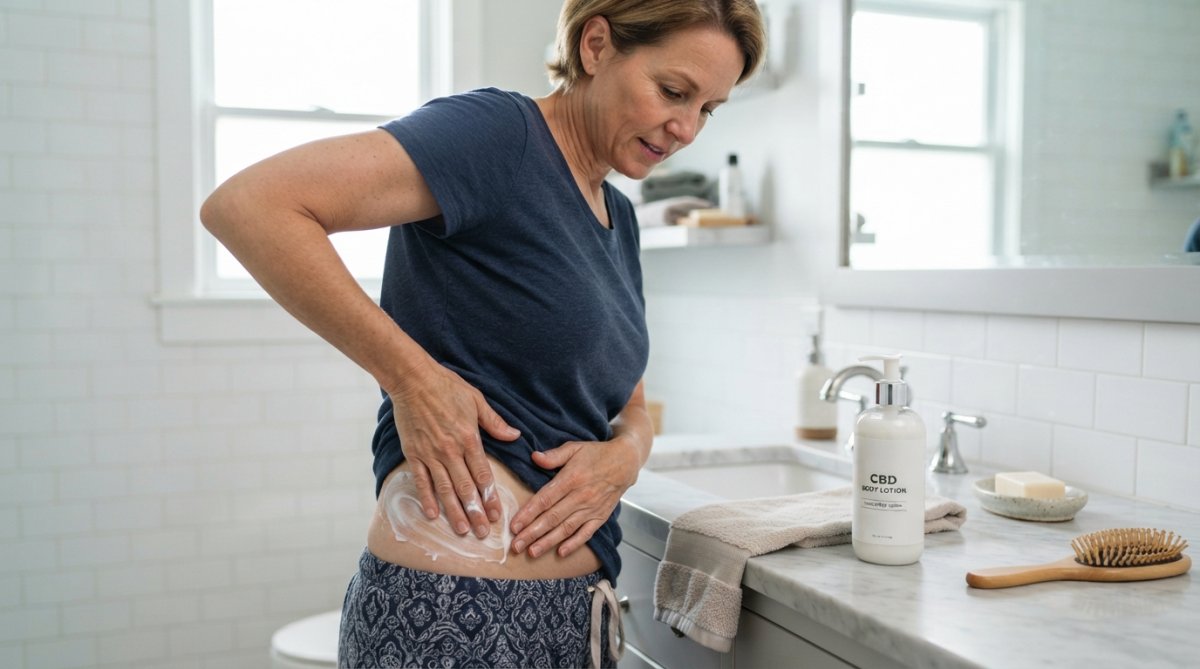
The base sequence
- Warm the lotion between your palms for a few seconds before applying.
- Start at the outer edge of the sore area and work inward with firm, circular pressure.
- Use broad strokes along the muscle fibers rather than short dabs.
- Spend 60 to 90 seconds per region. The friction helps absorption.
- Reapply every 4 to 6 hours as needed, and wash your hands after.
Lower back: target the erector spinae, not the spine
The lower back has two vertical muscle columns, the erector spinae, running on either side of the spine from pelvis to ribcage. Most lower back pain lives in those columns, not the vertebrae. Apply along each column from the sacrum upward, pressing in with thumbs or knuckles, and avoid the bony points of the spine.
Upper back: work from the shoulder blade down
Upper back tension usually concentrates around the shoulder blades and trapezius. Apply starting at the top of the shoulder, work down and inward toward the mid-back, and finish along the inner edge of each shoulder blade. The fibers run at an angle, so diagonal strokes cover more tissue than vertical rubbing.
Pairing with heat, TENS, and movement
CBD lotion sits alongside whatever else you're already doing for your back.
- Heating pads: apply lotion first, wait 10 to 15 minutes, then use heat. Never apply lotion on top of an active heating pad, trapped heat plus occlusive ingredients can irritate skin.
- TENS units: place electrode pads on clean, dry skin, not over fresh lotion; oils interfere with adhesion and conductivity. Apply lotion to surrounding muscle after the session.
- Physical therapy and stretching: apply after, not before. Movement increases circulation on its own; lotion afterward targets tissue that still feels tight.
- Ice: ice first, then apply lotion once skin returns to normal temperature. Lotion on numb, cold skin reduces absorption and makes pressure harder to judge.
How often is enough
Twice a day, morning and evening, is the common starting pattern for chronic back discomfort. For acute flare-ups, some users apply every 4 to 6 hours, then taper back. If you're reapplying every hour, the formula may not be reaching the target tissue effectively; considering a higher-potency or different carrier product might be more beneficial than more frequent application.
CBD + CBC Relief Lotion 2000mg →
How Long Does CBD Lotion Take to Work?
CBD lotion typically takes 15 to 45 minutes to produce a noticeable effect, depending on formula, potency, and how thoroughly you worked it in.
A few practical notes:
- Thin, fast-absorbing lotions may feel like they're working sooner, but might need more frequent reapplication
- Richer formulas with shea butter and heavier oils may take longer to absorb but might last longer between applications
- Applying after a warm shower, when skin is more permeable, can shorten the wait
Reading a COA: Potency, Third-Party Testing, and What to Verify
A certificate of analysis (COA) is a lab report showing what's actually in a CBD product: cannabinoid potency, contaminant testing, and batch identity. Serious brands publish these for each batch, not just one sample from launch.
When you review a COA, verify these items:
| What to Check | Why It Matters | Red Flag |
|---|---|---|
| Cannabinoid potency | Confirms CBD and CBC match the label | No milligram breakdown |
| Batch or lot number | Ties the report to your exact bottle | Report with no batch ID |
| Heavy metals panel | Screens for lead, arsenic, cadmium | Panel missing entirely |
| Pesticide screen | Confirms clean cultivation | "Not tested" note |
| Microbial testing | Rules out mold and bacteria | No date on the report |
| Lab name and accreditation | Shows who ran the test | Unnamed or unverifiable lab |
Sensitive Skin, Radiation Therapy, and Pet Use: Safety Considerations
Sensitive skin is the most common reason people abandon CBD lotions, and the fix is usually a patch test, not a different product. Apply a small amount to your inner forearm, wait 24 hours, and check for redness, itching, or swelling before using it on your back.
Matching Formula Strength to Your Pain Level
Potency should match the job, not your budget. A 500mg lotion and a 2000mg lotion aren't "good" and "better" versions of the same thing. They're built for different levels of discomfort and different body areas.
How to decide:
- Mild, occasional soreness: start with 500mg
- Daily joint discomfort or osteoarthritis: step up to 2000mg
- Nerve pain or long-standing chronic pain: the higher-potency, multi-cannabinoid formula is the better first try
- Sensitive or post-treatment skin: start lower and patch test first
Frequently Asked Questions
What type of CBD is best for back pain?
Full-spectrum CBD lotion contains multiple cannabinoids and terpenes that work together, which may support a broader therapeutic effect for back pain. Broad-spectrum offers similar benefits without THC. Isolate contains only CBD and is best for those who want to avoid other cannabinoids entirely. For back pain and inflammation, full-spectrum or broad-spectrum formulas with added CBC may offer a broader approach to discomfort.
How much CBD should be in a lotion for back pain?
Potency matters, but so does the size of the container. A 500mg lotion in a 3.3oz bottle delivers roughly 5mg of CBD per pump, which can be suitable for mild soreness or daily maintenance. A 2000mg formula delivers closer to 20mg per pump, which may be preferred for chronic pain or targeted relief. Check the milligrams per container, not just the total number, to understand what each application actually delivers.
Are there side effects to using CBD lotion?
Topical CBD is generally well tolerated. Some users experience mild skin irritation, redness, or dryness, especially with formulas containing menthol or essential oils. A patch test on your inner forearm before applying to your back can help you identify dermatological sensitivity. If you have sensitive skin from radiation therapy or other conditions, choose a lotion with soothing ingredients like aloe, shea butter, and allantoin, and avoid products with high concentrations of cooling agents.
Will CBD lotion help with nerve pain or only muscle soreness?
CBD lotion works primarily through local interaction with cannabinoid receptors in the skin and underlying tissue, which can help with inflammation and muscle discomfort. For nerve pain, results can be less predictable because nerve pain often originates deeper and may not respond to topical application alone. Combining CBD lotion with other pain management approaches may offer broader support. If nerve pain is your primary concern, talk to your doctor about whether a topical fits your overall plan.
