

High Strength CBD Pain Relief: Top Products & Dosing Guide
Table of Contents
- What Qualifies as High Strength CBD for Pain Relief
- How We Evaluated High Strength CBD Pain Products
- Best High Strength CBD Pain Relief Products Compared
- CBD Topicals vs. Ingestibles for Pain: Which Works Better
- CBD Dosage for Severe Pain: Finding Your Optimal Strength
- Full Spectrum CBD for Pain Relief: Why It Matters
- THC-CBD Ratio for Pain Relief and Prescription Drug Interactions
- Cost-Per-Milligram Analysis: Value for High Strength Products
High Strength CBD Pain Relief: Top Products & Dosing Guide
Last Updated: July 18, 2026
When dealing with chronic pain or acute injury, finding effective relief is critical. The CBD market offers options ranging from weak topicals to serious formulations. This guide covers products, dosing strategies, and application methods that work for high-strength pain management, separating effective solutions from marketing hype.
Not all CBD products are interchangeable. The difference between a 500mg lotion and a 2000mg formula lies in bioavailability, ingredient synergy, and whether you're getting full-spectrum benefits or isolated cannabinoids. Below, we show you how to evaluate high-strength CBD pain relief products, what dosage works for severe pain, and why some formulations outperform others.
What Qualifies as High Strength CBD for Pain Relief
High-strength CBD for pain relief typically starts at 1000mg per container and reaches 10,000mg or higher. However, concentration matters more than total milligrams. A 500mg lotion in a 1-ounce jar delivers higher concentration than a 2000mg lotion in a 4-ounce jar. For topicals, anything above 1000mg is considered high potency. For ingestibles like tinctures, 30mg per serving or higher qualifies as high strength.
Understanding CBD Concentration and Milligrams
Concentration refers to how much CBD is packed into a given volume. A 2000mg lotion in a 3.3-ounce container is significantly more concentrated than a 2000mg lotion in an 8-ounce container. A 1000mg tincture in 30ml delivers about 33mg per milliliter, while the same 1000mg in 60ml delivers only 16.5mg per milliliter. For pain relief, higher concentration means faster onset and stronger effects from smaller doses.
Full-Spectrum vs. Broad-Spectrum vs. CBD Isolate
Full-spectrum CBD contains all cannabinoids, terpenes, and plant compounds from hemp, including trace amounts of THC (under 0.3% by law). This creates the "entourage effect," where cannabinoids work synergistically to enhance pain relief. For pain management, full-spectrum typically outperforms isolates because CBD works alongside cannabichromene (CBC) and other compounds that amplify anti-inflammatory benefits.
Broad-spectrum removes THC while keeping other cannabinoids and terpenes intact. It's a middle ground for people concerned about THC content but wanting some entourage effect.
CBD isolate is pure cannabidiol with no other compounds. It's THC-free but lacks the synergistic benefits that make full-spectrum formulations more effective for chronic pain.
For high-strength pain relief, full-spectrum dominates because you get CBC alongside CBD. Railroad Remedies (RXR)'s 2000mg CBD/CBC blend leverages this principle, the combination creates enhanced anti-inflammatory and analgesic properties that isolate formulations cannot match.
How We Evaluated High Strength CBD Pain Products
We assessed products across five critical dimensions: potency and concentration, third-party lab testing and Certificate of Analysis (COA), ingredient quality and sourcing transparency, absorption speed and application method, and real-world user feedback on pain relief outcomes. Every product has been third-party tested with a publicly available COA showing actual CBD content, absence of pesticides, and heavy metal screening.
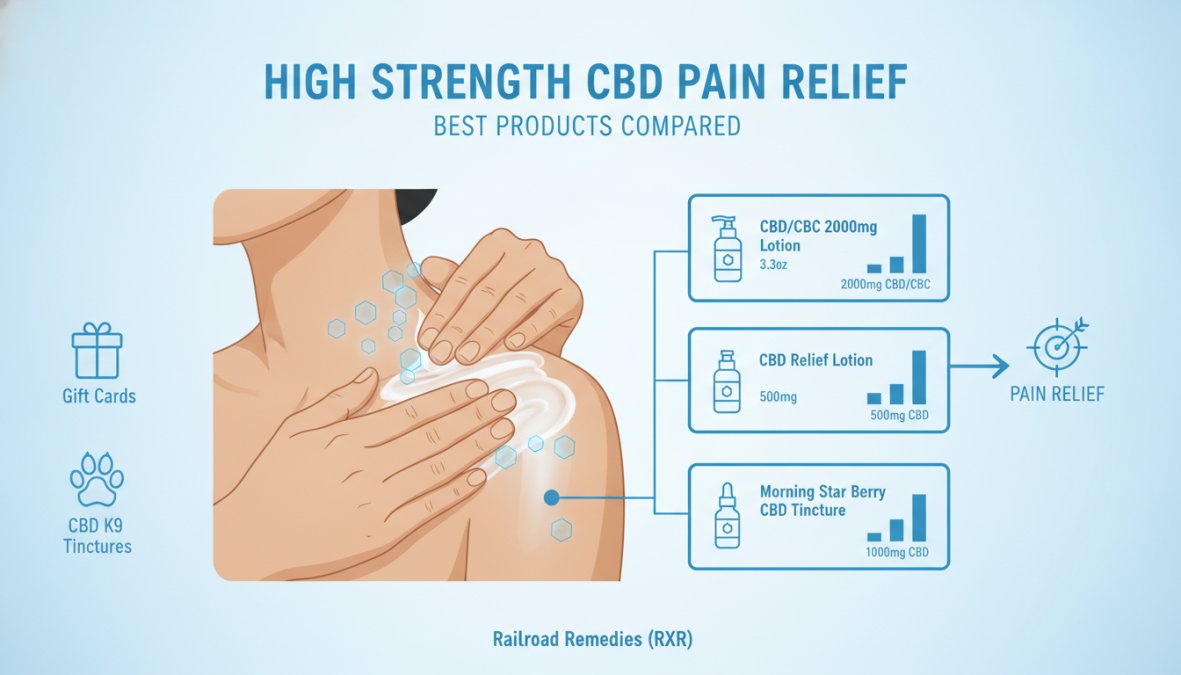
Best High Strength CBD Pain Relief Products Compared
| Product | Potency | Type | Format | Best For | Price |
|---|---|---|---|---|---|
| Railroad Remedies CBD/CBC 2000mg | 2000mg | Full-spectrum + CBC | Topical lotion | Severe joint and arthritis pain | $69.99 |
| Myaderm Advanced RX CBD Cream | 10,000mg | Full-spectrum | Topical cream | Professional-strength localized pain | Contact for pricing |
| Medterra Pain Relief Cream | 1000mg | Broad-spectrum isolate | Topical cream | Muscle soreness and acute pain | $59.99 |
| Lazarus Naturals High Potency Tincture | 6000mg | Full-spectrum | Ingestible tincture | Chronic pain and systemic relief | $89.99 |
| Aspen Green Bliss Organic CBD Oil | 2400mg | Full-spectrum | Ingestible oil | Premium organic pain relief | $149.99 |
Railroad Remedies CBD/CBC 2000mg Pain Relief Lotion
Railroad Remedies positions itself as the premium option for serious pain relief. The 2000mg CBD/CBC blend distinguishes this product from standard CBD creams. CBC (cannabichromene) is a proven analgesic and anti-inflammatory compound that amplifies CBD's effects. The lotion uses organic coconut oil as its base, paired with shea butter and kukui nut oil for deep hydration.
The non-greasy formula absorbs quickly without leaving residue, making it practical for daytime use. At $69.99 for a 3.3-ounce container, you're paying approximately $0.035 per milligram of CBD, competitive for a full-spectrum product with CBC.
Myaderm Advanced RX CBD Cream
Myaderm's 10,000mg formulation is the highest-potency topical available. The transdermal water-based formula penetrates deeper into muscle and connective tissue than standard lotions, designed for severe localized pain. Pricing isn't listed publicly, typically signaling professional/wholesale pricing.
Medterra Pain Relief Cream
Medterra combines 1000mg CBD isolate with 4% menthol and 7% arnica for a multi-mechanism approach to pain relief. The menthol creates immediate cooling sensation, while arnica provides traditional herbal anti-inflammatory support. At $59.99 for 1000mg, the cost-per-milligram is reasonable.
Lazarus Naturals High Potency Full Spectrum Tincture
Lazarus Naturals offers 6000mg of full-spectrum CBD in a 4-fluid-ounce bottle, delivering 50mg per milliliter. Full-spectrum means you get the entourage effect with CBC, CBN, and terpenes working alongside CBD. For systemic pain relief, ingestibles reach your whole body rather than just the application site.
At $89.99, this works out to approximately $0.015 per milligram, excellent value for a full-spectrum product. Lazarus offers a discount program for low-income individuals and veterans.
Aspen Green Bliss Organic Full Spectrum CBD Oil
Aspen Green positions itself as the premium organic option with USDA certification. The formulation delivers 133mg of CBD per 1ml serving, reaching 2400mg total per bottle. Physician-formulated with additional botanicals, this appeals to people prioritizing organic sourcing and clinical backing.
At $149.99, this is the most expensive option per milligram ($0.062), but USDA organic certification and physician formulation justify the premium for some users.
CBD Topicals vs. Ingestibles for Pain: Which Works Better
The choice between topical and ingestible CBD depends on pain location and desired effect timeline. Topicals work faster (15-30 minutes) and target specific areas, ideal for localized joint pain, muscle soreness, or arthritis. Ingestibles take longer (30-90 minutes) but reach your entire body, making them better for systemic pain like fibromyalgia or widespread nerve pain.
Topical Application and Absorption Methods
Topical CBD penetrates skin through several mechanisms. Standard lotions and creams absorb into the epidermis and dermis, reaching surface-level pain receptors and inflammation. Transdermal formulations penetrate deeper into muscle and connective tissue, which matters for deep muscle pain or joint inflammation.
Massage the lotion into the affected area for 1-2 minutes to increase blood flow and enhance penetration. Apply to clean, dry skin for best results.
When to Use Ingestibles vs. Topicals
Use ingestible CBD when pain is systemic or affects multiple areas. Fibromyalgia, widespread arthritis, or chronic nerve pain throughout your body responds better to tinctures than spot treatments. Use topical CBD for localized pain: a specific joint, muscle group, or injury site. Many people use both for comprehensive pain management.
CBD Dosage for Severe Pain: Finding Your Optimal Strength
There's no universal CBD dosage for pain, it depends on body weight, pain severity, CBD sensitivity, and whether you're using topicals or ingestibles. For ingestibles, most people with severe pain start at 25-50mg daily and increase by 10-25mg every 3-5 days until they find relief. Some people need 100mg+ daily for significant pain reduction.
Chronic Pain vs. Acute Pain Dosing
Chronic pain requires consistent daily dosing to reduce baseline inflammation and pain sensitivity. Acute pain can be addressed with higher doses used temporarily.
Starting Low and Titrating Up
Start with a lower dose and increase gradually. For ingestible tinctures, start with 10-15mg daily for 3-5 days. If pain improvement is minimal, increase to 25mg daily.
Full Spectrum CBD for Pain Relief: Why It Matters
Full-spectrum CBD outperforms isolate for pain management because of the entourage effect. When CBD works alongside CBC, CBN, terpenes, and other cannabinoids, the combined effect exceeds what CBD alone can achieve. For pain relief specifically, the combination of CBD and CBC is particularly powerful.
The Entourage Effect and Anti-Inflammatory Benefits
The entourage effect describes how cannabinoids, terpenes, and other plant compounds work together more effectively than in isolation. Full-spectrum CBD includes cannabichromene (CBC) with analgesic and anti-inflammatory properties, cannabinol (CBN) with sedative properties useful for pain-related sleep disruption, terpenes that enhance cannabinoid absorption and provide anti-inflammatory benefits, and flavonoids with antioxidant properties that reduce inflammation.
Full-spectrum CBD addresses pain at its source by reducing underlying inflammation rather than just numbing sensation.
Third-Party Lab Testing and Certificate of Analysis
A Certificate of Analysis (COA) from an independent lab proves what's actually in the product. It shows CBD content, confirms THC is below 0.3%, screens for pesticides and heavy metals, and validates that the product matches label claims. A missing or outdated COA is a red flag.
THC-CBD Ratio for Pain Relief and Prescription Drug Interactions
Federal law limits THC to 0.3% in hemp-derived CBD products. This amount is too small to produce psychoactive effects. For pain relief specifically, trace THC actually enhances CBD's analgesic effects through the entourage effect.
If you're subject to drug testing or prefer zero THC, broad-spectrum products remove THC while keeping other cannabinoids. The pain relief is still strong, just slightly less potent than full-spectrum alternatives.
CBD Interactions with NSAIDs and Pain Medications
CBD doesn't directly interact with NSAIDs (ibuprofen, naproxen) or acetaminophen in dangerous ways. However, both CBD and NSAIDs reduce inflammation through different mechanisms, so combining them may enhance anti-inflammatory effects.
CBD can interact with certain pain medications metabolized by the liver's CYP3A4 enzyme. If you're taking prescription opioids, muscle relaxants, or other pain medications, consult your doctor before adding CBD.
Cost-Per-Milligram Analysis: Value for High Strength Products
Cost-per-milligram reveals true value beyond sticker price. A $50 product with 500mg CBD costs $0.10 per milligram. A $70 product with 2000mg costs $0.035 per milligram, significantly better value despite the higher upfront price.
| Product | Total Price | Total Milligrams | Cost Per Milligram | Value Rating |
|---|---|---|---|---|
| Railroad Remedies 2000mg | $69.99 | 2000 | $0.035 | Excellent |
| Medterra 1000mg | $59.99 | 1000 | $0.060 | Good |
| Lazarus Naturals 6000mg | $89.99 | 6000 | $0.015 | Outstanding |
| Aspen Green 2400mg | $149.99 | 2400 | $0.062 | Premium |
Lazarus Naturals offers the best cost-per-milligram for ingestibles. Railroad Remedies (RXR) provides excellent value for topicals, especially considering the CBC addition and organic ingredients. For most people with severe pain, the best value is Lazarus Naturals for systemic relief combined with Railroad Remedies (RXR) topical for localized pain.
Finding effective high-strength CBD pain relief requires understanding potency, formulation type, and your specific pain pattern. Railroad Remedies (RXR) CBD/CBC lotion delivers pharmaceutical-grade relief with organic ingredients and verified potency. The 2000mg CBD/CBC combination targets inflammation-driven pain while nourishing skin, addressing both the symptom and underlying inflammatory cascade.
Frequently Asked Questions
What is considered high strength CBD for pain management?
High strength CBD typically refers to products containing 1000mg or more of cannabidiol per serving or container. For topicals, concentrations of 1000mg-2000mg are considered high strength, while ingestibles like tinctures may range from 2000mg-6000mg per bottle. Full-spectrum formulations with CBC (Cannabichromene) added, like Railroad Remedies' 2000mg CBD/CBC blend, offer enhanced anti-inflammatory benefits for pain relief beyond standard CBD alone.
How does full spectrum CBD for pain relief differ from isolate products?
Full-spectrum CBD contains the complete plant profile including other cannabinoids, terpenes, and beneficial compounds that work synergistically, called the entourage effect. This approach typically delivers stronger anti-inflammatory and analgesic results for pain management. CBD isolate contains only pure cannabidiol, making it THC-free and predictable, but potentially less effective for chronic pain. Third-party lab testing via Certificate of Analysis (COA) confirms potency and purity in both formats.
What's the difference between topical and oral CBD dosage for severe pain?
CBD dosage for severe pain depends on delivery method. Topicals (creams, lotions) work locally on joint and muscle pain with concentrations of 500mg-2000mg applied directly to affected areas. Oral ingestibles (tinctures, softgels) require higher doses, typically 20-40mg daily for chronic pain, to achieve systemic effects. Topicals avoid liver metabolism and drug interactions, making them ideal if you're on NSAIDs or other pain medications; ingestibles provide whole-body relief for widespread pain.
Does high strength CBD actually work for chronic pain, or is it marketing?
Clinical evidence supports CBD's role in pain management through its interaction with the endocannabinoid system and anti-inflammatory pathways. High-strength formulations (1000mg+) deliver measurable relief for arthritis, joint pain, and muscle soreness when third-party tested. Results vary by individual, pain type, and formulation, full-spectrum products with added botanicals like menthol or arnica show faster-acting relief. Starting with a lower dose and titrating up helps identify your effective threshold.
Are there side effects or interactions I should know about with high strength CBD pain creams?
Topical CBD is generally well-tolerated with minimal systemic side effects since absorption is localized. Some users report mild skin irritation if sensitive to coconut oil or other carrier ingredients. If you're taking prescription pain medications like NSAIDs, consult your doctor, CBD may potentiate effects or interact with certain medications. Dermatologically tested formulations with organic shea butter and kukui nut oil reduce irritation risk, especially for sensitive or compromised skin.
This article was written using GrandRanker
