

High Potency CBD for Chronic Back Pain: 2026 Guide
Table of Contents
- Why High Potency CBD Is Different for Chronic Back Pain
- CBD vs CBC for Pain Relief: What the Research Shows
- How to Dose High Potency CBD for Back Pain
- Topical CBD for Back Pain: Why Location Matters
- Third-Party Lab Report Literacy: Reading a COA Like a Pro
- CBD and Common Back Pain Medications: What to Know
- Choosing a High Potency CBD Product That Fits Your Routine
- Frequently Asked Questions
Last Updated: September 28, 2026
Why High Potency CBD Is Different for Chronic Back Pain
High potency CBD for chronic back pain works differently than standard-strength topicals: dose per application, not product volume, determines whether cannabinoids reach the tissue that hurts.
The Endocannabinoid System and Back Pain
The endocannabinoid system regulates pain signaling through cannabinoid receptors found throughout the body, including spinal tissue and peripheral nerves. Applied topically, cannabinoids bind locally rather than entering the bloodstream in large amounts, which is why location matters.
Potency-to-Weight Ratio: The Number Most Shoppers Miss
Potency-to-weight ratio is the milligrams of CBD per ounce of product, and it is the single most useful number on a label. A 2000mg lotion in a 3.3oz container delivers roughly 606mg per ounce. A 500mg lotion in the same size delivers about 152mg per ounce.
FDA consumer guidance on cannabis-derived products
CBD vs CBC for Pain Relief: What the Research Shows
CBD and CBC are both hemp-derived cannabinoids studied for their anti-inflammatory properties, but they are not interchangeable. CBC, or cannabichromene, has drawn research interest for interacting with the body's own endocannabinoid signaling, and early work suggests it may work through pathways CBD does not touch directly.
The Role of Minor Cannabinoids (CBG/CBN)
CBG and CBN are minor cannabinoids that appear in smaller quantities in hemp. CBG is discussed for potential anti-inflammatory activity, while CBN is associated with relaxation. Neither has CBD's depth of clinical research, so treat claims with caution.
How to Dose High Potency CBD for Back Pain
Dosing high-potency CBD for back pain is where most guides get vague, because "start low and go slow" says nothing about milligrams. The useful version is a potency-to-weight calculation you can run before opening the jar.
The Potency-to-Weight Math Nobody Shows You
Topical cannabinoids act locally, so the relevant number is not body weight as with oral dosing, it is the milligrams deposited per square inch of skin over the painful area:
- Lower back coverage area: roughly 60-100 square inches for an average adult.
- Light application: about 0.5 ml per 100 square inches.
- Heavy application: about 1.5 ml per 100 square inches.
A Titration Framework With Actual Numbers
Use this as a starting scaffold, not a prescription. Response varies widely, and topical absorption depends on formulation, skin condition, and how much you rub in.
- Days 1-3: One light application (about 10mg CBD) to the single most painful spot, once daily. Log comfort on a 1-10 scale at 30 minutes, 2 hours, and 6 hours.
- Days 4-7: If no change, add a second application in the evening rather than increasing the amount per application. Frequency is easier to reverse than dose.
- Week 2: If still no change, increase to a heavy application (about 20-30mg CBD) once daily, keeping the second application at the light amount.
- Week 3+: Only after you have a stable pattern for at least five days should you consider a third application or a higher-potency product.
Topical vs. Oral Dosing Are Not the Same Conversation
Everything above assumes a topical. Oral CBD dosing is weight-based and systemic, and the milligram ranges discussed for oral use are an order of magnitude higher than what you apply to skin. Do not translate a topical milligram figure into an oral one, and do not assume a topical dose "counts" toward an oral routine.
NIH information on cannabidiol research
When to Stop Titrating Up
The ceiling is not a number on a label, it is the point where additional milligrams stop changing your comfort rating. If a stable application amount for two weeks shows no movement in your log, more product is unlikely to be the answer; revisit application location, formulation, or whether a topical suits your pain source at all.
Topical CBD for Back Pain: Why Location Matters
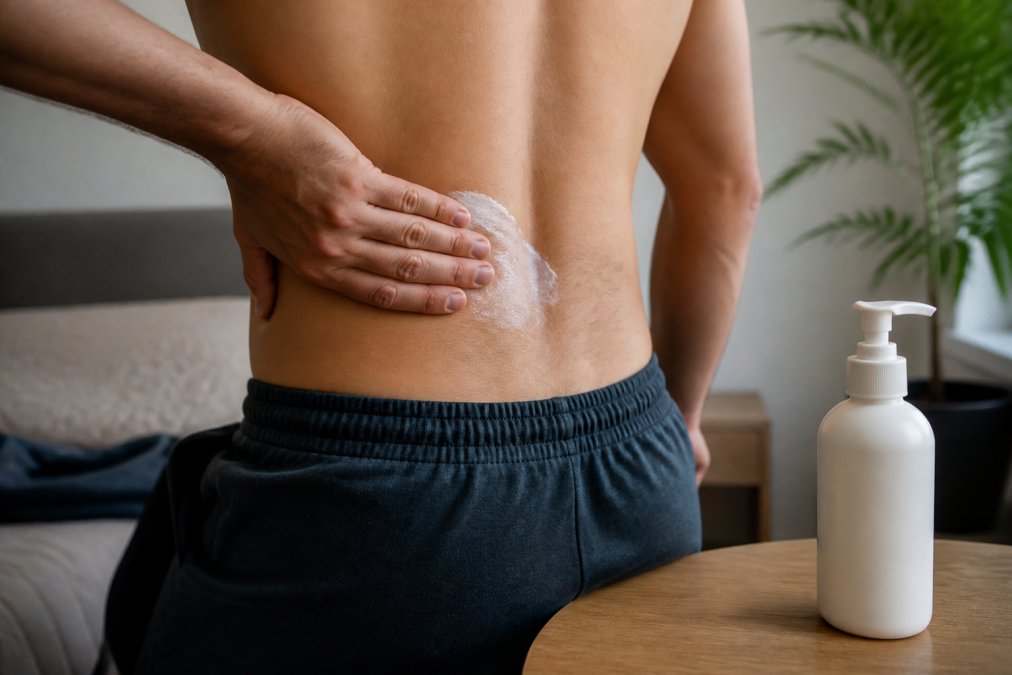
Topical CBD for back pain depends on getting the product onto the right tissue. Cannabinoids applied to skin act locally, so a lotion rubbed on your shoulder will not help a facet joint in your lumbar spine. The lower back is a large surface area with several distinct pain sources, and where you apply matters as much as what you apply.
Third-Party Lab Report Literacy: Reading a COA Like a Pro
A certificate of analysis is a lab report showing what is actually in the bottle, and it is the fastest way to separate a serious brand from a marketing page. Look for the batch number matching your product, the testing lab's name, and a date within the last year.
Four things to check on any COA:
CBD + CBC Relief Lotion 2000mg →
- Cannabinoid profile: Does the CBD and CBC content match the label claim?
- Pesticides and heavy metals: Should read "not detected" or below reporting limits
- Microbials: Yeast, mold, and bacteria results should pass
- Solvents: Residual solvent testing matters for any extracted product
USDA organic certification program information
CBD and Common Back Pain Medications: What to Know
Most chronic back pain routines are not one drug, they are a stack: typically an over-the-counter NSAID, a prescription muscle relaxant, and sometimes an opioid for flare-ups. Adding any cannabinoid product to that stack deserves more than a generic "talk to your doctor" line, so here is the class-by-class picture.
Why the Liver Enzyme Pathway Matters
The interaction concern with CBD centers on the cytochrome P450 enzyme family, particularly CYP3A4 and CYP2C19. Oral CBD can inhibit or compete with these enzymes, changing how quickly the liver clears certain drugs. Slower clearance means higher blood levels of the other drug than expected, which is where side-effect risk comes from.
NSAIDs (Ibuprofen, Naproxen, Diclofenac)
NSAIDs are metabolized through several pathways, and the overlap with CBD's enzyme activity is generally considered low. Most people using a topical CBD product alongside an occasional NSAID are unlikely to see a meaningful interaction. The bigger practical issue is additive stomach irritation if you are already a heavy NSAID user, worth tracking in your log.
Muscle Relaxants (Cyclobenzaprine, Baclofen, Tizanidine)
This is where caution rises. Cyclobenzaprine is metabolized through CYP3A4 and CYP1A2, and sedation is its most common side effect. Adding an oral CBD product to a muscle relaxant can produce more sedation than either alone. Topical use is lower risk, but if you apply a high-potency product over a large area twice daily, mention it to your prescriber.
Opioids (Hydrocodone, Oxycodone, Tramadol)
This class warrants the most explicit conversation with your prescriber. Opioids are metabolized through CYP3A4 and CYP2D6, and CBD's effect on those enzymes can change how much active drug stays in your system. Tramadol is a particular case because it requires CYP2D6 conversion to its active metabolite, anything altering that conversion can change both pain relief and side-effect profile.
Blood Thinners and Seizure Medications
Warfarin and clopidogrel are both metabolized through pathways CBD can influence, and CBD is an FDA-approved adjunct for certain seizure disorders, so interaction data with anti-epileptics is more developed than for most classes. If you are on either category, treat this as a pharmacist conversation before applying anything.
A Practical Disclosure Checklist
Before adding any high-potency CBD product to a back pain routine, have these four facts ready:
- The full list of current medications, including over-the-counter NSAIDs you take regularly.
- Whether the CBD product is topical or oral, and the milligrams per application.
- How often you apply it and over what surface area.
- Any new side effects, drowsiness, dizziness, unusual bruising, since you started.
FDA consumer guidance on cannabis-derived products
Choosing a High Potency CBD Product That Fits Your Routine
The best product is the one you will actually use twice a day for a month. A high-potency formula only helps if the texture, scent, and application time fit your routine, if a lotion feels greasy, you will stop reaching for it within a week.
| Product | CBD + CBC | Size | Best For | Price |
|---|---|---|---|---|
| CBD + CBC Relief Lotion 2000mg | 2000mg blend | 3.3 oz | Daily chronic back pain | $69.99 |
| CBD Relief Lotion 500mg | 500mg CBD | 3.3 oz | Mild soreness, maintenance | $39.99 |
Frequently Asked Questions
What type of CBD is best for back pain?
For chronic back pain, a high potency CBD product that includes CBC (cannabichromene) may offer more targeted support. Full-spectrum or broad-spectrum extracts retain terpenes and minor cannabinoids that work together, while topicals deliver cannabinoids directly to the painful area. Look for third-party lab reports to confirm potency and purity. A 2000mg CBD/CBC lotion is an example of a high potency topical option.
How much CBD should I use for severe back pain?
Start with a low dose and increase gradually, a process called titration. For a high potency topical like a 2000mg CBD/CBC lotion, begin with a pea-sized amount applied to the painful area once or twice daily. If you feel no change after a week, add a second application. Oral doses vary widely, from 10mg to 50mg or more per day, but topicals are not absorbed systemically the same way. Track your response and adjust slowly.
What is the difference between CBD and CBC for pain relief?
CBD and CBC are both hemp-derived cannabinoids, but they interact with the body differently. CBD is widely studied for its anti-inflammatory properties and its effect on the endocannabinoid system. CBC shows promise for enhancing the body's natural endocannabinoid levels, which may extend pain relief. When combined, as in a CBD/CBC blend, they may create an entourage effect that supports longer-lasting comfort than CBD alone.
Are there FDA-approved CBD products for back pain?
No FDA-approved CBD products are specifically indicated for back pain. The FDA has approved one CBD-based prescription drug for certain seizure disorders, but it is not intended for pain. Many CBD topicals and oils are sold as dietary supplements or cosmetics, which are not FDA-approved for treating pain. Always check third-party certificates of analysis (COAs) for potency, purity, and to confirm the product is free of contaminants like heavy metals or pesticides.
