

CBD vs NSAIDs for Muscle Soreness: Efficacy & Safety
Table of Contents
- Understanding Muscle Soreness: DOMS and Inflammation
- How NSAIDs Work for Pain and Inflammation
- CBD vs NSAIDs for Muscle Soreness: Mechanism and Action
- Efficacy Comparison: Clinical Evidence and Results
- NSAIDs Side Effects Long Term: Risks and Considerations
- Topical CBD for Muscle Pain: Bioavailability and Absorption
- CBD Dosage for Muscle Soreness: Protocols for Athletes
- Best CBD for Athletes: What to Look For
CBD vs NSAIDs for Muscle Soreness: Efficacy & Safety
Last Updated: July 19, 2026
When athletes experience muscle soreness, they choose between traditional pain relief and emerging alternatives. The debate between CBD vs NSAIDs for muscle soreness has intensified as people seek options beyond conventional pharmaceuticals. At Railroad Remedies (RXR), we've analyzed how these approaches compare across efficacy, safety, and real-world application. NSAIDs like ibuprofen operate through a well-established pharmaceutical pathway, while CBD interacts with your body's endocannabinoid system differently. Understanding these differences directly affects whether a treatment will work for your specific soreness.
Understanding Muscle Soreness: DOMS and Inflammation
Delayed-onset muscle soreness (DOMS) peaks 24-72 hours after intense exercise and stems from microscopic muscle fiber tears combined with inflammatory response. Your immune system floods the affected area with inflammatory mediators, cytokines, and prostaglandins that trigger pain signals and stiffness. This inflammation is part of healing, but it also makes movement painful.
The inflammatory cascade involves macrophages and neutrophils migrating to damaged tissue, fluid accumulation in the muscle compartment, and sensitized nerve endings. This process is necessary for repair but can extend recovery time.
Traditional approaches include rest, ice, compression, and elevation (RICE), though recent guidance emphasizes active recovery. Pain relievers reduce inflammatory signals without requiring complete immobilization. The choice between NSAIDs and CBD reflects different philosophies about managing that inflammatory response.
How NSAIDs Work for Pain and Inflammation
NSAIDs like ibuprofen (Advil, Motrin) and naproxen (Aleve) reduce pain by inhibiting cyclooxygenase (COX) enzymes, which produce prostaglandins, signaling molecules that amplify inflammation and pain. Ibuprofen typically begins working within 30-60 minutes. Naproxen, with a longer half-life, lasts 8-12 hours per dose. Topical versions like Voltaren (diclofenac) deliver localized relief with lower systemic exposure.
However, NSAIDs carry documented risks with long-term use. Chronic consumption increases risk of gastrointestinal ulcers, cardiovascular events, and kidney damage. The stomach lining produces protective prostaglandins, and NSAIDs suppress those too. For occasional post-workout use, NSAIDs are generally safe. For daily use over weeks or months, the risk-benefit calculation shifts significantly.
Topical NSAIDs reduce systemic absorption compared to oral forms, minimizing gastrointestinal exposure while delivering anti-inflammatory benefit to the affected area.
CBD vs NSAIDs for Muscle Soreness: Mechanism and Action
NSAIDs block prostaglandin production directly. CBD doesn't suppress prostaglandins; instead, it modulates pain perception and inflammatory signaling through the endocannabinoid system and other receptor networks.
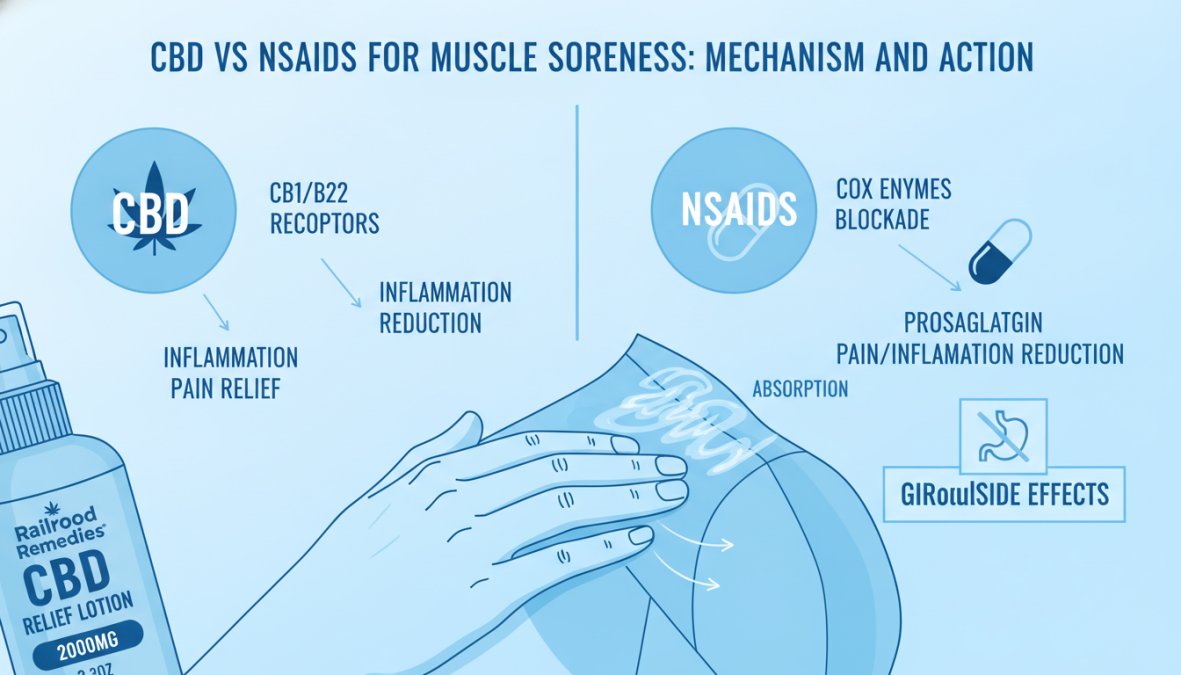
CBD binds to CB1 and CB2 cannabinoid receptors distributed throughout the nervous system and immune cells. Activation reduces pro-inflammatory cytokine release and suppresses pain signal transmission in the spinal cord and brain. Unlike NSAIDs, which work through a single mechanism, CBD engages multiple pain-modulation pathways simultaneously.
Research demonstrates that CBD reduces TNF-alpha and IL-6, two major inflammatory cytokines. However, most human studies have focused on chronic pain conditions like arthritis rather than acute DOMS.
How CBD Interacts with the Endocannabinoid System
Your endocannabinoid system (ECS) is a signaling network present in nearly every tissue, including muscle, immune cells, and the nervous system. The ECS regulates pain perception, immune response, and tissue repair. When you experience muscle damage, your ECS activates to modulate the inflammatory response and pain signals.
CBD acts as a negative allosteric modulator, changing the shape of cannabinoid receptors so that endogenous cannabinoids bind more effectively. This indirect mechanism is why CBD doesn't produce the psychoactive effects of THC.
Additionally, CBD interacts with serotonin receptors (5-HT1A) and vanilloid receptors (TRPV1). The TRPV1 receptor is involved in detecting temperature and pain, and CBD's activation may contribute to pain relief through a cooling sensation similar to menthol.
Oral CBD takes 1-2 hours to reach peak concentration, while topical CBD penetrates skin slowly, with effects building over 15-30 minutes. This delayed onset makes CBD less suitable for immediate acute pain but may offer sustained relief over hours.
Efficacy Comparison: Clinical Evidence and Results
The evidence base is asymmetrical. NSAIDs have decades of clinical trials demonstrating effectiveness for muscle soreness. CBD's evidence is emerging but limited specifically for acute DOMS.
Systematic reviews found that NSAIDs consistently reduce pain intensity by 30-50% in acute pain scenarios. For muscle soreness, ibuprofen at standard doses (400-600mg) reduces perceived soreness by roughly 40-50% compared to placebo when taken within 2 hours of exercise.
CBD's efficacy for muscle soreness remains understudied. Most human trials focus on chronic pain and arthritis, where CBD shows modest benefits. A 2024 study found that CBD reduced chronic pain ratings by approximately 20-30%, lower than typical NSAID effects but still clinically meaningful for some patients.
The gap reflects research funding and regulatory constraints. NSAIDs are well-established pharmaceuticals with clear regulatory pathways. CBD remains federally classified as Schedule I despite growing state-level legalization, making large-scale clinical trials logistically difficult.
Anecdotal evidence from athletes suggests CBD provides meaningful relief, particularly for delayed soreness and recovery-related stiffness. However, the placebo effect accounts for roughly 30-40% of pain relief from any intervention.
NSAIDs Side Effects Long Term: Risks and Considerations
The safety profile of NSAIDs shifts dramatically with chronic consumption. Short-term use for acute soreness carries minimal risk for most people. Long-term daily use introduces genuine health concerns.
Gastrointestinal toxicity is the most common serious side effect. NSAIDs inhibit protective prostaglandins in the stomach lining, increasing ulcer risk. Approximately 1-3% of regular NSAID users develop clinically significant GI complications annually.
Cardiovascular risk increases with chronic NSAID use. Even traditional NSAIDs like ibuprofen increase the risk of heart attack and stroke when used daily for extended periods. Kidney function can deteriorate with long-term use, especially in people with pre-existing renal disease, dehydration, or concurrent use of ACE inhibitors or diuretics.
The risk profile changes based on individual factors:
- Age over 65: significantly higher GI and cardiovascular risk
- History of ulcers or GI bleeding: NSAIDs contraindicated
- Hypertension or cardiovascular disease: NSAIDs increase event risk
- Kidney disease: NSAIDs can worsen renal function
- Concurrent medications: ACE inhibitors, diuretics, anticoagulants increase complications
For these populations, alternatives like topical NSAIDs, acetaminophen, or CBD become more attractive despite less strong efficacy data.
Topical CBD for Muscle Pain: Bioavailability and Absorption
Bioavailability differs dramatically between oral and topical CBD. Oral CBD undergoes first-pass hepatic metabolism, with bioavailability ranging from 6-20%. Topical CBD bypasses the liver and penetrates skin to reach local tissue.
However, topical CBD's penetration depth is limited. The stratum corneum (outer skin layer) acts as a barrier. CBD molecules are lipophilic (fat-loving), which helps them cross the skin but also means they accumulate in skin and subcutaneous fat rather than reaching deep muscle tissue.
For superficial muscle soreness affecting the trapezius, shoulders, or calves, muscles close to the skin surface, topical CBD can deliver meaningful local concentration. For deep muscle groups like the glutes or hamstrings, topical CBD's penetration may be insufficient.
Railroad Remedies (RXR) addresses this through their CBD/CBC 2000mg Pain Relief Lotion, which combines full-spectrum CBD with Cannabichromene (CBC). CBC is a minor cannabinoid with its own anti-inflammatory properties, and the combination may enhance local effects. The formulation includes organic coconut oil and shea butter, which improve skin penetration and provide additional anti-inflammatory benefit.
Topical CBD works best for localized, superficial soreness. For systemic muscle soreness or deep muscle groups, oral CBD or NSAIDs may be more effective.
CBD Dosage for Muscle Soreness: Protocols for Athletes
Optimal CBD dosing for muscle soreness remains empirically undefined because clinical trials haven't established clear dose-response relationships for this specific indication. Existing research on chronic pain suggests effective doses range from 150-600mg daily, but these involved weeks of consistent use, not acute post-workout administration.
For acute muscle soreness, athletes typically use 50-300mg orally within 2-4 hours of exercise. The wide range reflects individual variability in CBD metabolism.
Topical CBD dosing is less standardized because skin penetration is difficult to measure. Products typically contain 250-2000mg of CBD per container. The amount you apply dramatically affects local concentration.
Individual factors affecting CBD dosing include body weight, metabolism, concurrent medications, and delivery method. Taking CBD 1-2 hours before intense exercise won't prevent DOMS. Taking CBD immediately after exercise or within 2-4 hours may help modulate the initial inflammatory response. Continuing use over the first 48-72 hours of soreness may provide cumulative benefit.
Best CBD for Athletes: What to Look For
When selecting a CBD product for muscle soreness, third-party testing is non-negotiable. It verifies that the product contains the advertised amount of CBD and is free from contaminants like heavy metals, pesticides, and residual solvents.
Look for products that specify CBD content in milligrams per serving. Transparency about sourcing matters; CBD derived from US-grown industrial hemp is generally safer than products from unregulated sources.
Formulation type affects efficacy. Full-spectrum products contain CBD plus other cannabinoids and terpenes. Broad-spectrum products contain cannabinoids and terpenes but with THC removed. Isolate products contain only CBD, offering consistency but potentially missing synergistic benefits.
For topical CBD, the carrier matrix matters as much as the CBD itself. Coconut oil, shea butter, and other emollients improve skin absorption and provide complementary anti-inflammatory effects. Non-greasy, easily absorbed formulations encourage regular application.
The Railroad Remedies (RXR) CBD Relief Lotion (500mg) and CBD/CBC 2000mg Pain Relief Lotion exemplify these principles. Both use full-spectrum cannabinoids, include organic coconut oil and shea butter for absorption, and maintain a non-greasy texture. The 2000mg formula's inclusion of CBC provides potential synergistic benefit beyond CBD alone.
| Factor | What to Look For | Why It Matters |
|---|---|---|
| Third-party testing | Certificate of Analysis (COA) available | Verifies CBD content and absence of contaminants |
| CBD content | Milligrams per serving, clearly labeled | Ensures you know the actual dose |
| Spectrum type | Full-spectrum, broad-spectrum, or isolate | Affects efficacy through entourage effect |
| Carrier ingredients | Coconut oil, shea butter, MCT oil | Improves absorption and skin health |
| Texture | Non-greasy, easily absorbed | Determines whether you'll use it consistently |
| Source | US-grown hemp with clear supply chain | Reduces contamination risk |
| Price point | Premium but reasonable ($40-70 for quality topical) | Reflects actual quality and testing |
The choice between CBD vs NSAIDs for muscle soreness depends on your individual circumstances, risk tolerance, and recovery goals. NSAIDs offer faster, more predictable pain relief backed by extensive clinical evidence, ideal for acute soreness when used occasionally. Chronic NSAID use carries real risks that make alternatives attractive for long-term pain management or for people with contraindications. CBD shows promise for sustained relief and carries a favorable safety profile, though the evidence base remains smaller. Many athletes benefit from a strategic combination: NSAIDs for immediate post-workout relief, then topical CBD like Railroad Remedies (RXR)'s formulations for sustained comfort over the following days. Start with whichever approach aligns with your current needs, monitor your response, and adjust based on real results rather than marketing claims.
Frequently Asked Questions
Is CBD better than ibuprofen for muscle pain?
CBD and ibuprofen work through different mechanisms. NSAIDs like ibuprofen directly inhibit inflammation by blocking prostaglandins, while CBD interacts with the endocannabinoid system. Clinical evidence for CBD's efficacy in muscle soreness remains limited compared to NSAIDs. The choice depends on your pain type, sensitivity to NSAID side effects, and preference for topical versus systemic relief. For acute muscle soreness, NSAIDs have stronger established efficacy; CBD may be preferable for those seeking alternatives due to gastrointestinal concerns.
Can you take CBD and NSAIDs together for muscle soreness?
Taking CBD and NSAIDs together is generally considered safe, as they don't significantly interact at typical doses. However, combining them hasn't been extensively studied in clinical trials. Both affect inflammation through different pathways, so combining them theoretically could enhance relief, but this benefit remains unproven. Consult your healthcare provider before combining, especially if you're on other medications. Starting with one option and evaluating results over 1-2 weeks is often more practical than combining both initially.
What are the main differences between topical CBD and oral NSAIDs?
Topical CBD lotions provide localized relief without entering the bloodstream, reducing systemic side effects but potentially limiting bioavailability. Oral NSAIDs like ibuprofen and naproxen enter the bloodstream for systemic relief, offering faster onset but higher risk of gastrointestinal distress and liver enzyme elevation with long-term use. Topical options (including CBD and NSAIDs like Voltaren) minimize systemic exposure. For targeted muscle soreness, topicals are convenient; for widespread DOMS or acute injury, oral medications may provide faster systemic relief.
How much CBD dosage should athletes use for muscle soreness?
Athlete-specific CBD dosage protocols vary widely because research is limited. Most topical CBD products range from 500mg to 2000mg per container. For localized muscle soreness, applying topical CBD directly to the affected area allows you to control dosage through application frequency and product strength. Railroad Remedies offers 500mg and 2000mg formulations; the 2000mg CBD/CBC blend provides enhanced anti-inflammatory support. Start with lower concentrations and increase based on response. Oral CBD for athletes typically ranges 10-50mg daily, but this requires consultation with a healthcare provider.
Are topical CBD products effective for muscle soreness compared to NSAIDs?
Topical CBD effectiveness for muscle soreness shows promise but lacks the extensive clinical validation of topical NSAIDs like diclofenac. CBD's anti-inflammatory and analgesic properties are theoretically beneficial for DOMS, but placebo-controlled trials remain limited. Topical NSAIDs penetrate tissue effectively with proven efficacy. CBD lotions offer advantages: fewer systemic side effects, organic formulations with skin-nourishing ingredients like coconut oil and shea butter, and suitability for those sensitive to NSAIDs. For best results, choose based on your skin sensitivity, preference for natural ingredients, and prior response to similar products.
This article was written using GrandRanker
