

CBD Topicals for Psoriatic Arthritis Pain: What Works
Table of Contents
- Understanding Psoriatic Arthritis and CBD Topicals
- Benefits of CBC for Inflammation
- How to Apply CBD Lotion for Joint Pain
- Is CBD Safe for Sensitive Skin?
- Choosing a Quality CBD Topical for Psoriatic Arthritis
- Integrating CBD Topicals into Your Psoriatic Arthritis Management Plan
- Frequently Asked Questions
Last Updated: September 15, 2026
Understanding Psoriatic Arthritis and CBD Topicals
Psoriatic arthritis is a chronic inflammatory condition that causes joint pain, stiffness, and swelling alongside the scaly skin plaques of psoriasis (Psoriasis). CBD topicals for psoriatic arthritis pain have moved from fringe curiosity to a genuinely common question in rheumatology waiting rooms, and for good reason: many patients want relief without adding another systemic drug to an already full regimen.
Here's the honest framing. CBD, or cannabidiol, is a hemp-derived compound that interacts with your body's endocannabinoid system, a network of receptors involved in regulating inflammation and pain signaling. That interaction is why researchers study cannabinoid receptors for anti-inflammatory and analgesic properties. What it is not is a cure, and no topical will replace the biologics or disease-modifying drugs your rheumatologist prescribes.
This guide covers what the current evidence actually supports, how to apply topicals correctly, and how to spot a product worth your money.
Benefits of CBC for Inflammation
Cannabichromene, or CBC, is a lesser-known hemp cannabinoid that early research links to anti-inflammatory activity through pathways distinct from CBD. Preclinical studies suggest CBC may interact with cannabinoid receptors and other targets involved in inflammation, which is why formulators pair it with CBD rather than treating it as a substitute.
The practical case for CBC is synergy. That mirrors the broader industry shift toward full-spectrum and broad-spectrum formulas, where multiple cannabinoids work together instead of an isolated compound.
One caveat worth stating plainly: human clinical trials on CBC specifically remain limited. Most of what we know comes from preclinical work and anecdotal reports, so treat CBC as a promising addition, not a proven pharmaceutical.
How to Apply CBD Lotion for Joint Pain
Applying CBD lotion correctly matters as much as what's in the bottle. Most people use too little, apply it to the wrong layer of skin, or give up before it has a chance to work. But with psoriatic arthritis, there's a complication most guides skip: you're treating two different problems on the same body, inflamed joints beneath the skin and psoriatic plaques on top of it, and they need two different techniques.
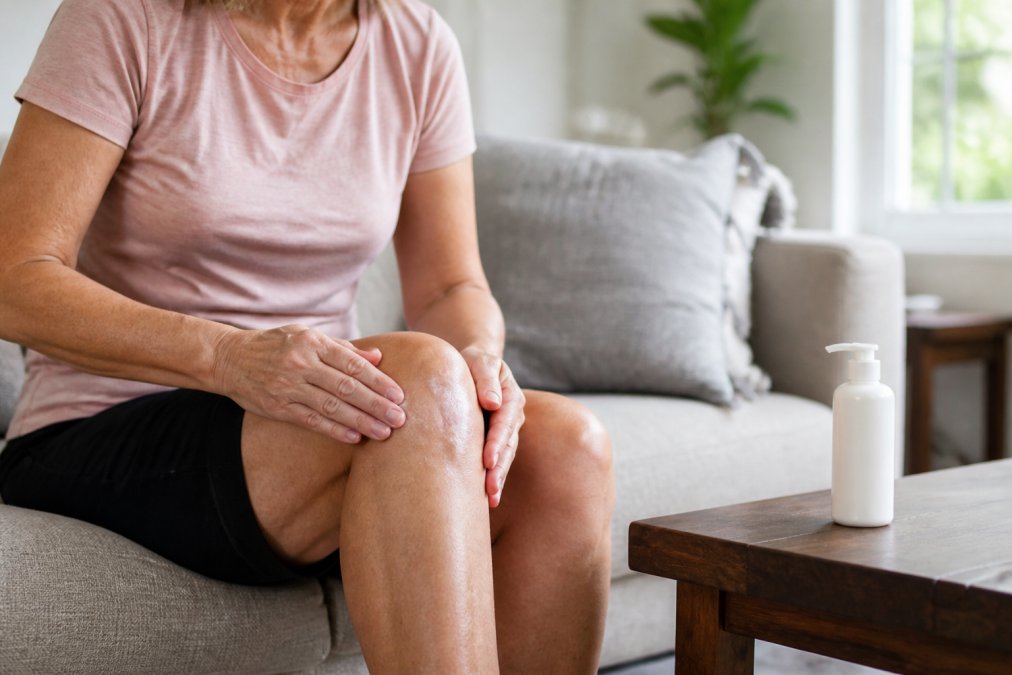
For deep joint pain
Joint pain sits below the dermis, so the goal is to drive cannabinoids as far into the tissue as a topical can reasonably go while increasing local circulation.
- Cleanse and dry the area. Lotions absorb poorly over dead skin or residue from other creams.
- Warm a small amount between your fingers. A pea-sized dose per joint is a reasonable starting point.
- Massage it in for 60 to 90 seconds. Friction improves absorption and loosens stiff tissue. Work in small circles over the joint line, then outward along the surrounding muscle.
- Apply to joints and surrounding muscle, not just the sore spot. Referred pain is common, knee pain often traces to the quadriceps, and hand pain to the forearm.
- Wait 20 to 30 minutes and reassess. Topicals build effect gradually; don't reapply immediately.
For joints, apply after a warm shower when pores are open and circulation is up. A heating pad over the area for 10 minutes before application can help too, but never combine heat with a topical that contains menthol or capsaicin, since the combination can burn.
For psoriatic plaques
The technique changes completely. Plaques are thickened, inflamed skin with a compromised barrier, and they absorb, and react, differently than healthy skin.
- Apply to clean, fully dry skin. Moisture traps product against the plaque and increases irritation.
- Use a lighter touch. Dab and press rather than rub. Scrubbing a plaque can trigger the Koebner phenomenon, where trauma to psoriatic skin causes a new lesion to form.
- Start with a smaller dose than you would on a joint. Plaque skin is more permeable, so less product goes further.
- Never apply to broken, cracked, or bleeding skin. Open plaques are an infection risk and a fast track to stinging.
- Let it absorb fully before dressing. Occluding a fresh plaque under clothing or a bandage can worsen irritation.
Sequencing when you have both
If a joint and a plaque overlap, common on knees, elbows, and knuckles, treat the plaque first with a gentle dab, let it dry, then work the joint line around the plaque rather than through it. Keep the two applications at least 15 minutes apart so you can tell which one is causing a reaction if one occurs.
Is CBD Safe for Sensitive Skin?
For most people, CBD topicals are well tolerated, and the most common adverse effects are mild irritation or redness at the application site. That matters if your skin is already compromised by psoriasis or radiation therapy.
A few things to watch:
- Fragrance and preservatives cause more reactions than CBD itself. Check the inactive ingredients.
- Patch test first. Apply a small amount to your inner forearm and wait 24 hours.
- Drug-drug interactions are less of a concern with topicals than with oral CBD, because systemic absorption through skin is limited. Still, tell your rheumatologist what you're using.
- Don't layer over prescription topical steroids without asking your dermatologist, since both affect the same skin.
If you have highly reactive skin, choose a formula built on organic oils like coconut, shea, or jojoba rather than one loaded with synthetic thickeners. Simpler ingredient lists are easier to tolerate.
Choosing a Quality CBD Topical for Psoriatic Arthritis
The market is crowded with products that make big claims and disclose almost nothing. A quality CBD topical for psoriatic arthritis pain has to pass two tests most guides ignore: it must actually help joint pain, and it must not irritate skin that's already inflamed. Those goals sometimes pull in opposite directions.
Here's what separates a real product from marketing:
| What to Check | What Good Looks Like | Why It Matters |
|---|---|---|
| Certificate of analysis | Batch-specific, third-party lab | Confirms actual CBD/CBC content |
| Base ingredients | Organic oils, no harsh fillers | Tolerable on sensitive or psoriatic skin |
| Cannabinoid profile | Full-spectrum or CBD/CBC blend | Broader therapeutic potential |
| Secondary actives | Menthol, camphor, or capsaicin, chosen deliberately | Drives the pain-relief effect, but can irritate plaques |
| Texture | Non-greasy, absorbs fully | You'll actually use it daily |
| Label accuracy | Matches the COA | Protects you from underdosed products |
Ingredient synergy: what actually helps, and what irritates
- Menthol creates a cooling sensation that distracts from pain signaling and can temporarily reduce the perception of stiffness. It's generally well tolerated on intact skin but can sting on active plaques.
- Camphor produces a similar cooling-then-warming effect and is common in arthritis rubs. It's more likely than menthol to cause irritation on compromised skin.
- Capsaicin depletes substance P, a pain-signaling compound, and has the strongest evidence base of any topical counterirritant for arthritis pain. It also causes a burning sensation that many psoriatic users can't tolerate on plaques. If you try it, start with the lowest concentration available and keep it strictly off lesions.
- Arnica, MSM, and glucosamine appear frequently in arthritis topicals. Evidence for topical absorption and meaningful joint effect is thin, so treat them as supporting ingredients rather than the reason to buy.
- Essential oils and fragrance are the most common cause of contact dermatitis in this category. If your skin is reactive, choose a fragrance-free formula.
Third-Party Testing and Certificate of Analysis
Integrating CBD Topicals into Your Psoriatic Arthritis Management Plan
Frequently Asked Questions
Does CBD work for psoriatic arthritis?
Research on CBD for psoriatic arthritis is limited, but early studies suggest cannabinoids may help reduce inflammation and pain. CBD interacts with the endocannabinoid system, which plays a role in immune response and pain signaling. Some people report relief when using CBD topicals for psoriatic arthritis pain, but clinical trials are needed. Always consult your rheumatologist before adding CBD to your treatment plan.
How often should you apply CBD topicals for joint discomfort?
There's no standard dosage for CBD topicals. Many users apply a thin layer to affected joints two to three times daily, adjusting based on relief. Start with once daily and increase if needed. For psoriatic arthritis, avoid applying to broken skin. Consistency matters more than quantity. Track your symptoms to find what works for you, and discuss with your doctor.
Is it safe to use CBD topicals alongside traditional psoriatic arthritis treatments?
Topical CBD is generally considered safe when used with biologics, topical steroids, or NSAIDs, but interactions are possible. CBD can affect how the liver processes certain drugs, though this is less likely with topicals due to low systemic absorption. Always inform your rheumatologist about any CBD product you use, especially if you take methotrexate or other DMARDs.
What should I look for in a CBD topical for arthritis?
Look for third-party lab testing (certificate of analysis), full-spectrum or broad-spectrum CBD, and organic ingredients. For arthritis, consider products with additional cannabinoids like CBC, which may enhance anti-inflammatory effects. Avoid products with synthetic fragrances or harsh preservatives. A non-greasy, easily absorbed formula is ideal for daily use on joints and sensitive skin.
Managing psoriatic arthritis means stacking small wins, and a well-formulated topical can be one of them. Railroad Remedies (RXR) builds lotions around organic ingredients, a non-greasy texture you'll actually use daily, and a CBD/CBC blend designed for real joint discomfort. Explore the full lineup and find the formula that fits your routine.
