

CBD Pain Relief Ingredients Explained for 2026
Table of Contents
- How CBD and CBC Interact With Your Body's Pain Signals
- The Benefits of CBC in Pain Relief: What This Lesser-Known Cannabinoid Does
- CBD Topical Absorption Science: Why Your Cream Might Not Be Working
- Common Ingredients in CBD Pain Relief Topicals (And What They Actually Do)
- How to Read CBD Product Labels for Pain Relief
- Full-Spectrum vs. Broad-Spectrum vs. Isolate: Which Form Works Best for Pain
- Safety, Side Effects, and Drug Interactions to Know Before You Buy
- Frequently Asked Questions
Last Updated: September 21, 2026
How CBD and CBC Interact With Your Body's Pain Signals
CBD pain relief ingredients explained starts with one fact most labels never tell you: cannabinoids don't block pain the way an NSAID does. They interact with your endocannabinoid system, a signaling network that helps regulate inflammation, nerve sensitivity, and how your brain perceives discomfort. This guide from Railroad Remedies (RXR) breaks down what's actually in your topical, why some creams underperform, and how to spot a formula worth buying.
The Endocannabinoid System and Cannabinoid Receptors
The endocannabinoid system is a body-wide signaling network of receptors (CB1 and CB2) that helps regulate inflammation, pain perception, and immune response. Cannabidiol and other hemp-derived cannabinoids interact with these receptors indirectly, influencing how strongly pain signals fire. According to a review of cannabinoid pharmacology in the British Journal of Pharmacology, these interactions are one reason researchers describe cannabinoids as modulators rather than blockers.
Why Topicals Work Differently Than Ingestibles
A topical delivers cannabinoids through the skin near the source of discomfort, while an ingestible travels through your digestive system and liver first. That difference matters because the liver breaks down a large share of oral cannabinoids before they reach circulation, which is why edible doses are typically much higher than topical concentrations. Topicals act locally with far less systemic exposure.
The Benefits of CBC in Pain Relief: What This Lesser-Known Cannabinoid Does
Cannabichromene, or CBC, is a hemp cannabinoid studied for its interaction with pain and inflammation pathways, and it works alongside CBD rather than replacing it. Research summarized by a cannabinoid review in the journal Molecules points to CBC's activity at TRPV1 and other receptors involved in pain signaling. That receptor profile is why formulators pair CBC with CBD: the two target overlapping but distinct pathways.
CBD Topical Absorption Science: Why Your Cream Might Not Be Working
CBD topical absorption science explains why two creams with identical milligram labels can perform completely differently. A cannabinoid has to cross the skin's outer barrier, the stratum corneum, to reach the tissue underneath, and most of it won't without help. The formula around the cannabinoid, not the cannabinoid itself, decides how much gets through. A cream that sits on top of your skin and feels greasy is often a cream that never absorbed.
The Three Routes Into (and Around) Your Skin
Not every product marketed as a "topical" behaves the same way. There are three distinct delivery routes, and they produce very different results:
- Surface topical: The cannabinoid stays in the upper layers of skin and acts on local nerve endings and receptors. Good for surface-level discomfort, muscle soreness, and joint-adjacent application. Most lotions and salves fall here.
- Transdermal: The formula is engineered to carry cannabinoids through the skin and into underlying tissue and, in some cases, the bloodstream. Transdermal patches and some gels are designed for this. Delivery is slower and steadier, and effects can last longer.
- Oral (ingestible): The cannabinoid passes through the digestive system and liver before reaching circulation. First-pass metabolism removes a large share of the dose, which is why edible milligram counts are typically far higher than topical counts for a comparable effect.
Bioavailability by Delivery Method
Bioavailability is the share of a dose that actually reaches its target. Oral products lose a large fraction to first-pass liver metabolism, while topicals avoid that route entirely and act where they're applied. Transdermal formulations aim for deeper, steadier delivery. This is why the same cannabinoid can feel completely different depending on the format, and why "more milligrams" is not the same as "more absorbed."
Penetration Enhancers and Carrier Systems That Actually Move Cannabinoids
This is the part most ingredient guides skip. Getting a cannabinoid past the stratum corneum usually requires one of a few well-known formulation strategies:
- Terpenes as penetration enhancers. Terpenes like d-limonene and beta-caryophyllene are not just aroma compounds. In topical formulations they can act as penetration enhancers, temporarily loosening the lipid packing in the skin barrier so other molecules move through more easily. This is one reason full-spectrum and broad-spectrum formulas can outperform isolate in a topical, even at the same CBD milligram count.
- Occlusives and emollients. Shea butter, coconut oil, and similar emollients slow water loss and keep the formula in contact with skin long enough to absorb instead of evaporating. They don't push cannabinoids through the barrier, but they buy the formula time to work.
- Humectants and barrier support. Hyaluronic acid and allantoin hold moisture in the skin and support barrier repair. A compromised barrier absorbs unpredictably, so keeping skin healthy is part of consistent delivery.
- Alcohol and glycol carriers. Some fast-drying gels use alcohol or glycols to carry cannabinoids and evaporate quickly. They feel lighter but can be drying, which matters if you're applying several times a day.
Why Ingredient Synergy Matters Beyond the Entourage Effect
Common Ingredients in CBD Pain Relief Topicals (And What They Actually Do)
Menthol, camphor, capsaicin, and carrier oils each do a distinct job, and a good formula uses them deliberately. Menthol creates a cooling sensation that distracts from pain signaling. Camphor produces mild warming and a local numbing effect. Capsaicin, the compound behind chili heat, gradually reduces substance P, a neurotransmitter tied to pain transmission, though it can sting for the first several applications.
Menthol, Capsaicin, and Camphor: The Cooling and Warming Agents
These three are counterirritants: they create a competing sensation that your nervous system registers instead of pain. Menthol and camphor are fast-acting and short-lived. Capsaicin builds up over days and needs consistent use. If you have sensitive or radiation-irritated skin, cooling agents are usually gentler than warming ones, and fragrance-free formulas reduce the chance of a reaction.
Carrier Oils and Moisturizers That Improve Absorption
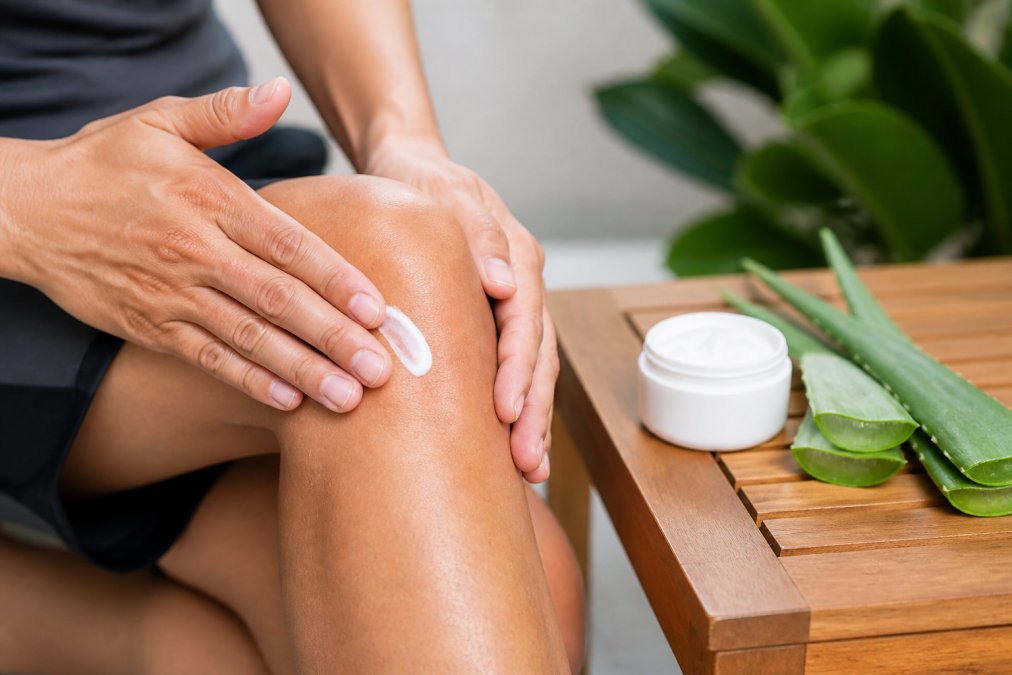
Carrier oils do more than feel nice. Jojoba and coconut oil spread cannabinoids evenly, while shea butter and hyaluronic acid hold moisture in the skin and support barrier repair. Emollients keep the formula workable long enough to absorb instead of evaporating. The Railroad Remedies (RXR) lotion pairs kukui and coconut oil with shea butter and allantoin, a combination built for absorption and skin comfort rather than a greasy after-feel.
CBD + CBC Relief Lotion 2000mg →
How to Read CBD Product Labels for Pain Relief
Learning how to read CBD product labels is the single fastest way to separate a real formula from marketing. Four numbers matter: total cannabinoid content, serving or application size, extraction type, and batch test results. Everything else on the label is decoration.
- Total cannabinoids, not just CBD: CBC, CBG, and other minor cannabinoids count toward the formula's effect. A label that lists only "CBD" is telling you less than one that breaks out the full cannabinoid profile.
- Milligrams per container vs. per application: a 2000mg jar and a 500mg jar aren't comparable without knowing how much you apply. Divide total milligrams by the number of applications you realistically get from the container to compare cost-per-use.
- Extraction type: full-spectrum, broad-spectrum, or isolate, each with different trade-offs. This determines whether terpenes and minor cannabinoids are present at all.
- Batch or lot number: without one, a certificate of analysis can't be matched to your bottle. No batch number means no way to verify what's actually in the jar you bought.
Third-Party Testing and Certificates of Analysis
A certificate of analysis (COA) is an independent lab report showing the cannabinoid profile and screening for pesticides, heavy metals, and residual solvents. Ask for the batch number, then confirm the COA matches your bottle rather than a generic sample. This is the transparency step most brands skip, and it is the one that tells you whether the label is accurate.
How to Actually Read a COA for Ingredient Verification
Most guides tell you to "look for a COA" and stop there. Here is what to check once you have one:
- Match the batch number. The lot number on the COA must match the lot number printed on your container. A COA for a different batch tells you nothing about your product.
- Check the cannabinoid profile, not just total CBD. A well-run COA lists CBD, CBC, CBG, CBDA, and trace THC separately. If the label claims CBC but the COA shows only CBD, the formula doesn't match the marketing.
- Look at the testing lab's name and accreditation. The COA should name the lab that ran the test. Independent labs with published methods are the standard; an in-house "lab report" from the brand itself is not third-party testing.
- Confirm the contaminant panel. A complete COA screens for pesticides, heavy metals, residual solvents, and microbials. If any of those panels are missing, the report is partial.
- Check the date. Cannabinoid content drifts over time. A COA from two years ago doesn't describe the bottle in your hand today.
- Compare the COA's milligram total to the label claim. If the label says 2000mg and the COA totals 1400mg, the label is overstated. This is the single most common discrepancy.
A Quick Label Audit You Can Do in the Store
Before you buy, run this 60-second check: find the batch number, scan or search for the COA, confirm the lot matches, confirm the cannabinoid profile matches the label, and confirm the contaminant panels are present. If any step fails, the product fails. This is the difference between buying an ingredient list and buying a verified formula.
Full-Spectrum vs. Broad-Spectrum vs. Isolate: Which Form Works Best for Pain
There's no universal winner here, and anyone who tells you otherwise is selling something. Full-spectrum keeps all the plant's cannabinoids, terpenes, and flavonoids, including trace tetrahydrocannabinol, the compound responsible for psychoactive effects. Broad-spectrum removes THC while keeping the rest of the profile. Isolate is purified CBD alone. The entourage effect is the theory that these compounds work better together than alone, though research continues to test how large that benefit really is.
| Form | Contains THC | Cannabinoid Range | Best For |
|---|---|---|---|
| Full-spectrum | Yes (trace) | Broadest | Users wanting whole-plant compounds |
| Broad-spectrum | No | Wide | THC-sensitive users |
| Isolate | No | CBD only | Anyone avoiding all other cannabinoids |
Safety, Side Effects, and Drug Interactions to Know Before You Buy
Topical cannabinoids are generally well tolerated, but "natural" is not the same as "risk-free." The most common complaints are skin irritation from menthol, camphor, or fragrance, plus drowsiness if you apply a large amount over broken skin. CBD can interact with medications processed by certain liver enzymes, including some blood thinners and seizure drugs, so check with your pharmacist if you take prescription medication.
Frequently Asked Questions
Which form of CBD is best for pain relief?
Broad-spectrum and full-spectrum topicals tend to work best for localized pain because they retain terpenes, flavonoids, and minor cannabinoids like CBC that support the entourage effect. Isolates contain only CBD and miss those supporting compounds. For joint or muscle pain, a lotion with both CBD and CBC applied directly to the area gives you targeted relief without the greasy residue of heavier balms. Look for third-party testing to confirm potency.
What is the difference between CBD and CBC in pain relief products?
CBD (cannabidiol) interacts with cannabinoid receptors to modulate pain signaling and inflammation. CBC (cannabichromene) works through different pathways, including TRPV1 and TRPA1 channels, and is studied for its analgesic and anti-inflammatory properties. When combined, CBC extends the overall effect of CBD, creating a steadier, longer-lasting sensation. Products like Railroad Remedies' 2000mg CBD/CBC lotion pair both cannabinoids for that reason.
What should I look for on a CBD product label for pain?
Check four things: total CBD and CBC milligrams per container, the extraction type (broad-spectrum, full-spectrum, or isolate), carrier oils like MCT or jojoba that aid absorption, and a batch-specific certificate of analysis from an independent lab. Avoid products that list 'hemp extract' without specifying cannabinoid content, and skip any label that doesn't disclose THC levels. Transparent labels list every ingredient, not just the active ones.
Does CBD cream work better with natural moisturizers like shea butter?
Yes. Shea butter, coconut oil, and kukui nut oil do more than hydrate. They create an occlusive layer that slows moisture loss and helps cannabinoids stay on the skin longer, which supports absorption through the stratum corneum. A formula that pairs CBD with these carrier oils, like Railroad Remedies' lotions, tends to feel less greasy and absorb faster than petroleum-based alternatives while still delivering cannabinoids to the applied area.
