

CBD Oil vs Lotion for Arthritis: Which Works?
Table of Contents
- How Topical CBD Works for Joint Pain
- CBD Oil vs Lotion for Arthritis: Key Differences
- Systemic vs Localized CBD Relief: What Your Body Actually Feels
- Benefits of CBD/CBC Pain Relief Lotions for Arthritis
- How to Apply CBD Lotion for Joint Pain: Practical Techniques
- Safety, Side Effects, and Medication Interactions
- How to Choose the Right CBD Product for Arthritis
- Frequently Asked Questions
Last Updated: September 16, 2026
How Topical CBD Works for Joint Pain
Topical CBD works for joint pain by binding to cannabinoid receptors in the skin and underlying tissue, where it may help calm localized joint inflammation without sending significant amounts of cannabidiol into the bloodstream. The cannabidiol in a cream or lotion interacts primarily with CB2 receptors, which are involved in pain modulation and immune response, rather than the CB1 receptors concentrated in the brain. That distinction is why a topical application tends to produce localized relief instead of a whole-body effect.
The practical result: you rub it into a sore knee, and the knee is what feels different. The rest of you does not.
This guide from Railroad Remedies (RXR) breaks down how CBD oil vs lotion compares for arthritis, where each one actually goes in your body, and how to apply a topical so it does what you paid for. If you have been cycling through creams that either did nothing or left your hands too greasy to grip a doorknob, the problem is usually the formula and the technique, not the concept.
CBD Oil vs Lotion for Arthritis: Key Differences
The key difference is delivery route: CBD oil is typically taken under the tongue or swallowed for systemic absorption, while CBD lotion is massaged into the skin for localized relief at the joint. One travels through your bloodstream. The other stays roughly where you put it.
| Feature | CBD Oil (Oral) | CBD Lotion (Topical) |
|---|---|---|
| Delivery route | Under tongue or ingested | Massaged into skin |
| Absorption | Systemic, whole-body | Localized, site-specific |
| Onset | Slower, varies by person | Faster at the application site |
| Best for | Widespread or nerve-related discomfort | Specific joints, hands, knees |
| Skin feel | None | Depends on the base formula |
A common mistake is expecting a lotion to behave like an edible. They are different tools for different jobs, and many people get better results using both for different problems.
Systemic vs Localized CBD Relief: What Your Body Actually Feels
Systemic CBD relief affects the whole body after the cannabinoid enters the bloodstream, while localized relief stays concentrated near the application site because the dermal barrier limits how much crosses into circulation. That barrier is not a flaw. It is the entire point of a topical.

Bioavailability, the share of a dose that actually reaches your system, is low for most topicals by design. Skin permeability varies by body region: thinner skin absorbs more readily than the thick, calloused skin over a kneecap. This is why application technique matters more than most guides admit.
If your discomfort is a specific, angry joint, a topical is the more targeted choice. If it is widespread or follows a nerve pathway, a topical alone will likely disappoint you, because it was never built to reach that far.
Benefits of CBD/CBC Pain Relief Lotions for Arthritis
The main benefits of a CBD/CBC pain relief lotion are targeted anti-inflammatory support, deep skin hydration, and relief you can apply exactly where it hurts without swallowing another pill. For people who cannot tolerate long-term NSAID use, that last point carries real weight.

Cannabichromene (CBC) is a lesser-known cannabinoid studied for its own anti-inflammatory and analgesic potential. Formulas that pair CBD with CBC aim for a broader therapeutic effect than CBD alone. Railroad Remedies (RXR) builds this into its 2000mg CBD/CBC blend, which combines both cannabinoids in a non-greasy base of organic coconut oil, shea butter, and kukui nut oil.
The moisturizing side is not decoration. Dry, compromised skin is more sensitive and less comfortable to massage, and a rich base makes the application itself gentler on an inflamed joint.
CBD/CBC 2000mg Pain Relief Lotion 3.3oz →
How to Apply CBD Lotion for Joint Pain: Practical Techniques
Apply a small amount to clean, dry skin and massage it in for 60 to 90 seconds using slow, circular motions that work the product into the joint rather than just across the surface. Rushing this step is the most common reason people feel nothing, and the reason is mechanical, not mystical. Massage increases local blood flow and gently stretches the tissue around the joint, which improves how much of the product settles into the skin and how quickly it gets there.
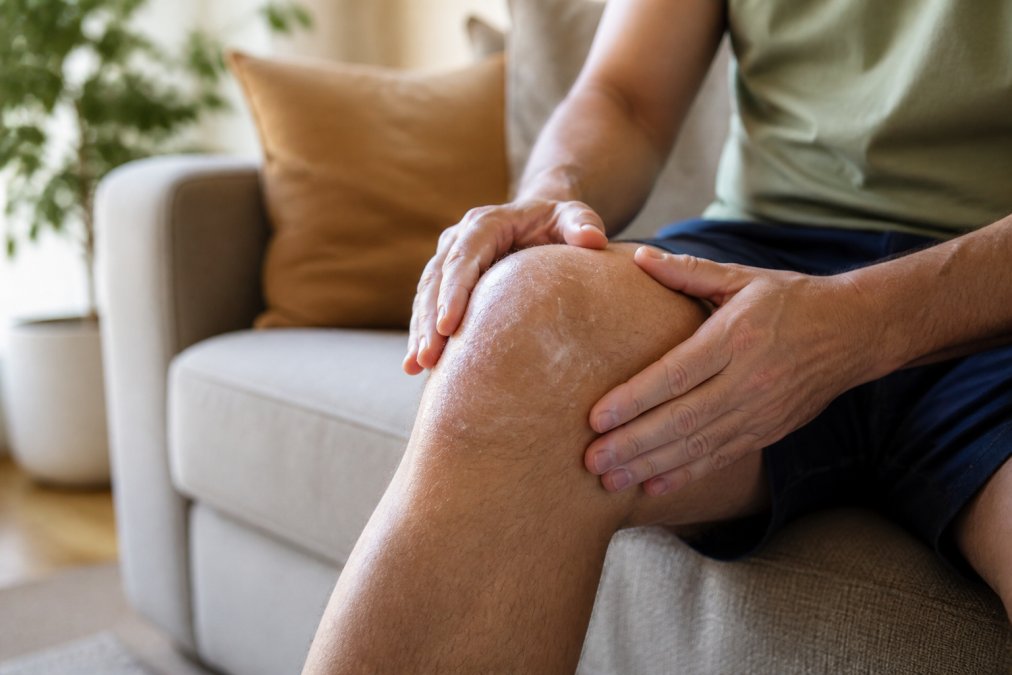
Most guides stop at "rub it in." The joints that hurt most in arthritis, hands, knees, and hips, each need a different approach because the anatomy is different. Here is how to apply for each.
Hands and fingers. Arthritis concentrates at the knuckles (MCP and PIP joints) and at the base of the thumb (the CMC joint).
Techniques that make a measurable difference regardless of joint:
- Warm the product first. Rub it between your palms for a few seconds. Warm lotion spreads more evenly and absorbs faster.
- Work around the joint, not just on it. Massage the surrounding muscle and tissue, where tension often compounds the joint pain.
- Apply after a warm shower. Open pores and hydrated skin improve how the product settles in.
- Reapply at consistent intervals. Most people find two or three applications a day works better than one large dose.
- Wash your hands after, unless your hands are the target. You do not want it migrating to your eyes.
One honest limitation: a topical cannot reach deep nerve pain that runs through the hands and feet, no matter how well you apply it. If that is your primary problem, technique will not fix it, that is a conversation for your doctor.
Safety, Side Effects, and Medication Interactions
- NSAIDs (ibuprofen, naproxen, celecoxib). No well-established direct interaction with topical CBD, but both can affect the liver and stomach lining. If you take NSAIDs daily, mention any cannabinoid product to your pharmacist so they can flag cumulative liver load.
- Methotrexate. This is the one to take seriously. Methotrexate is cleared partly through the same liver pathways, and it already carries liver and blood-count warnings. Adding a cannabinoid that competes for those enzymes is a conversation to have with your rheumatologist before you start, not after.
- Biologics (adalimumab, etanercept, tofacitinib). No direct metabolic interaction is well documented, but these drugs suppress the immune system. If your skin is compromised or you are prone to infections, a patch test becomes more important, not less.
- Blood thinners (warfarin, apixaban, rivaroxaban). Cannabidiol has been reported to affect how warfarin is processed in some case reports. If you are on an anticoagulant, do not add a cannabinoid product without clearing it with the prescriber managing that medication.
- Corticosteroids (prednisone). No major documented interaction, but long-term steroid use thins skin, which can change how a topical absorbs and how it feels. Start with a smaller amount.
How to Choose the Right CBD Product for Arthritis
What to check before you buy:
- Third-party testing and a certificate of analysis. This confirms the product contains what the label claims and is free of contaminants.
- Full-spectrum versus isolate. Full-spectrum products retain additional plant compounds; isolates contain only CBD. Neither is universally better, but full-spectrum is the more common choice for pain-focused formulas.
- Concentration. A higher milligram count suits larger areas or more stubborn joints. A lower count is fine for hands and smaller joints.
- Ingredient synergy. Menthol, capsaicin, and arnica are often paired with cannabinoids for a cooling or warming effect that some users find adds to the relief.
- Base formula. Organic oils and butters beat thin fillers if you plan to apply several times a day.
Frequently Asked Questions
Is CBD cream or oil better for arthritis pain?
It depends on where your pain sits. CBD lotion works best for localized joint pain because it absorbs through the skin near the affected area, delivering cannabinoids directly to inflamed tissue. CBD oil taken orally offers systemic relief that reaches the whole body, which helps if you have pain in multiple joints. Many people use both: lotion for targeted flare-ups and oil for full-body chronic pain management.
Who should not use CBD lotion?
Avoid CBD lotion if you are allergic to any ingredients in the formula, such as shea butter, coconut oil, or specific cannabinoids. People taking blood-thinning medications like warfarin should consult a doctor first, since cannabinoids can interact with how the liver processes certain drugs. If you are pregnant, breastfeeding, or under 18, talk to a healthcare provider before using any CBD product. Those with sensitive skin should patch-test on a small area first.
How long does it take for CBD lotion to provide relief for joint stiffness?
Most people notice effects within 15 to 45 minutes of applying CBD lotion, depending on skin permeability, product concentration, and how inflamed the joint is. Full-spectrum formulas with added ingredients like menthol or capsaicin may feel faster because of the cooling or warming sensation, though that is separate from the cannabinoid effect. For best results, apply consistently twice daily and give the product a week of regular use before judging how well it works for your arthritis.
Are there side effects associated with topical CBD application?
Topical CBD is generally well-tolerated. The most common side effects are skin irritation, redness, or dryness at the application site, especially if the formula contains menthol or other active ingredients. Unlike oral CBD, topicals rarely cause drowsiness or digestive upset because very little enters the bloodstream. If you experience a rash or itching, stop using the product and wash the area. Check with a doctor if irritation persists beyond a few days.
