

CBD Muscle Rub Buying Guide: What to Look For in 2026
Table of Contents
- What to Check Before You Buy a CBD Muscle Rub
- CBD Muscle Rub Comparison: 500mg vs 2000mg CBD/CBC
- The Benefits of CBD and CBC Blends for Sore Joints and Muscles
- How to Read a CBD Certificate of Analysis
- Ingredients That Decide How a Rub Feels and Works
- How to Use CBD Muscle Rub for Recovery
- What to Ignore When Shopping for CBD Muscle Rub
- Frequently Asked Questions
Last Updated: September 26, 2026
What to Check Before You Buy a CBD Muscle Rub
A CBD muscle rub combines cannabidiol with carrier oils and skin conditioners to deliver localized comfort to sore muscles and joints. Unlike ingestible CBD, a topical works where you put it, practical for a stubborn knee or an aching shoulder.
Before price or scent or packaging, check four things:
- Potency per container, not per "serving." A 500mg jar and a 2000mg jar are not interchangeable.
- Cannabinoid profile. Is it CBD alone, or a blend that includes CBC?
- A certificate of analysis from an independent lab. If you can't find one, walk away.
- The base ingredients. Carrier oils and skin conditioners decide how the rub feels and how long it stays comfortable.
CBD Muscle Rub Comparison: 500mg vs 2000mg CBD/CBC
The main difference between a 500mg and a 2000mg rub is concentration, which changes how often you apply and what you pay for. A 500mg lotion suits everyday maintenance and larger areas; a 2000mg CBD/CBC blend is built for targeted relief.
| Feature | CBD Relief Lotion 500mg | CBD + CBC Relief Lotion 2000mg |
|---|---|---|
| Price | $39.99 | $69.99 |
| Cannabinoids | Full-spectrum CBD | CBD plus CBC |
| Best for | Daily maintenance, large areas | Targeted relief, stubborn joints |
| Base | Organic coconut oil, shea butter | MCT oil, shea butter, jojoba oil |
| Application | As needed | As needed, often less frequent |
The Benefits of CBD and CBC Blends for Sore Joints and Muscles
Most guides tell you a CBD rub 'works locally.' That's true, but it's not useful until you understand what 'locally' means, and why a topical behaves differently from a tincture or capsule.

How CBD Actually Reaches the Tissue
When you massage a rub into your knee, the cannabinoids must cross the stratum corneum, the outermost layer of dead skin cells, before reaching the living epidermis and dermis. That barrier keeps things out, which is why formulation matters as much as milligram count.
Three things determine how much CBD gets through:
- Molecular size and lipophilicity. CBD is a small, fat-soluble molecule, which helps it partition into the lipid-rich layers of the skin. Carrier oils like MCT, jojoba, and coconut oil keep the cannabinoid dissolved and mobile.
- Penetration enhancers. Menthol, camphor, and certain terpenes temporarily loosen the lipid packing in the stratum corneum, which is why a cooling rub feels like it 'gets in' faster than a plain lotion.
- Contact time and massage. Rubbing the product in for 30 to 60 seconds increases local blood flow and pushes more of the formula into the follicle openings, a major absorption pathway.
Where CBD and CBC Fit In
CBD interacts with receptors in the skin and underlying tissue, including the endocannabinoid system's CB1 and CB2 receptors and the TRPV1 channel, which menthol and capsaicin also target. That overlap is why a CBD-plus-menthol rub can feel more pronounced than either alone.
What People Actually Report
The practical benefits fall into three buckets:
- Comfort during movement. A rub applied before activity can make a stiff joint feel easier to work with, largely because the massage and cooling agents reduce the guarding response around the area.
- Post-activity recovery. Applying after exercise or a long day supports the area through the hours that follow, when inflammation and stiffness typically peak.
- Skin support. Quality formulas hydrate and nourish while they work, which matters if you're applying several times a day and don't want to trade soreness for dry, irritated skin.
One honest limitation: topicals are not a substitute for medical care. If you're on NSAIDs and your stomach can't take them, a rub can be part of your routine, but that's a conversation with your doctor.
How to Read a CBD Certificate of Analysis
A certificate of analysis, or COA, is a lab report showing exactly what's in a batch of CBD product, including cannabinoid content and contaminant testing. It's the most useful document a CBD brand can publish, and the one most brands bury.
Here's what to look for, in order:
- Cannabinoid potency. The report should list CBD, CBC, and other cannabinoids in milligrams or percentages, roughly matching the label.
- Contaminant panel. Look for testing on heavy metals, pesticides, residual solvents, and microbials. A potency-only COA is half a report.
- Batch number. The COA must correspond to the batch printed on your jar. A generic report proves nothing.
- Independent lab. The testing lab should be third-party, not the brand's own facility.
Ingredients That Decide How a Rub Feels and Works
The cannabinoids get the attention, but the base decides whether you'll actually use the product. A rub that's greasy, tacky, or heavily perfumed ends up in a drawer, no matter how good the CBD is.
CBD + CBC Relief Lotion 2000mg →
Carrier Oils and Butters: The Absorption Trade-Off
- Coconut oil absorbs relatively quickly and leaves a light finish. Good for daytime use under clothing.
- Jojoba oil is chemically close to the skin's own sebum, so it spreads easily and rarely clogs pores.
- MCT oil is thin, nearly odorless, and carries cannabinoids well without a heavy feel.
- Kukui nut oil is lighter still and popular in formulas designed for frequent reapplication.
- Shea butter adds richness and helps the formula stay put, but it's also the ingredient most likely to leave residue on clothing.
A useful rule: the thinner the carrier, the faster it absorbs and the more often you'll reapply; the richer the butter, the longer it stays put and the more likely it is to stain clothing or sheets.
Cooling vs. Warming: What You're Actually Feeling
- Menthol activates the TRPM8 receptor, which your nervous system reads as cold. It's the source of the 'icy' sensation in most sports creams.
- Camphor produces a warming, slightly numbing feel and is often paired with menthol for a contrast effect.
- Capsaicin (from chili peppers) activates TRPV1 and produces genuine heat. It's more aggressive and not ideal for sensitive skin.
- Methyl salicylate is the active in many over-the-counter muscle rubs and produces a deep warming sensation. It's also the ingredient most likely to interact with blood-thinning medications, so check with a pharmacist if you're on warfarin or a daily aspirin regimen.
None of these add cannabinoids. They change how the product feels on contact, and for many users that sensory signal is a big part of why a rub feels like it's working.
Botanicals and Skin Conditioners
- Arnica is a botanical commonly included in recovery-focused topicals.
- Allantoin, aloe, and hyaluronic acid support hydration and skin comfort, which matters for sensitive or radiation-treated skin.
- Essential oils (lavender, eucalyptus, peppermint) provide scent. They're also the most common cause of contact irritation in this category.
Scent and Texture: The Daily-Use Test
Ask yourself three questions before you commit to a full-size jar:
- Would I wear this smell to work? A strong menthol or eucalyptus scent lingers for hours and can be noticeable to people around you.
- How long until I can dress? A non-greasy lotion lets you move on in two to three minutes. A heavy balm may need ten or more.
- Does it leave a film? Rub a small amount into the back of your hand, wait five minutes, then press a tissue to it. If the tissue sticks or shows an oil spot, expect residue on clothing.
Layering With Other Topicals
- Heat patches and CBD rubs. Don't stack them on the same area at the same time. The heat patch traps the rub against the skin and amplifies the warming agents, which can cause irritation or even a mild burn.
- Kinesiology tape. Apply the rub first, let it absorb fully (at least five minutes), then apply tape. Tape over a wet or oily surface won't adhere, and tape over a menthol-heavy rub can concentrate the cooling sensation under the adhesive.
- Compression sleeves. Same principle, let the rub dry down before you pull anything tight over it.
- Other CBD topicals. Layering a CBD rub with a CBD balm isn't dangerous, but it makes it impossible to know which product is doing what. Change one variable at a time.
Skin Sensitivity
If your skin reacts easily, do a patch test on the inside of your forearm and wait a full day before applying to a larger area. Fragrance, menthol, and methyl salicylate are the three most common irritants in this category, so a lighter, unscented formula is usually the safer first purchase.
How to Use CBD Muscle Rub for Recovery
Applying a CBD muscle rub correctly takes about two minutes. The goal is a thin, even layer on clean skin over the area that hurts, then time to absorb.
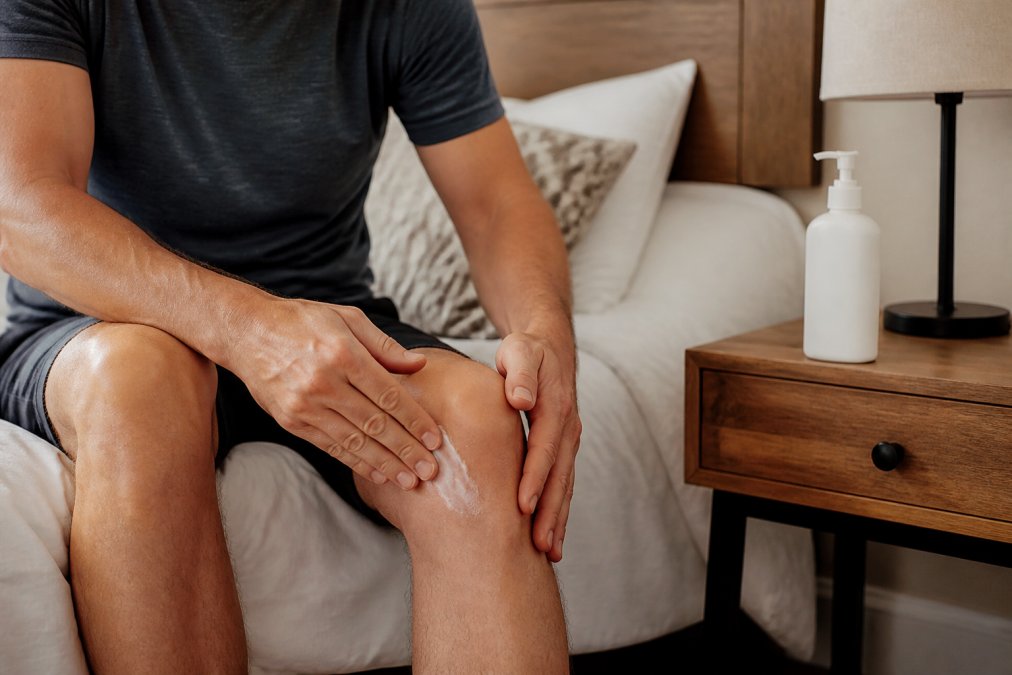
A simple routine:
- Cleanse the area. Oils and sweat block absorption. Apply after a shower when the skin is clean and dry.
- Start with a small amount. A pea-sized dab per area is enough to begin. You can always add more.
- Massage it in. Work the lotion into the muscle or joint for 30 to 60 seconds. The massage itself helps.
- Wait before dressing. Give the formula a few minutes to absorb, especially with a richer base.
- Reapply as needed. Most people apply two to three times a day, or before and after activity.
What to Ignore When Shopping for CBD Muscle Rub
Marketing language is where most buying decisions go wrong. The claims that sound most impressive are usually the least informative.
Ignore these:
- "Maximum strength" with no milligram count. Strength is a number. If the label won't give you one, there's nothing to compare.
- Serving sizes on a topical. You don't eat a lotion. What matters is total cannabinoids per container and how much you use per application.
- "Proprietary blend" ingredient lists. A blend that hides individual amounts usually hides small ones.
- Scent as a proxy for quality. Strong fragrance is a sensory preference, not a sign of potency, and it's a common irritant.
- Testimonials without context. A five-star review tells you someone liked it. It doesn't tell you what they used it for.
Frequently Asked Questions
Is a CBD muscle rub anti-inflammatory?
CBD topicals are used for localized discomfort, and research points to anti-inflammatory and analgesic properties for cannabinoids like CBD and CBC. A 2000mg CBD/CBC lotion pairs both compounds, and CBC is included for its anti-inflammatory and analgesic properties. Effects are typically felt where you apply the product rather than throughout the body. If you take prescription anti-inflammatories, ask your doctor before adding a topical to your routine.
What is the difference between CBD isolate and full-spectrum muscle rubs?
Isolate contains only CBD. Full-spectrum keeps the plant's other cannabinoids, terpenes, and trace compounds, which many buyers prefer for the entourage effect. Broad-spectrum sits in between: multiple cannabinoids, no THC. Check the certificate of analysis to confirm which category a rub falls into and how much CBD and CBC it actually contains per container.
How much CBD potency should I look for in a muscle rub?
Match potency to the job. A 500mg CBD lotion in a 3.3oz tube suits daily maintenance, mild soreness, and sensitive skin. A 2000mg CBD/CBC formula is built for stubborn joint pain, post-workout recovery, and areas that need stronger, longer-lasting relief. Milligram potency only matters alongside the container size, so compare concentration, not just the big number on the label.
Are there side effects to using CBD topicals?
Topical CBD is generally well tolerated. The most common issues are skin irritation from carrier oils, menthol, or preservatives rather than from CBD itself. Do a patch test on your inner forearm and wait 24 hours before applying to a large area. If you have sensitive skin from radiation therapy or a skin condition, introduce the product gradually and stop if redness or itching appears.
