

CBD Lotion vs. Pills: Which Works Better for Pain?
Table of Contents
- Is CBD Lotion Better Than Pills? Quick Comparison
- How CBD Bioavailability Differs: Topical vs. Oral
- How Oral CBD Is Absorbed and Why It Matters
- CBD Cream vs. Oral CBD for Pain: When to Use Each
- Benefits of CBD Lotion for Skin and Targeted Relief
- Safety, Side Effects, and Drug Interactions
- Cost-Per-Dose Analysis: Lotion vs. Pills
- Third-Party Testing and Certificate of Analysis
CBD Lotion vs. Pills: Which Works Better for Pain?
Last Updated: July 20, 2026
Is CBD Lotion Better Than Pills? Quick Comparison
When choosing between CBD lotion and pills, the answer depends on your pain location, desired onset time, and whether you need localized or systemic relief. Topical lotions deliver targeted relief to specific joints, muscles, and inflamed areas without entering your bloodstream. Oral CBD pills travel through your digestive system and reach your endocannabinoid system systemically, providing broader effects throughout your body.
Topical lotions offer faster onset at the application site, while pills provide sustained, whole-body effects. Neither approach is inherently "better", one will work better for YOUR situation based on these three factors: pain location, desired onset time, and whether you need systemic or localized relief.
Comparison Table: Lotion vs. Pills at a Glance
| Factor | CBD Lotion | CBD Pills |
|---|---|---|
| Onset Time | 15-45 minutes (localized) | 30-90 minutes (systemic) |
| Duration | 4-6 hours (localized relief) | 6-8 hours (systemic effects) |
| Best For | Joint pain, muscle soreness, localized inflammation | Nerve pain, systemic inflammation, whole-body relief |
| Absorption | Transdermal/topical (skin barrier) | Oral (first-pass metabolism) |
| Dosage Control | Applied topically; no overdose risk | Precise mg per serving; easy to adjust |
| Greasy/Residue | Non-greasy formulas available (like RXR) | No residue; clean application |
| Cost Per Dose | $0.50-$2.00 per application | $1.50-$4.00 per serving |
| Systemic Effects | Minimal (stays localized) | Full endocannabinoid system activation |
How CBD Bioavailability Differs: Topical vs. Oral
Bioavailability determines how much CBD actually reaches your system and produces effects. When you apply a CBD lotion, cannabidiol molecules attempt to cross your skin barrier, a protective layer designed to keep things out. This results in lower overall bioavailability but highly localized effects, exactly what you want for knee pain or shoulder tension.
Oral CBD takes a different route. When you swallow a pill, it enters your digestive tract and reaches your liver, where it undergoes first-pass metabolism. This process breaks down some of the CBD, so only 6-15% of what you ingest reaches your bloodstream unchanged. However, what does make it through distributes throughout your entire body via your circulatory system.
Research shows that topical cannabinoids demonstrate significantly higher localized concentrations compared to oral delivery, but minimal systemic absorption. This is a feature, not a bug. If you have arthritis in your hands, you want the CBD concentrated there, not diluted across your entire body.
First-Pass Metabolism and Oral Absorption
When you swallow a CBD pill, it travels to your stomach, gets absorbed through your intestinal wall, and heads straight to your liver before circulating elsewhere. Your liver metabolizes foreign compounds, breaking down a significant portion of the CBD before it reaches your general circulation.
This metabolic process takes 30 to 90 minutes before you feel systemic effects. The upside: your body distributes the CBD throughout your system, providing sustained relief lasting 6-8 hours or longer. The downside: you lose a substantial amount of the dose to liver metabolism, which is why many users need higher oral doses to achieve the same effect as a topical application at the pain site.
Transdermal and Skin Barrier Absorption
Your skin is a barrier designed to keep water in and pathogens out. CBD molecules are lipophilic (fat-soluble), which helps them penetrate skin more effectively than water-soluble compounds. Quality CBD lotion formulas use penetration enhancers like coconut oil and shea butter to help cannabidiol molecules navigate through the skin barrier efficiently.
The amount of CBD that penetrates varies based on skin condition and thickness. Damaged or inflamed skin allows better penetration, which is why people with arthritis or eczema often report better results from topical CBD.
How Oral CBD Is Absorbed and Why It Matters
Swallowing a CBD pill sets off a predictable chain of events. The pill dissolves in your stomach, the cannabidiol gets absorbed through your intestinal wall, and then it goes directly to your liver before circulating to the rest of your body.
Your liver contains cytochrome P450 enzymes, which metabolize CBD. This first-pass metabolism is why oral bioavailability is lower than expected. If you take a 25mg CBD pill, you're getting roughly 1.5-3.75mg of active cannabidiol in your system, depending on your individual metabolism.
Most people feel systemic effects between 30 and 90 minutes after ingestion. This delayed onset makes topical lotions preferable for acute pain, but the sustained 6-8 hour effect of oral CBD is valuable for chronic pain management. Many users take oral CBD morning and evening as a preventive measure rather than waiting for pain to strike.
CBD Cream vs. Oral CBD for Pain: When to Use Each
Both methods work for different pain scenarios. Understanding which matches your situation will save you money and frustration.
Localized Pain Relief with Topical Lotions
Use a CBD lotion when your pain has a specific location: knee arthritis, shoulder tension, lower back muscle soreness, or hand inflammation. Topical CBD shines here because you're applying the cannabidiol exactly where you need it.
Onset is faster, 15 to 45 minutes, because the CBD doesn't travel through your digestive system or undergo liver metabolism. It works locally, reducing inflammation and modulating pain signals in the specific tissue you're targeting.
A common mistake is assuming topical CBD can't reach deep tissue pain. It can, but there are limits. If your pain originates 2-3 inches below the skin surface, a topical lotion will have difficulty reaching it. For deep muscle pain or nerve pain that radiates across your body, oral CBD becomes more practical.
Systemic Effects and Whole-Body Relief with Pills
Use oral CBD when your pain is systemic: widespread inflammation from autoimmune conditions, peripheral neuropathy affecting multiple areas, fibromyalgia, or migraines. These conditions benefit from cannabidiol circulating through your entire endocannabinoid system.
Oral CBD also makes sense if you have multiple pain sites. Applying lotion to your knees, lower back, shoulders, and hands four times daily becomes impractical. A morning and evening CBD pill delivers consistent relief across all those areas simultaneously.
However, oral CBD requires patience. You won't feel effects for 30-90 minutes, making it unsuitable for acute pain flare-ups.
Benefits of CBD Lotion for Skin and Targeted Relief
Beyond pain relief, a quality CBD lotion offers genuine skin benefits that oral CBD cannot provide. You're applying nourishing ingredients directly to your skin barrier while delivering cannabidiol to inflamed tissue.
Premium formulas incorporate organic coconut oil, shea butter, and kukui nut oil, ingredients that provide deep hydration, nourishment, and protection. People with arthritis, eczema, or psoriasis often report that the lotion itself improves their skin condition. The organic oils reduce dryness, the cannabidiol reduces inflammation, and the cumulative effect is skin that looks and feels better.
Non-Greasy Formulas and Skin Hydration
A major objection to CBD lotions is greasiness. Quality matters here. Poorly formulated lotions sit on top of your skin like a barrier. Premium formulas are engineered to absorb quickly while delivering sustained hydration.
This matters because skin hydration directly affects pain perception. Dry, inflamed skin amplifies pain signals. Well-hydrated, nourished skin with reduced inflammation naturally experiences less pain.
Safety, Side Effects, and Drug Interactions
Both topical and oral CBD are generally well-tolerated, but they carry different safety profiles.
Topical Safety Profile
CBD lotions are remarkably safe. Since the cannabidiol stays localized and doesn't enter your bloodstream significantly, systemic side effects are virtually nonexistent. The biggest risks are skin sensitivity to specific ingredients and allergic reactions, which are rare.
Topical CBD also doesn't interact with medications because it's not entering your systemic circulation, making it an excellent choice for people on complex medication regimens.
Oral CBD and Drug Interaction Warnings
Oral CBD is metabolized by your liver's cytochrome P450 enzyme system, the same system that metabolizes most prescription medications. This means oral CBD can potentially increase or decrease medication effectiveness.
Common drug interactions include blood thinners (warfarin, apixaban), heart medications (beta-blockers, calcium channel blockers), immunosuppressants, seizure medications, and statins. This doesn't mean you can't use oral CBD with these medications, it means you need medical supervision. Your doctor can adjust dosages or monitor your response more carefully.
Cost-Per-Dose Analysis: Lotion vs. Pills
A 500mg CBD Relief Lotion at $39.99 provides roughly 50 applications at approximately $0.80 per dose for localized pain relief. A 2000mg Pain Relief Lotion at $69.99 brings the cost to roughly $0.70 per dose.
Oral CBD tinctures at $105.00 containing approximately 30 servings cost about $3.50 per dose. This is higher per dose than topical, but remember that oral CBD provides systemic, whole-body relief for 6-8 hours.
The real cost comparison depends on your usage pattern:
- Localized pain affecting one area: Topical is cheaper at $0.80-$1.60 daily.
- Multiple pain sites: Oral becomes competitive at $3.50 daily, covering all areas simultaneously.
- Chronic systemic pain: Oral is more cost-effective at $7 daily for 24-hour coverage.
Third-Party Testing and Certificate of Analysis
Whether you choose topical lotion or oral pills, you need proof that what you're buying actually contains the CBD it claims. A certificate of analysis (COA) is a third-party lab report that independently verifies actual CBD content, THC presence, and contamination screening.
What to look for in a COA:
- CBD content within 10% of the advertised amount
- THC below 0.3% (the legal limit)
- No pesticide residues or heavy metal contamination
- Testing by an accredited third-party lab, not the company's own lab
This verification applies equally to topical lotions and oral pills. Don't assume higher price means better quality, verify with lab results.
Which Should You Choose? A Decision Framework
Answer these questions in order:
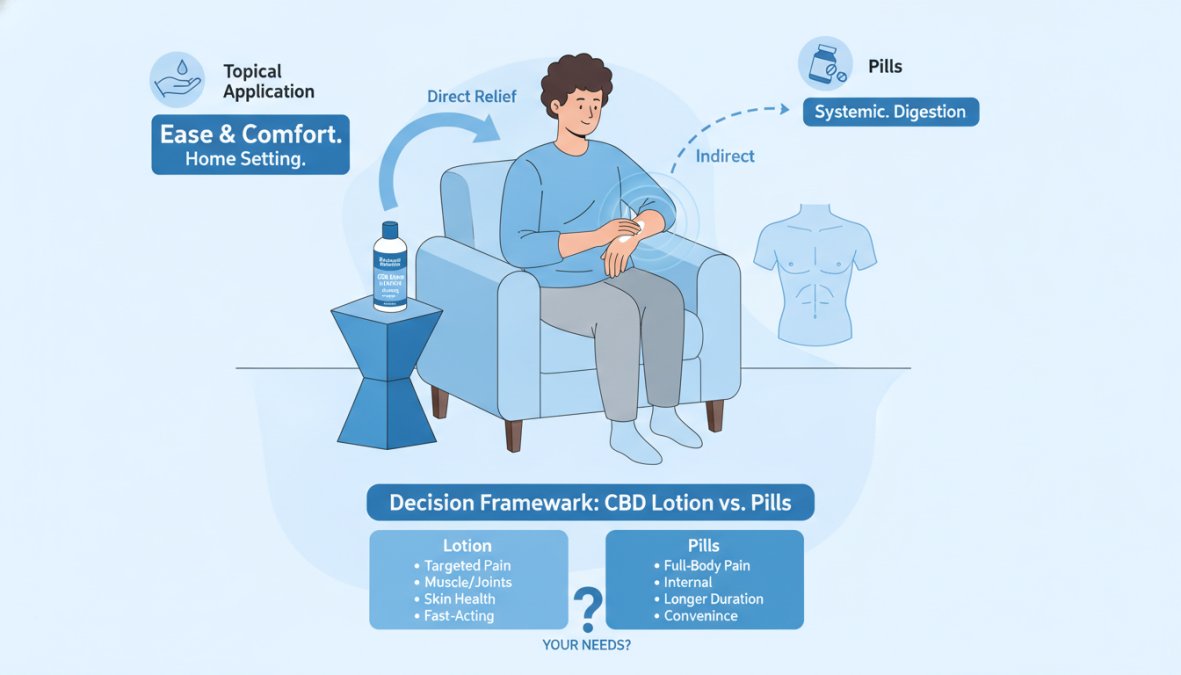
Question 1: Is your pain localized to specific areas, or is it systemic?
- Localized: Use topical lotion
- Systemic or multiple areas: Use oral CBD
Question 2: How quickly do you need relief?
- Acute pain flare-ups: Use topical (15-45 minutes)
- Chronic pain requiring consistent relief: Use oral (sustained 6-8 hours)
Question 3: Are you on medications that might interact with CBD?
- Yes, on blood thinners or heart meds: Use topical (no systemic absorption)
- No significant interactions: Either option works
Question 4: Do you have skin sensitivity or inflammatory skin conditions?
- Yes, and you want to address skin health: Use topical
- No, or you prefer not to apply anything topically: Use oral
Question 5: What's your budget?
- Limited budget, localized pain: Topical is cheaper ($0.70-$0.80 per dose)
- Multiple pain sites: Oral becomes cost-competitive ($3.50 per dose covers everything)
Most pain sufferers end up using both, topical lotion for acute flare-ups and localized inflammation, oral CBD as a daily foundation for systemic relief and prevention.
Making Your Final Decision
The question isn't "is cbd lotion better than pills", it's "which is better for my specific pain situation?" A topical lotion is superior for knee arthritis. Oral CBD is superior for peripheral neuropathy affecting multiple areas. Neither is universally better; they're better for different problems.
Start with what matches your pain pattern. If you have localized joint pain, try a quality CBD lotion first. You'll know within 2-3 applications whether it's working. If you have systemic pain or multiple pain sites, oral CBD makes more practical sense despite the longer onset time.
Quality matters more than delivery method. A premium topical lotion with verified third-party testing will outperform a cheap oral pill with no COA. Verify your source, check the third-party lab results, and choose based on your pain location and lifestyle.
Frequently Asked Questions
What is the difference between topical CBD and oral CBD?
Topical CBD lotions are applied directly to skin and provide localized relief to specific areas like joints or muscles, with minimal systemic absorption. Oral CBD pills are ingested and absorbed through the digestive system, creating whole-body effects through the endocannabinoid system. Topical CBD bypasses first-pass metabolism, while oral CBD is metabolized by the liver, affecting bioavailability and onset time. Topical lotions typically work within 15-30 minutes for localized pain, while pills may take 1-2 hours but provide broader systemic relief for inflammation throughout the body.
Does CBD lotion actually work for pain, and how does it compare to pills?
CBD lotion can be effective for localized pain like arthritis, muscle soreness, and joint discomfort through transdermal absorption and local anti-inflammatory action. Clinical trials and anecdotal evidence support topical CBD for targeted relief. However, for systemic pain conditions like peripheral neuropathy or widespread inflammation, oral CBD pills may provide superior therapeutic potential since they reach the entire endocannabinoid system. The choice depends on whether you need localized or systemic effects, lotion excels at targeting specific areas, while pills address full-body pain management.
How long does CBD lotion take to work compared to pills?
CBD lotion typically begins working within 15-30 minutes as it penetrates the skin barrier and reaches local cannabinoid receptors, with peak effects around 1-2 hours. Oral CBD pills take longer to onset, usually 1-2 hours, because they must be digested and undergo first-pass metabolism in the liver before entering the bloodstream. However, oral CBD's effects last longer, typically 4-6 hours, while lotion effects may last 3-5 hours. For immediate localized relief, lotion wins; for sustained whole-body effects, pills are more practical despite the longer wait time.
Can I use CBD lotion and pills together for better pain relief?
Yes, many users combine topical lotion and oral pills for comprehensive pain management, using lotion for immediate localized relief while pills provide sustained systemic effects. This combination approach can target both specific problem areas and underlying inflammation throughout the body. However, consult your healthcare provider first, especially if you take other medications, as oral CBD can interact with certain drugs through first-pass metabolism. Starting with lower doses of each when combining is prudent. This dual-method approach appeals to users with multiple pain types or those seeking maximum therapeutic potential.
Which is better for arthritis: CBD lotion or pills?
For arthritis, CBD lotion is often preferred for immediate joint-specific relief, especially in hands, knees, or shoulders, thanks to direct transdermal absorption and anti-inflammatory action on localized joints. However, oral CBD pills may be better for systemic arthritis affecting multiple joints, as they address inflammation throughout the entire body via the endocannabinoid system. Many arthritis sufferers use both: lotion for flare-ups and targeted joint pain, pills for baseline inflammation management. The best choice depends on whether your arthritis is localized to a few joints or widespread, lotion excels at the former, pills at the latter.
This article was written using GrandRanker
