

CBD Lotion vs CBD Oil for Muscles: Which Works?
Table of Contents
- CBD Lotion vs CBD Oil for Muscles: Key Differences
- How Topicals and Tinctures Deliver Relief Differently
- Systemic vs Localized Relief: What Your Muscles Actually Need
- How CBD Lotion and CBD Oil Support Inflammation
- Benefits of CBD/CBC for Muscle Pain and Recovery
- How to Apply CBD Lotion for Soreness
- Absorption, Bioavailability, and Onset Time
- Choosing the Right CBD Product for Your Pain
- Frequently Asked Questions
Last Updated: September 12, 2026
CBD Lotion vs CBD Oil for Muscles: Key Differences
The choice between CBD lotion vs CBD oil for muscles comes down to one question: do you need relief in one specific spot, or throughout your whole body? This guide from Railroad Remedies (RXR) breaks down how each format works, when to reach for which, and why some people use both. If you've rubbed a cream into a stiff shoulder and felt nothing, or swallowed a tincture hoping it would reach a single aching knee, the problem was likely the delivery method, not the cannabinoids.
CBD lotion is a topical product that delivers cannabinoids through the skin at the application site. CBD oil is a tincture taken under the tongue, where cannabinoids enter the bloodstream and circulate systemically. One targets a spot. The other targets the body.
Below, we'll show you how to match the format to your pain pattern, layer them, and avoid application mistakes that waste product.
How Topicals and Tinctures Deliver Relief Differently
Topicals and tinctures take entirely different routes through the body, and that route determines what each can do. A lotion stays largely in the skin and underlying tissue, interacting with local cannabinoid receptors. A tincture absorbed under the tongue enters circulation and reaches the endocannabinoid system centrally, which is why it can influence sleep, mood, and widespread inflammation alongside pain.
The practical consequence: a topical will not help nerve pain in your feet if you rub it on your hands. A tincture will not give you fast, targeted relief in one overworked muscle.
| Feature | CBD Lotion (Topical) | CBD Oil (Tincture) |
|---|---|---|
| Delivery route | Through the skin at the site | Under the tongue into the bloodstream |
| Onset time | Minutes to about an hour | Often 15-60 minutes |
| Duration | Several hours, reapplied as needed | Several hours, longer for some |
| Best for | Localized muscle and joint discomfort | Widespread or systemic concerns |
| Reaches nerve pain | Unlikely | More plausible |
| Skin benefits | Yes, hydrating base | None |
Systemic vs Localized Relief: What Your Muscles Actually Need
Localized pain relief means the effect is concentrated where you apply the product. Systemic effects mean the cannabinoids circulate and act on the body as a whole. Most muscle complaints fall clearly into one camp once you describe them honestly.

Ask yourself where the problem lives:
- One area, recent strain: a hamstring after sprinting, a shoulder after lifting. Topical.
- Delayed onset muscle soreness (DOMS) across multiple muscle groups: often systemic, though topicals still help the worst spots.
- Joint discomfort from osteoarthritis in the knees or hands: topical, applied directly over the joint.
- Nerve pain, chronic inflammation, or sleep disruption alongside pain: systemic support is the more realistic target.
A common mistake is expecting a topical to fix a body-wide problem. It will not, and no honest product claims otherwise.
How CBD Lotion and CBD Oil Support Inflammation
Inflammation is the common thread in almost every muscle complaint, but the two formats engage it at different scales, and that difference separates a product that works from one that just feels nice going on.
The topical pathway. When you massage a CBD lotion into a sore quad or stiff lower back, the cannabinoids bind primarily to CB2 receptors concentrated in skin, subcutaneous fat, and the fascia and muscle tissue just beneath. That local receptor activity is associated with calming the cytokine signaling that produces heat, swelling, and tenderness at the site. The effect is real but geographically bounded, a few square inches of tissue, not your whole leg.
The systemic pathway. A tincture held under the tongue bypasses first-pass liver metabolism and enters circulation within roughly 15 to 60 minutes. From there, cannabinoids interact with CB1 and CB2 receptors throughout the body, including the central nervous system, which is why sublingual use is more often linked to whole-body effects like reduced soreness across multiple muscle groups, easier sleep, and a calmer inflammatory baseline.
Here is the practical trade-off most guides skip:
| What you're treating | Better format | Why |
|---|---|---|
| A single swollen, hot muscle after a strain | Lotion | Direct CB2 contact at the site; onset in minutes |
| Soreness spread across quads, glutes, and calves after leg day | Tincture | A topical can't cover that much surface area evenly |
| Joint stiffness in both knees and both hands | Tincture (plus lotion on the worst joint) | Multiple distant sites need systemic reach |
| A knot in one trap that won't release | Lotion | Massage plus localized cannabinoids |
Where the formats overlap. Both can influence inflammation, but at different depths. A topical calms the surface layer, the tissue you can press on. A tincture works on the systemic drivers: the circulating inflammatory signals that make everything ache at once. If your inflammation is one hot spot, the lotion is the sharper tool. If it's a body-wide flare, the tincture does the heavier lifting, and the lotion is a spot treatment on top.
This is why many users don't choose between the two at all. They treat the hotspot with a lotion and support the whole system with a tincture, a layered approach we'll break down next.
Benefits of CBD/CBC for Muscle Pain and Recovery
The benefits of CBD/CBC for muscle pain come down to two cannabinoids working together. CBD is the well-known one. CBC, or cannabichromene, is a lesser-known cannabinoid valued for its soothing properties, and it works alongside CBD to extend the overall effect.
For muscle recovery, that combination matters most after exertion. Post-workout, the goal is calming overworked tissue, easing muscle tension, and supporting comfort so you can move normally the next day. A lotion with both CBD and CBC gives you that localized, steady sensation where you need it.
Railroad Remedies (RXR) builds its maximum-strength formula around this pairing. The CBD/CBC 2000mg Pain Relief Lotion combines broad-spectrum CBD with a full-spectrum CBC isolate in a base of organic MCT oil, shea butter, and jojoba oil. For lighter, everyday use, the CBD Relief Lotion 500mg pairs full-spectrum CBD with organic coconut oil and shea butter in a gentler formula.

How to Apply CBD Lotion for Soreness
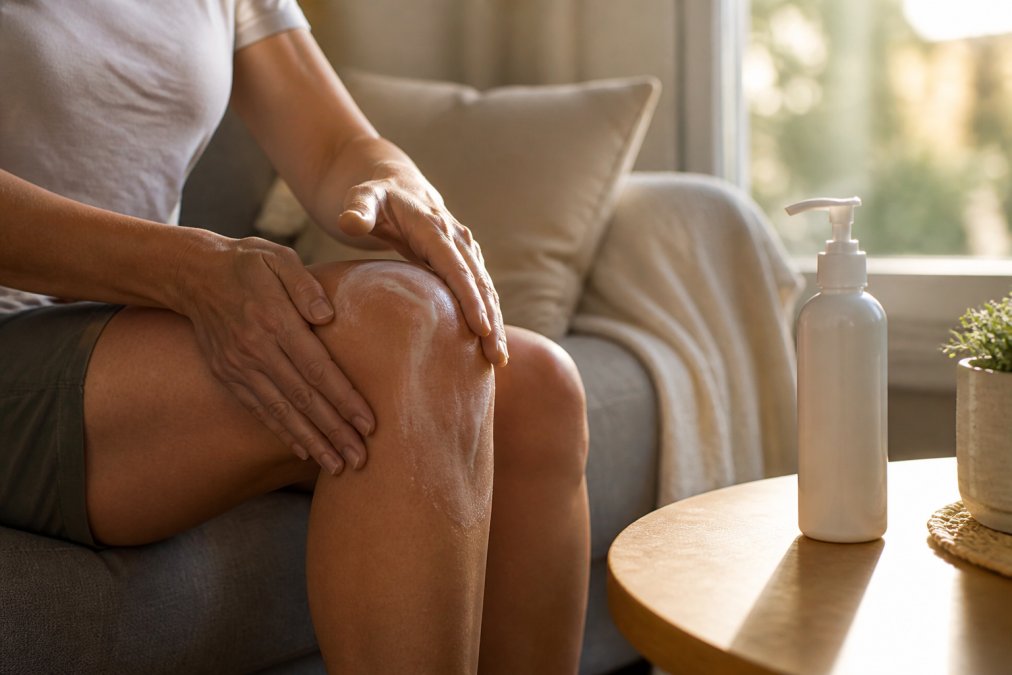
Knowing how to apply CBD lotion for soreness is mostly about timing and technique, not quantity. Apply to clean, dry skin, massage it in fully, and give it time to absorb before judging the result.
- Apply after activity, not before. Post-workout timing lets the lotion work on tissue that is already stressed rather than masking a problem mid-exercise.
- Start with a small amount. A thin layer over the sore area is enough to begin. You can add more, but you cannot take it back.
- Massage in a circular motion for 30-60 seconds. The massage itself helps muscle tension, and it improves how evenly the product spreads.
- Cover the area around the pain, not just the point. Soreness radiates; so should the application.
- Reapply every few hours as needed. Topicals are not one-and-done. Most users reapply two to three times on a heavy day.
- Wash your hands after. Unless your hands are the target, in which case, leave it.
Absorption, Bioavailability, and Onset Time
Absorption determines everything about how a CBD product feels in practice. Bioavailability is the share of the cannabinoid that actually reaches its target, and it differs sharply between formats. A tincture held under the tongue absorbs into the bloodstream efficiently. A topical absorbs into the skin and surrounding tissue, which is exactly why it acts locally rather than everywhere.
Onset time follows the same logic:
- Topical: effects often begin within minutes to an hour, depending on the formula and how well it penetrates the skin barrier.
- Sublingual: effects typically begin within 15-60 minutes, with the full effect building over the following hour.
Consistency and viscosity matter more than most people realize. A lotion that absorbs cleanly reaches the tissue beneath; one that sits on the surface does not. This is also where carrier oils come in. A base of coconut oil, shea butter, or MCT oil does more than moisturize. It carries the cannabinoids and supports transdermal absorption through the skin barrier.
Railroad Remedies (RXR) formulates its lotions to be non-greasy and easily absorbed, using organic coconut oil, shea butter, and kukui nut oil so the product sinks in rather than sitting on top. For systemic support, the Morning Star Berry CBD Tinctures offer broad-spectrum CBD in organic MCT coconut oil for sublingual use.

Choosing the Right CBD Product for Your Pain
Choosing the right product starts with one honest question: is your pain in one place, or everywhere? The answer points you to a format before you ever look at a label. But once you've picked a format, the harder question is how much to use, and this is where most guides go silent.
The decision framework:
- One area, recent strain (a pulled hamstring, a stiff shoulder): CBD lotion applied directly to the site.
- Widespread, chronic, or nerve-related pain: a CBD oil tincture, since a topical can't reach nerves sitting deep beneath the skin.
- Both a hotspot and body-wide inflammation: layer them, tincture for the system, lotion for the spot.
- Sensitive skin: look for a formula with soothing organic ingredients like aloe, shea butter, and chamomile rather than a bare cannabinoid extract.
The dosage math nobody gives you. Oral CBD has a rough milligram target per body weight. Topicals don't work that way, the relevant number is concentration per square inch of skin. Here's how to calculate it yourself:
- Find total milligrams and total volume. A 2000mg lotion in a 3.3 oz tube contains roughly 2000mg of cannabinoids spread across the entire tube.
- Estimate milligrams per pump or pea-sized dab. A 3.3 oz tube typically yields about 100 pumps. That's roughly 20mg of CBD per pump at 2000mg, or about 5mg per pump at 500mg.
- Match the dose to the area. A single sore knee or elbow is roughly 4 to 6 square inches, one to two pumps of a 2000mg formula is a reasonable starting point. A full lower back is closer to 30 to 40 square inches, so expect three to five pumps.
- Start low, add gradually. Apply a thin layer, wait 30 to 45 minutes, and assess. You can always add more; you can't remove what's already absorbed.
That math is why concentration matters more than bottle size. A 2000mg formula lets you deliver a meaningful dose to a small stubborn area with one pump. A 500mg formula is better suited to broad, everyday application where you're covering more surface at a lower intensity.
Carrier oils change the equation. The base isn't filler, it determines how well cannabinoids cross the skin barrier. Menthol and camphor create a cooling sensation that can distract from pain signals and increase blood flow. Arnica is traditionally used for bruising and swelling. Capsaicin generates heat that can desensitize nerve endings over repeated use. A pure CBD lotion with a simple shea or MCT base is gentler for sensitive skin, but won't deliver the same immediate sensory feedback as an activated formula.
Post-workout timing matters too. For immediate soreness in a specific muscle, apply lotion within 30 minutes of finishing. For delayed onset muscle soreness (DOMS) that peaks 24 to 48 hours later, a tincture taken in the evening supports recovery overnight, while a lotion handles the worst spots the next morning.
Railroad Remedies (RXR) makes the format choice straightforward. The CBD/CBC 2000mg Pain Relief Lotion at $69.99 is the pick for serious, localized muscle and joint discomfort, while the CBD Relief Lotion 500mg at $39.99 covers daily aches and doubles as a skin-nourishing moisturizer. For systemic support, the Polar Express Peppermint CBD Tinctures and Pacific Sunrise Peace CBD Tinctures both deliver broad-spectrum CBD under the tongue at $105.00.
Frequently Asked Questions
Does topical CBD lotion get into your bloodstream?
Most CBD lotion stays in the skin and underlying tissue rather than entering the bloodstream in significant amounts. This is because the skin barrier limits how much CBD crosses into circulation. For muscle soreness, this localized action is often what you want. If you need whole-body effects, a sublingual tincture is a better fit.
Is CBD lotion or oil better for deep muscle pain?
It depends on the type of pain. CBD lotion works well for surface-level muscle soreness, joint discomfort, and localized areas you can reach. CBD oil taken sublingually reaches the bloodstream and may help with widespread inflammation or nerve pain. Many people use both: lotion for targeted spots and oil for overall recovery support.
How long does it take for CBD lotion to work on muscles?
Most people notice effects within 15 to 30 minutes of applying CBD lotion. The onset depends on concentration, carrier oils, and how thoroughly you massage it into the skin. A 2000mg formula like Railroad Remedies CBD/CBC lotion delivers more cannabinoids per application than lower-dose options, which may speed up perceived relief.
Can you use CBD oil and lotion at the same time?
Yes. Using both is a common approach called synergistic application. Apply CBD lotion directly to sore muscles or joints for localized relief, and take CBD oil sublingually for systemic effects. This combination targets pain from two angles: the specific area and your body's overall inflammatory response.
Who should not use CBD cream?
Avoid CBD cream if you are allergic to any ingredients in the formula, such as shea butter, coconut oil, or specific botanicals. Pregnant or breastfeeding women should consult a doctor first. If you take blood-thinning medication or have a bleeding disorder, check with your healthcare provider before using any CBD product.
