

CBD Cream vs Prescription Arthritis Cream: Which Works Best?
Table of Contents
- CBD Cream vs Prescription Arthritis Cream: A Head-to-Head Comparison
- What Is CBD Cream and How Does It Work?
- Prescription Topical NSAIDs for Arthritis Pain
- Scientific Evidence: Clinical Efficacy and Limitations
- Side Effects of CBD Cream for Arthritis
- CBD Oil vs Cream for Arthritis: Delivery Method Matters
- Cost-Benefit Analysis: Price vs Effectiveness
- How to Choose the Best CBD Cream for Arthritis Pain
CBD Cream vs Prescription Arthritis Cream: Which Works Best?
Last Updated: July 24, 2026
When comparing cbd cream vs prescription arthritis cream, the decision often comes down to efficacy, safety, and how your body responds to each approach. At Railroad Remedies (RXR), we've observed that many arthritis sufferers face a genuine crossroads: topical CBD products promise natural relief without systemic side effects, while prescription NSAIDs like diclofenac offer decades of clinical validation. This comparison cuts through the marketing noise to show you exactly what the evidence supports, where each option excels, and which is actually better for your specific situation.
Quick Comparison Table
| Feature | CBD Cream | Prescription Topical NSAID (Voltaren) | Winner |
|---|---|---|---|
| Proven Clinical Efficacy | Limited RCT data | Strong clinical evidence | Prescription NSAID |
| Systemic Side Effects | Minimal to none | Low but possible | CBD Cream |
| Time to Relief | Variable (days to weeks) | 7 days consistent use | Prescription NSAID |
| Price Range | $40-$70 per container | $12-$18 per tube | Prescription NSAID |
| Bioavailability | Low (topical only) | Moderate (some systemic absorption) | Depends on goal |
| Drug Interactions | Minimal reported | Moderate (NSAIDs interact with many drugs) | CBD Cream |
| Best For | Mild pain, sensitive skin, natural preference | Moderate arthritis pain, faster results needed |
Key Differences at a Glance
Prescription topical NSAIDs like diclofenac (Voltaren) contain a non-steroidal anti-inflammatory drug that penetrates joint tissue and reduces inflammation at the source. CBD creams rely on cannabinoid receptors and the endocannabinoid system, a mechanism still being researched in humans.
Voltaren has FDA approval, decades of use data, and randomized controlled trials showing pain reduction within seven days. CBD creams operate in a regulatory gray zone, legal under federal law if derived from hemp with less than 0.3% THC, but not FDA-approved as a drug.
Cost differs significantly. Voltaren runs $12-$18 per tube, while premium CBD creams like Railroad Remedies (RXR)'s 2000mg CBD/CBC blend cost $39.99-$69.99 per container. For those worried about gastrointestinal side effects from systemic NSAIDs, topical CBD offers peace of mind at higher cost.
What Is CBD Cream and How Does It Work?
CBD cream is a topical formulation containing cannabidiol, a non-intoxicating cannabinoid extracted from hemp. When applied to skin, the cream's active compounds interact with cannabinoid receptors in local tissue, theoretically reducing inflammation and pain signaling without entering the bloodstream in meaningful amounts.
The mechanism involves the endocannabinoid system, a network of receptors found throughout the body, including in skin and joint tissue. CBD modulates receptor activity and affects other pain-signaling pathways like serotonin and vanilloid receptors. However, translating this mechanism into clinical reality has proven challenging; most human studies remain small or observational rather than large randomized controlled trials.
Understanding Topical CBD and Bioavailability
Bioavailability, the amount of an active compound that reaches systemic circulation, is where topical CBD shows both strength and limitation. When you apply CBD cream, the cannabinoid molecules must penetrate the stratum corneum to reach deeper tissue where inflammation occurs. This barrier limits how much CBD actually reaches the joint capsule beneath the skin.
Research suggests topical CBD has very low systemic bioavailability, meaning most stays localized rather than entering the bloodstream. For arthritis pain, this is an advantage: you get targeted relief without systemic side effects. The downside is that deep joint inflammation may not respond as well because CBD concentration at the inflamed site remains modest.
Absorption depends heavily on formulation. Creams with organic carrier oils like coconut oil and shea butter enhance penetration compared to water-based formulas. Full-spectrum CBD, which includes other cannabinoids and terpenes, may offer better absorption than CBD isolate due to the entourage effect, though this remains largely anecdotal.
Full-Spectrum vs Isolate: What's the Difference?
Full-spectrum CBD contains all cannabinoids, terpenes, and plant compounds from hemp, including trace amounts of THC (up to 0.3% federally). Isolate contains only pure cannabidiol. Full-spectrum products like Railroad Remedies (RXR)'s CBD/CBC blend theoretically offer enhanced pain relief through the entourage effect. CBC (cannabichromene) is a minor cannabinoid with emerging evidence for anti-inflammatory and analgesic properties.
Isolate appeals to users concerned about THC exposure or drug testing. For arthritis sufferers, the choice comes down to personal preference: if you want the theoretical benefits of multiple cannabinoids and don't worry about trace THC, full-spectrum wins. If you need THC-free assurance, isolate is the safer choice.
Prescription Topical NSAIDs for Arthritis Pain
Prescription topical NSAIDs, primarily diclofenac (Voltaren), represent the gold standard for localized arthritis pain relief according to decades of clinical use. These creams contain a non-steroidal anti-inflammatory drug that works by inhibiting cyclooxygenase (COX) enzymes, reducing prostaglandin production and thus inflammation. Unlike CBD's theoretical mechanism, NSAID action is well-established and FDA-validated.
Voltaren Arthritis Pain Gel contains diclofenac sodium 1%, approved as an over-the-counter topical medication. Clinical trials show it reduces arthritis pain and improves mobility within seven days of consistent use. The cream penetrates deep enough to reach inflamed joints but produces minimal gastrointestinal side effects because systemic absorption is low.
How Diclofenac (Voltaren) Works on Joint Inflammation
Diclofenac reduces inflammation by blocking COX-1 and COX-2 enzymes, which produce prostaglandins, hormone-like substances that trigger inflammation, pain, and swelling. By reducing prostaglandin levels at the application site, diclofenac directly addresses the inflammatory cascade driving arthritis pain.
Studies show diclofenac concentration in joint tissue reaches therapeutic levels after topical application, making it effective for osteoarthritis and other localized joint pain. For rheumatoid arthritis or psoriatic arthritis, topical NSAIDs provide adjunctive relief but don't address systemic inflammation. They work best for single-joint or few-joint involvement, making them ideal for hand arthritis, knee pain, or ankle inflammation.
FDA Approval and Over-the-Counter Status
Voltaren Arthritis Pain Gel is FDA-approved as an over-the-counter topical medication, meaning it has undergone rigorous testing for safety and efficacy. CBD creams occupy a different regulatory space. The FDA has not approved any CBD product for arthritis pain relief. While hemp-derived CBD is legal federally under the 2018 Farm Bill, the FDA maintains that CBD cannot be marketed as a drug without approval.
For consumers, FDA approval of Voltaren provides regulatory confidence. The clinical evidence gap between the two is real and significant.
Scientific Evidence: Clinical Efficacy and Limitations
The evidence base for cbd cream vs prescription arthritis cream reveals a striking asymmetry. Diclofenac has decades of clinical data, multiple randomized controlled trials, and widespread medical acceptance. CBD for arthritis has limited RCT data, mostly observational studies, and significant research gaps.
Medical literature shows numerous studies on topical diclofenac for osteoarthritis, with consistent findings: it reduces pain and improves function within 7-14 days of consistent application. These are prospective, blinded, placebo-controlled trials, the gold standard for clinical evidence. By contrast, CBD arthritis research consists mainly of small pilot studies, cell culture experiments, and anecdotal reports.
What Randomized Controlled Trials Show
Randomized controlled trials (RCTs) are the research gold standard because they eliminate bias through blinding and randomization. For topical NSAIDs, RCTs consistently show efficacy: patients using diclofenac report greater pain reduction than placebo within 7 days.
For CBD, the RCT picture is sparse. A 2023 study on topical CBD for chronic pain showed promise but involved only 29 participants. No large, multi-site RCT has definitively established CBD's superiority over placebo for arthritis specifically. The current evidence base is clear: diclofenac has strong RCT support; CBD does not.
Anecdotal Evidence vs Clinical Data
Anecdotal evidence, patient reports and testimonials, fills the gap where clinical trials are absent. Many arthritis patients report significant relief from CBD creams, particularly those who've had poor experiences with NSAIDs. However, anecdotal evidence is unreliable for proving efficacy because it's vulnerable to placebo effect, confirmation bias, and regression to the mean.
For prescription NSAIDs, clinical data and anecdotal evidence align: both show consistent benefit. For CBD, anecdotal reports are enthusiastic, but clinical data remains limited. This disconnect suggests CBD may help some people, but we don't yet know which people, at what doses, or in what formulations.
Side Effects of CBD Cream for Arthritis
One of CBD cream's major appeals is its favorable safety profile. Applied topically, CBD produces minimal systemic absorption, meaning side effects are rare and typically limited to localized skin reactions like mild irritation, redness, or contact dermatitis in sensitive individuals.
The main concern with CBD cream is product quality. Unregulated CBD products may contain contaminants, mislabeled potency, or unwanted ingredients. This is why third-party testing and transparent certificates of analysis matter: they verify what's actually in the product.
Safety Profile and Drug Interactions
Topical CBD has an excellent safety profile for localized use. The risk of adverse effects is minimal because systemic absorption is low. Prescription NSAIDs carry more significant interaction risks. NSAIDs can interact with blood thinners, certain blood pressure medications, and other drugs. They also increase cardiovascular and gastrointestinal risk, especially in older adults or those with a history of ulcers. Topical diclofenac has lower systemic exposure than oral NSAIDs, reducing these risks, but the risk remains non-zero.
Systemic Absorption and Long-Term Use Concerns
Topical CBD's low systemic bioavailability is both an advantage and a limitation. The advantage: minimal risk of systemic side effects or long-term toxicity. The limitation: you can't achieve high CBD blood levels using cream alone, which may reduce efficacy for widespread inflammation.
For topical NSAIDs, long-term use carries some risk. Even though systemic absorption is lower than with oral NSAIDs, prolonged use can lead to cumulative systemic exposure. Guidelines recommend using topical NSAIDs for short-term relief rather than indefinitely.
CBD Oil vs Cream for Arthritis: Delivery Method Matters
CBD oil (tincture) is taken orally, either swallowed or held under the tongue for sublingual absorption. This delivery method achieves higher systemic CBD levels because the cannabinoid enters the bloodstream directly. For widespread arthritis affecting multiple joints or systemic inflammatory conditions like rheumatoid arthritis, oral CBD may be more effective than topical application.
CBD cream is applied directly to the skin over the affected joint. This localized approach keeps CBD concentrated at the pain site, minimizing systemic exposure and side effects. For single-joint or few-joint arthritis, like osteoarthritis of the hands or knees, topical cream often outperforms oral oil.
Why Topical Application Differs from Oral CBD
Topical CBD cream doesn't enter the bloodstream significantly, so it can't treat systemic inflammation or affect pain signaling in the brain. Oral CBD reaches systemic circulation, crosses the blood-brain barrier, and can modulate pain perception centrally. This is why oral CBD might help widespread arthritis pain, while topical cream is better for localized joint pain.
Bioavailability differs dramatically. Oral CBD faces first-pass metabolism in the liver, reducing bioavailability to 5-20%. Topical CBD avoids this, but achieves much lower absolute blood levels because skin is a barrier. Onset time also differs. Topical CBD can provide relief within 15-30 minutes because it works locally. Oral CBD takes 30-90 minutes to peak, but the effect lasts longer (4-6 hours vs 2-4 hours for topical).
Localized Relief vs Systemic Effects
Localized relief means reducing pain and inflammation in one specific area, your arthritic knee, for example, without affecting the rest of your body. Topical CBD cream excels here. You apply it directly to the joint, it reduces local inflammation, and you avoid systemic side effects. This is ideal for osteoarthritis, which typically affects one or a few joints.
Systemic effects mean the treatment influences your whole body's inflammatory response. This is what you want for rheumatoid arthritis or psoriatic arthritis, where inflammation is widespread and driven by immune dysregulation. Topical CBD can't address this because it doesn't reach systemic circulation in meaningful amounts.
Cost-Benefit Analysis: Price vs Effectiveness
Voltaren Arthritis Pain Gel costs $12-$18 per 1.76-ounce tube. A typical application uses a pea-sized dab per joint, so one tube lasts 2-4 weeks with regular use. This translates to roughly $3-$9 per week.
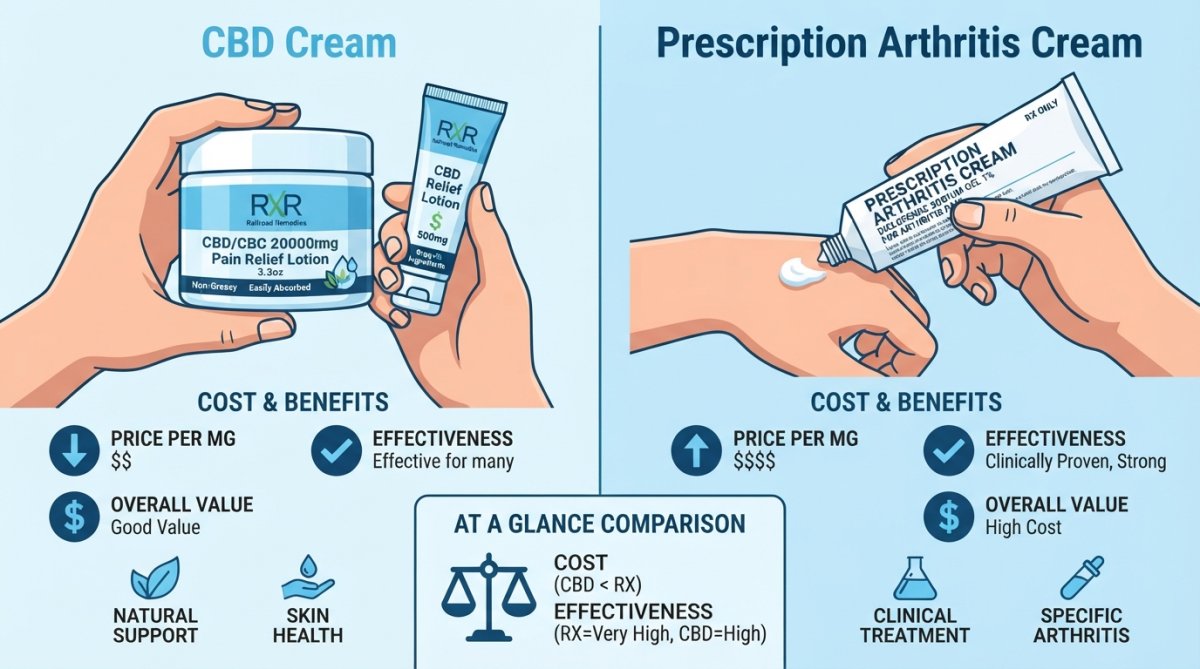
Premium CBD creams range from $40-$70 per container. Railroad Remedies (RXR)'s CBD Relief Lotion 500mg is $39.99, while the maximum-strength CBD/CBC 2000mg blend is $69.99. A comparable weekly cost is $10-$20, making CBD roughly 2-3 times more expensive than Voltaren.
Cost-benefit analysis requires considering efficacy, not just price. If Voltaren provides 80% pain relief in 7 days at $6 per week, and CBD cream provides 40% relief in 14 days at $15 per week, the NSAID is clearly better value. But if CBD provides 70% relief in 10 days and you can't tolerate NSAIDs due to stomach sensitivity, the higher cost may be justified.
Ingredient Quality and Third-Party Testing
Not all CBD creams are created equal. Price doesn't always correlate with quality because the CBD market is largely unregulated. A $60 cream might contain less CBD than labeled, while a $40 cream from a reputable brand might be accurately dosed and tested.
Third-party testing is the marker of quality. Reputable CBD brands send samples to independent labs and publish certificates of analysis (CoA) showing actual cannabinoid content, absence of contaminants, and absence of heavy metals or pesticides. Railroad Remedies (RXR) provides transparent third-party testing results.
When comparing CBD creams, check for:
- Certificate of analysis from an accredited lab
- Actual CBD/CBC content verified by testing
- Absence of contaminants (pesticides, heavy metals, microbial)
- Organic certification for carrier oils
- Clear labeling of full-spectrum vs isolate
Premium Options: What the CBC Blend Offers
Cannabichromene (CBC) is a minor cannabinoid with emerging research suggesting anti-inflammatory and analgesic properties. Railroad Remedies (RXR)'s CBD/CBC 2000mg blend combines full-spectrum cannabinoids, including CBC, with organic coconut oil, shea butter, and kukui nut oil. If you've tried standard CBD creams without sufficient relief, the CBC blend offers a chance to try a more comprehensive cannabinoid profile. For mild arthritis pain, the standard 500mg CBD cream may suffice. For moderate pain or previous failed attempts with other creams, the premium 2000mg blend is worth considering.
How to Choose the Best CBD Cream for Arthritis Pain
The decision between CBD cream and prescription arthritis cream hinges on five factors: pain severity, tolerance for NSAIDs, joint location, symptom pattern, and personal preference for natural products.
Start with pain severity. Mild arthritis pain (1-4 on a 10-point scale) often responds well to topical treatments. Moderate pain (5-7) benefits from stronger formulations like Railroad Remedies (RXR)'s 2000mg CBD/CBC blend or prescription-strength diclofenac. Severe pain (8-10) typically requires oral medications, injections, or systemic therapies.
Consider your NSAID tolerance. If you have a history of gastric ulcers, take blood thinners, or are over 65, NSAIDs carry elevated risk. CBD cream avoids these risks entirely. Joint location matters too. Hand arthritis responds excellently to topical creams because the skin is thin and the joint is small. Knee arthritis is mixed; topical creams help, but deeper joint inflammation may require higher systemic drug levels.
Application Technique and Optimal Use
How you apply CBD cream or NSAID cream significantly impacts efficacy. Most users apply too little, reducing effectiveness.
For optimal application:
- Clean and dry the skin over the affected joint
- Dispense a pea-sized amount for small joints like fingers, or a quarter-sized amount for larger joints like knees
- Massage gently into the skin using circular motions for 1-2 minutes
- Allow 5-10 minutes for absorption before covering with clothing
- Wash hands after application unless treating hand arthritis
- Apply 2-3 times daily for consistent relief
For prescription NSAIDs like Voltaren, consistency matters. The label recommends applying 4 times daily for 7 days to achieve pain relief. For CBD cream, relief often takes 3-5 days of consistent application to become noticeable, and 1-2 weeks for maximum benefit. Give it at least a week of twice-daily use before judging efficacy.
Certificate of Analysis and Product Transparency
Before purchasing any CBD cream, verify third-party testing. A certificate of analysis (CoA) from an accredited lab should show:
- Cannabinoid profile: Actual CBD, CBC, and other cannabinoid content
- Potency verification: Does the product contain what the label claims?
- Contaminant screening: Absence of pesticides, heavy metals, microbial contaminants
- Solvent residues: Absence of extraction solvents
- Microbial testing: Absence of E. coli, salmonella, mold
Reputable brands like Railroad Remedies (RXR) publish CoAs on their website or provide them upon request. If a brand refuses to share testing results, that's a red flag. Additionally, check the ingredient list. Organic carrier oils (coconut oil, shea butter) are preferable to mineral oil or petroleum derivatives.
Choosing between cbd cream vs prescription arthritis cream ultimately depends on your individual circumstances. If you have moderate arthritis pain, tolerate NSAIDs well, and want the fastest proven relief, Voltaren Arthritis Pain Gel delivers results within 7 days at minimal cost. If you're concerned about NSAID side effects, prefer natural products, or have previous success with CBD, Railroad Remedies (RXR)'s CBD Relief Lotion or premium CBD/CBC 2000mg blend offers a safer alternative with comparable pain relief for many users. Both approaches work best as part of a broader arthritis management strategy that includes exercise, weight management, and medical supervision. Start with whichever aligns with your risk tolerance and preferences, monitor results for 2-3 weeks, and adjust if needed.
References & Further Reading
For evidence-based information on arthritis treatment options, consult the Arthritis Foundation's clinical guidelines on topical pain relief, which reviews both NSAID and emerging topical treatments. The FDA's guidance on over-the-counter topical pain relievers provides regulatory context for diclofenac and other approved topicals. Additionally, research from the National Institutes of Health on cannabinoid pharmacology offers peer-reviewed perspectives on how CBD and related compounds interact with pain-signaling pathways.
Frequently Asked Questions
Does CBD cream really help with arthritis pain?
CBD cream shows promise for arthritis pain relief through interaction with cannabinoid receptors, but clinical evidence remains limited. Most studies on CBD for arthritis are small or preclinical. Many users report anecdotal relief, particularly for localized joint pain and inflammation, but results vary significantly. Unlike prescription NSAIDs such as diclofenac (Voltaren), CBD cream lacks large-scale randomized controlled trials proving efficacy. Third-party testing and quality matter, look for a certificate of analysis to verify cannabinoid content.
How does CBD cream compare to Voltaren for arthritis pain?
Voltaren (diclofenac) is FDA-approved and clinically proven to reduce arthritis pain and inflammation within 7 days of consistent use. CBD cream lacks this level of clinical validation. Voltaren works by blocking pain-signaling chemicals at the source of inflammation, while CBD may work through endocannabinoid system interaction and anti-inflammatory pathways. Voltaren carries risks of systemic absorption and gastrointestinal issues with prolonged use. CBD cream is generally well-tolerated but offers less predictable results. Choice depends on symptom severity and individual tolerance.
What should I look for when choosing a CBD cream for arthritis?
Prioritize third-party testing and a certificate of analysis verifying cannabinoid concentration and purity. Check ingredient sourcing, organic coconut oil, shea butter, and other natural moisturizers support skin health alongside CBD. Full-spectrum formulas may offer enhanced benefits through the entourage effect compared to isolates. Consider potency: Railroad Remedies offers options from 500mg to 2000mg CBD/CBC blends. Avoid greasy formulas that don't absorb well. Read customer reviews for localized relief results, and ensure the product is transparent about its supply chain and manufacturing standards.
Can I use CBD cream and prescription arthritis cream together?
Using CBD cream and prescription topical NSAIDs together is generally safe for localized application, as both are topical treatments with minimal systemic absorption when used as directed. However, consult your healthcare provider before combining them, especially if you have sensitive skin, use heating pads, or have conditions affecting systemic absorption. Avoid applying both to the exact same joint simultaneously, alternate application sites or times. If you take oral medications, be aware that CBD may interact with certain drugs metabolized by the liver, so discuss your full regimen with your doctor.
How quickly does CBD cream work compared to prescription arthritis cream?
Prescription NSAID creams like Voltaren typically show noticeable relief within 7 days of consistent use and target pain at the source through proven anti-inflammatory action. CBD cream onset varies widely, some users report localized relief within minutes to hours, while others see benefits only after days of use. This inconsistency reflects the limited clinical data on CBD. Topical delivery bypasses systemic absorption, meaning both work primarily on localized joints rather than throughout the body. Individual response depends on skin absorption, CBD potency, and the severity of osteoarthritis or rheumatoid arthritis symptoms.
This article was written using GrandRanker
