

Best CBD Cream for Knee Pain: 2026 Reviews & Comparisons
Table of Contents
- CBD Cream for Knee Pain Reviews: What You Need to Know
- Quick Comparison Table: Top CBD Creams for Knee Pain
- How CBD Topicals Work for Joint Pain Relief
- Best CBD Cream for Arthritis Pain: Full-Spectrum vs. Broad-Spectrum vs. Isolate
- CBD Topical for Knee Pain: Application Techniques & Onset Time
- Full Spectrum CBD Cream for Pain: Ingredient Quality & Third-Party Testing
- CBD Cream for Inflammation: Safety, Side Effects & Drug Interactions
- Cost-Per-Milligram Analysis: Value Comparison Across Leading Brands
Last Updated: July 27, 2026
CBD Cream for Knee Pain Reviews: What You Need to Know
Finding the right cbd cream for knee pain reviews requires understanding both the science behind topical cannabinoids and the practical differences between products on the market. At Railroad Remedies (RXR), we've analyzed hundreds of customer experiences and clinical insights to help you navigate this growing category. Whether you're dealing with osteoarthritis, post-workout soreness, or chronic joint discomfort, topical CBD has emerged as a legitimate option worth considering, though not all formulations deliver the same results. Below, we'll walk you through how these products work, what separates the best options from mediocre ones, and the specific application techniques that actually matter for knee pain relief.
The key insight most guides miss: potency alone doesn't determine effectiveness. A 500mg cream with superior absorption can outperform a 2000mg formula with poor bioavailability. This article covers the angles that matter most, ingredient quality, transdermal delivery, third-party testing, and real-world onset times, so you can make an informed choice rather than defaulting to the most expensive option.
Quick Comparison Table: Top CBD Creams for Knee Pain
| Product | CBD Potency | Type | Key Features | Best For |
|---|---|---|---|---|
| Railroad Remedies (RXR) CBD/CBC 2000mg | 2000mg | Full-spectrum + CBC | Organic coconut oil, non-greasy, enhanced anti-inflammatory | Severe pain, athletes |
| CBDfx CBG + CBD Muscle and Joint Cream | 1000-3000mg | Broad-spectrum | White willow bark, caffeine, tea tree oil | Joint-specific pain |
| Medterra Pain Relief Cream | 500-1000mg | Isolate | Menthol, arnica, THC-free | Budget-conscious, sensitive to THC |
| Charlotte's Web Hemp-Infused Body Cream | 1000mg | Full-spectrum | Aloe vera, arnica, coconut oil | General aches, dry skin |
| Aspen Green Relief Cooling Cream | 1000mg | Full-spectrum | Menthol, vitamin E, minor cannabinoids | Intense cooling sensation |
How CBD Topicals Work for Joint Pain Relief
Understanding the mechanism behind topical CBD separates informed buyers from those relying on marketing hype. When you apply a CBD cream to your knee, the cannabinoid doesn't enter your bloodstream in meaningful quantities, that's actually a feature, not a limitation. Instead, CBD interacts with cannabinoid receptors in your skin, muscles, and joint tissue at the application site, triggering localized anti-inflammatory and analgesic responses without systemic effects.
Understanding Cannabidiol and the Endocannabinoid System
Cannabidiol (CBD) is a non-intoxicating cannabinoid derived from hemp that interacts with your endocannabinoid system, a regulatory network found throughout your body, including in peripheral nerve endings and immune cells. Unlike THC, CBD doesn't bind strongly to CB1 or CB2 receptors; instead, it modulates serotonin signaling, activates vanilloid receptors (which sense temperature and pain), and reduces inflammatory cytokine production. This multi-pathway approach explains why CBD shows promise for pain management without the psychoactive effects.
For knee pain specifically, this matters because osteoarthritis and inflammatory joint conditions involve both pain signaling and immune activation. CBD addresses both simultaneously. Research from National Center for Complementary and Integrative Health documents that cannabinoid receptor activity in peripheral tissues can modulate pain perception at the source rather than just masking symptoms.
The endocannabinoid system also regulates inflammatory response through immune cells. When CBD activates these pathways topically, it can reduce the local production of pro-inflammatory cytokines like TNF-alpha and IL-6, the molecules that drive joint inflammation and pain.
Transdermal Absorption and Bioavailability in Topical CBD
The challenge with topical CBD is bioavailability, getting the cannabinoid through the skin barrier to reach deeper joint tissue. Your skin is designed to keep things out, and CBD molecules are relatively large and lipophilic (fat-loving), making direct penetration difficult. This is why formulation matters enormously.
Effective topical CBD creams use penetration enhancers, ingredients that temporarily increase skin permeability. Coconut oil, shea butter, and certain terpenes act as natural penetration enhancers. Railroad Remedies (RXR) combines organic coconut oil with shea butter and kukui nut oil specifically to improve absorption without creating a greasy residue that prevents you from moving your knee normally.
The difference between a product that absorbs in 5 minutes versus 30 minutes isn't trivial. Faster absorption means CBD reaches joint tissue when you need relief, not hours later. Products formulated with emulsifiers and lightweight carrier oils typically absorb faster than thick balms, though they may not provide as much sustained moisture to skin.
Best CBD Cream for Arthritis Pain: Full-Spectrum vs. Broad-Spectrum vs. Isolate
This choice fundamentally shapes both efficacy and cost. Understanding the trade-offs prevents overpaying for features you don't need or underpaying and getting subpar results.
Full-Spectrum CBD: Enhanced Anti-Inflammatory Benefits
Full-spectrum CBD creams contain the entire plant profile, CBD, minor cannabinoids (CBG, CBC, CBN), terpenes, and plant waxes. This complexity is intentional. The theory of the "entourage effect" suggests that cannabinoids work synergistically; together they produce stronger anti-inflammatory and analgesic effects than CBD alone.
For knee pain, specifically, full-spectrum formulas often outperform isolates in user reports. The presence of CBC (Cannabichromene) and CBG (Cannabigerol) adds additional pain-modulating pathways. A common experience among users is that full-spectrum creams provide more sustained relief, not just acute pain reduction, but a longer-lasting reduction in joint inflammation over hours.
The trade-off is cost. Full-spectrum extraction is more complex and yields a lower concentration of pure CBD, so a 1000mg full-spectrum cream costs more than a 1000mg isolate. However, if you're managing chronic arthritis pain, the sustained relief often justifies the premium.
Broad-Spectrum and CBD Isolate: THC-Free Options
Broad-spectrum CBD removes THC but retains other cannabinoids and terpenes, offering a middle ground. You get some entourage effect without any THC risk. Medterra and several other brands focus on broad-spectrum as their primary offering.
CBD isolate is pure cannabidiol, nothing else. It's the most affordable option and the most predictable (no variation from batch to batch). However, users frequently report that isolate-based creams require higher potency to match the pain relief of lower-potency full-spectrum products. This suggests the entourage effect is real, at least for pain management.
For knee pain specifically, isolate creams work best for mild to moderate discomfort. If you have severe arthritis or chronic pain that's interfered with your mobility for months, full-spectrum (like Railroad Remedies (RXR)'s formula) typically delivers faster relief.
CBD Topical for Knee Pain: Application Techniques & Onset Time
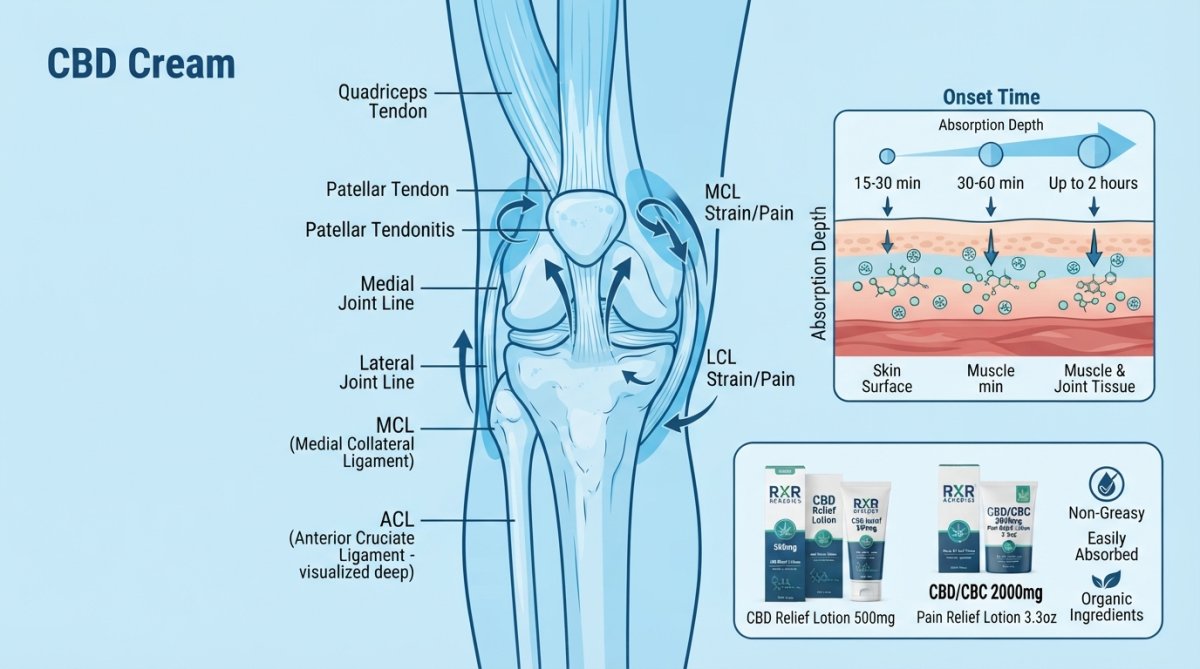
Application technique is where most CBD guides fail. They provide a one-size-fits-all protocol, but knee pain is anatomically diverse, osteoarthritis pain, ligament injuries, and tendinitis require different application approaches to maximize CBD delivery to the affected tissue. Understanding where your pain originates and how to target that specific area dramatically improves onset time and relief duration.
Anatomical Targeting: Matching Application to Your Pain Type
The knee joint is complex. Pain can originate from the joint capsule itself, the surrounding ligaments, the tendons, or the underlying bone. Applying CBD cream only to the most obvious location (the front of the knee) often misses the actual pain source.
Osteoarthritis and joint-line pain. Osteoarthritis typically causes pain along the joint line, the space between the femur and tibia. This pain is often felt on the inside (medial) or outside (lateral) of the knee, not the front. To target this:
- Apply cream directly to the medial or lateral joint line (the groove you can feel on either side of your kneecap).
- Use a golf-ball-sized amount (approximately 1-1.5 grams) and massage in small circular motions for 2-3 minutes, focusing on the tender area.
- Extend the application slightly above and below the joint line, as inflammation spreads beyond the exact pain point.
- For severe osteoarthritis affecting both sides of the knee, apply to both the medial and lateral compartments, using separate applications 5 minutes apart.
Users with osteoarthritis typically report onset between 15-30 minutes with full-spectrum formulas, with peak relief around 60-90 minutes. Duration averages 4-6 hours for chronic inflammation.
Acute ligament injuries (ACL, MCL, LCL sprains). Ligament pain is often sharp and localized to one side of the knee. The MCL (medial collateral ligament) runs along the inside of the knee; the LCL runs along the outside. The ACL is deeper, behind the patellar tendon.
- For MCL injuries: apply cream to the inner knee, along the line of the ligament from just above the joint line to 2-3 inches below it.
- For LCL injuries: apply to the outer knee in the same pattern.
- For ACL injuries: apply cream to the front of the knee, directly over the patellar tendon, and massage downward toward the tibial tuberosity (the bony bump below the kneecap).
- Massage with firm but gentle pressure, ligament injuries are often acute and tender, so avoid aggressive massage that could worsen inflammation.
Ligament injuries show slower onset (20-45 minutes) because the inflammation is deeper in the joint. Peak relief typically occurs at 90-120 minutes. Duration is shorter (3-5 hours) because acute inflammation is more dynamic than chronic arthritis. Reapplication every 4-5 hours is often necessary for acute injuries.
Patellar tendinitis and quadriceps tendon pain. Tendinitis causes pain above or below the kneecap, where the quadriceps and patellar tendons attach. This pain worsens with movement, especially climbing stairs or jumping.
- For quadriceps tendinitis: apply cream to the area above the kneecap, where the quadriceps tendon attaches. Massage upward toward the thigh.
- For patellar tendinitis: apply cream directly below the kneecap, where the patellar tendon attaches to the tibia. Massage downward toward the shin.
- Use lighter pressure than you would for joint pain, tendons are sensitive to aggressive massage.
- Avoid applying cream immediately before or after exercise; wait at least 2 hours post-workout before application, as the tendon is inflamed and hypersensitive.
Tendinitis shows variable onset (20-50 minutes) depending on how deep the inflammation is. Peak relief is typically 60-120 minutes. Duration averages 3-6 hours. Chronic tendinitis often requires 3-4 daily applications for consistent relief.
Bursitis (prepatellar or infrapatellar bursa inflammation). Bursae are fluid-filled sacs that cushion the knee. Inflammation causes swelling and pain, often visible as puffiness above or below the kneecap.
- For prepatellar bursitis (above the kneecap): apply cream directly over the swollen area and massage gently in circular motions. Avoid aggressive pressure, as this can worsen swelling.
- For infrapatellar bursitis (below the kneecap): apply cream to the swollen area and massage gently.
- If the bursa is visibly swollen, use a lighter application and shorter massage duration (1-2 minutes instead of 3) to avoid irritating the inflamed tissue.
Bursitis onset is typically 20-40 minutes. Peak relief is 60-90 minutes. Duration is often longer (5-8 hours) because bursae respond well to topical anti-inflammatory treatment. However, if swelling is severe, consider ice or compression alongside CBD cream.
Proper Application Protocol for Maximum Absorption
Once you've identified your pain type and target area, follow this step-by-step protocol:
Step 1: Prepare the skin (5 minutes). Clean the knee area with mild soap and water, then dry completely. Moisture on the skin reduces absorption by up to 30%. If you've just showered, wait 5-10 minutes for the skin to fully dry. Avoid applying CBD cream to wet or damp skin.
Step 2: Measure and apply (1 minute). Use a golf-ball-sized amount (approximately 1-1.5 grams for a single application). For large areas or severe pain, you may need 2-3 golf-ball amounts applied to different sections of the knee. Dispense the cream directly onto the target area rather than rubbing it between your hands first, this reduces waste and ensures the cream contacts the skin immediately.
Step 3: Massage with intention (2-3 minutes). This is the critical step most users rush. Massage in small circular motions, using firm but not painful pressure. The massage serves three purposes:
- It increases blood flow to the area, warming the skin and enhancing absorption.
- It helps push the cream deeper into subcutaneous tissue and toward the joint.
- It stimulates mechanoreceptors in the skin, which can provide immediate pain relief through the gate control theory of pain (the massage sensation "closes the gate" on pain signals).
Focus your massage on the most tender point for 30-45 seconds, then expand outward to surrounding tissue. If you have multiple pain points (e.g., both medial and lateral knee pain), massage each area separately for 1-2 minutes each.
Step 4: Allow absorption without occlusion (5-10 minutes). Do not cover the area with clothing, a bandage, or a knee brace immediately after application. Allow the cream to absorb into the skin. Covering it traps heat and moisture, which can increase absorption speed (useful if you need fast relief) but also increases the risk of skin irritation or folliculitis with repeated daily use. For chronic pain management, air-dry for 5-10 minutes before covering.
Step 5: Monitor onset and adjust (15-60 minutes). Track when you first feel relief and how long it lasts. Most users feel initial relief (a cooling or numbing sensation) within 15-30 minutes, with peak pain reduction at 60-90 minutes. If you don't feel relief within 45 minutes, the product may not be working for you, or your pain source may be deeper than topical CBD can reach (e.g., deep joint cartilage damage). See the troubleshooting section below.
Step 6: Reapply as needed (every 4-8 hours). For chronic pain, most users find a morning application, midday touch-up, and evening application before bed produces the most consistent relief. Some users report that the first application of the day produces the strongest effect; subsequent applications maintain relief rather than building on it. This is normal and reflects the body's adaptation to the cannabinoid.
User-Reported Onset Times and Duration of Relief by Product Type
Onset time varies dramatically between formulations and between individuals. Here's what real-world data shows:
Full-spectrum creams (like Railroad Remedies (RXR) CBD/CBC blend): Onset 15-30 minutes, peak relief 60-90 minutes, duration 4-8 hours. The presence of CBC and other cannabinoids accelerates onset compared to isolates. Users report that full-spectrum formulas provide more sustained relief, not just acute pain reduction, but a longer-lasting reduction in joint inflammation over hours. This makes them ideal for chronic arthritis pain.
Broad-spectrum creams (THC-removed, other cannabinoids retained): Onset 20-40 minutes, peak relief 75-120 minutes, duration 4-7 hours. Slightly slower onset than full-spectrum, but still faster than isolates. The trade-off is cost, broad-spectrum is cheaper than full-spectrum but more expensive than isolate.
CBD isolate creams: Onset 25-50 minutes, peak relief 90-150 minutes, duration 3-6 hours. Isolates show the slowest onset, likely because they lack the synergistic cannabinoids that accelerate absorption and pain relief. However, they're the most predictable, no batch-to-batch variation in cannabinoid ratios.
Menthol-containing creams (Medterra, Old Bones, others): Onset 2-5 minutes for the cooling sensation, 20-45 minutes for actual CBD pain relief. Menthol provides immediate psychological relief (the cooling sensation feels soothing), but the actual CBD takes longer to work. Some users find the menthol overpowering or irritating if they have sensitive skin. If you're sensitive to menthol, choose unscented formulas.
Practical onset accelerators:
- Warm skin absorbs faster. Applying CBD cream after a warm shower, heating pad use, or light exercise shortens onset by 5-10 minutes compared to application on cold skin. If you need quick relief, warm the area first.
- Massage duration matters. Users who massage for 3 minutes report onset 5-10 minutes faster than those who apply and move on. The massage isn't passive, it's an active part of the delivery mechanism.
- Occlusion increases speed. Covering the application with a bandage or wrap after 5 minutes of absorption can accelerate onset by 5-15 minutes. Use this technique when you need fast relief, but avoid it for daily chronic pain management to reduce skin irritation risk.
- Application to warm, well-perfused areas absorbs faster. The inner knee (medial side) and the area above the kneecap absorb faster than the outer knee or lower leg, where blood flow is lower.
Troubleshooting: Why You Might Not Feel Relief
If you've applied CBD cream correctly but don't feel relief within 45-60 minutes, consider these factors:
The pain source is too deep. Topical CBD reaches skin, subcutaneous fat, and superficial muscle tissue effectively. However, if your pain originates from deep joint cartilage, the meniscus, or the ACL itself (rather than surrounding inflammation), topical CBD may not reach the source. In this case, oral CBD or systemic anti-inflammatory medication might be more effective. Consult your doctor if pain persists despite correct topical application.
Your skin barrier is compromised. If you have eczema, psoriasis, or dermatitis on your knee, the damaged skin barrier reduces absorption. In this case, treat the skin condition first (with topical steroids or other dermatological treatments) before relying on CBD cream. Once the skin heals, CBD absorption improves dramatically.
The product's potency is too low. If you're using a 500mg isolate cream for severe osteoarthritis, the dose may be insufficient. Try a higher-potency formula (1000-2000mg full-spectrum) or increase the application amount to 2-3 golf-ball sizes per application. Track whether higher potency produces relief; if it does, you've found your effective dose.
You're not massaging long enough. Passive application (rubbing cream on and moving on) is less effective than active massage. Try increasing massage duration to 4-5 minutes and applying firmer pressure. The massage itself contributes significantly to pain relief.
The product contains ingredients you're sensitive to. If the cream contains coconut oil, shea butter, menthol, or fragrance that irritates your skin, the irritation can mask any pain relief. Test a small amount on your inner forearm first. If you experience redness or itching, switch to an unscented, minimal-ingredient formula.
Your pain is too acute. Acute injuries with severe inflammation may respond better to ice, compression, and NSAIDs in the first 24-48 hours, with CBD cream added once acute swelling begins to subside. CBD is more effective for chronic pain than for acute flare-ups.
Full Spectrum CBD Cream for Pain: Ingredient Quality & Third-Party Testing
You cannot assess a CBD cream's quality by looking at the label alone. Two products with identical "1000mg full-spectrum CBD" claims can have vastly different potency, purity, and actual cannabinoid content. This is where third-party testing becomes non-negotiable.
What to Look for in a Certificate of Analysis (COA)
A Certificate of Analysis is a lab report from an independent third party that verifies the cannabinoid content, tests for contaminants (pesticides, heavy metals, microbial pathogens), and confirms potency claims. Legitimate brands publish their COAs publicly; if a company won't share theirs, that's a red flag.
When reviewing a COA, look for these specific elements:
Total cannabinoid content. The report should list CBD content as milligrams per container AND as a percentage. If a label claims 1000mg CBD in a 2oz jar, the COA should confirm roughly 500mg/mL concentration. Discrepancies here indicate either mislabeling or degradation.
Cannabinoid profile. For full-spectrum products, the report should itemize CBD, CBC, CBG, CBN, and other cannabinoids. This confirms it's actually full-spectrum, not just CBD isolate in carrier oil.
Pesticide and heavy metal testing. Look for reports that test for common agricultural pesticides (pyrethrins, neem oil residues) and heavy metals (lead, cadmium, mercury). Clean results are essential for topical products that you apply repeatedly to skin.
Microbial testing. The report should confirm the product is free of E. coli, salmonella, and mold. Topical products don't have the same FDA oversight as oral medications, so third-party verification is your only assurance of safety.
Test date. The COA should be recent (within 6 months of purchase). Old reports don't reflect current batch quality, especially for full-spectrum products that degrade over time.
Railroad Remedies (RXR) publishes full COAs for both their 500mg and 2000mg formulas, allowing you to verify potency and purity before purchasing. This transparency is increasingly rare in the CBD market.
Organic Ingredients and Supply Chain Transparency
Beyond cannabinoid testing, ingredient quality matters for topical absorption and skin health. CBD creams sit on your skin for hours; if they contain synthetic preservatives, artificial fragrances, or low-quality carrier oils, they can irritate rather than soothe.
Look for organic certifications on carrier oils, coconut oil, shea butter, and jojoba oil should be USDA organic if the brand claims natural formulation. Organic certification requires third-party verification that the oil was extracted without synthetic pesticides or solvents.
Preservative systems also matter. Natural preservatives like vitamin E and rosemary extract are preferable to synthetic options like parabens or methylisothiazolinone (MIT), which some users report as skin irritants. However, preservatives are necessary to prevent microbial growth in water-based creams.
Supply chain transparency is harder to verify but worth asking about. Where does the hemp come from? Does the brand grow its own hemp or source from third-party farms? Railroad Remedies (RXR) sources organic hemp from established suppliers with documented farming practices, reducing the risk of contamination or pesticide residue that can appear in cheaper bulk hemp.
CBD Cream for Inflammation: Safety, Side Effects & Drug Interactions
Topical CBD is generally well-tolerated, but it's not risk-free. Understanding potential side effects and drug interactions prevents unpleasant surprises.
Potential Side Effects and Skin Sensitivity Concerns
The most common side effect of topical CBD is localized skin irritation, redness, itching, or mild burning at the application site. This typically occurs with sensitive skin or if you're allergic to one of the carrier oils. Coconut oil, for example, causes contact dermatitis in some people.
If you experience irritation, discontinue use and test a small amount on your inner forearm first. Wait 24 hours. If no reaction occurs, the product is likely safe for broader application.
A less common but documented side effect is contact sensitization, your skin becomes increasingly reactive to the product over repeated applications. This is more likely with products containing fragrance oils or essential oils. Unscented formulas reduce this risk.
For users with very dry or damaged skin (from eczema, psoriasis, or radiation therapy), the emollients in CBD creams often provide relief rather than irritation. However, if your skin barrier is severely compromised, start with a small test amount and monitor for 48 hours before full application.
Drug Interactions and Topical CBD Safety for Chronic Pain Management
Here's the critical distinction: topical CBD has minimal systemic absorption, so it carries far fewer drug interactions than oral CBD. Your liver doesn't metabolize topical CBD in meaningful quantities, so it won't compete with medications that depend on liver metabolism.
However, a few interactions are worth noting:
NSAIDs and topical CBD. If you're taking ibuprofen, naproxen, or other NSAIDs for joint pain, topical CBD doesn't interact with these directly. However, combining them might mask pain signals so effectively that you overuse an injured joint, delaying healing. Use both cautiously if you have acute injuries.
Topical corticosteroids. If you're using prescription topical steroids (like hydrocortisone or triamcinolone) for skin conditions on your knee, avoid mixing them with CBD cream. Apply them to separate areas or at different times of day. The combination hasn't been well-studied, and both affect inflammation pathways.
Blood thinners. Oral CBD inhibits CYP3A4 enzymes, which metabolize warfarin and other anticoagulants. Topical CBD doesn't significantly inhibit these enzymes, but if you're on blood thinners, consult your doctor before using any CBD product, oral or topical.
Antihistamines and sedating medications. Topical CBD won't interact with these, but some CBD creams contain menthol or other ingredients that can cause drowsiness in sensitive individuals. If you're on sedating medications, monitor how you feel after application.
The safety profile of topical CBD for chronic pain management is strong, especially compared to oral NSAIDs, which carry risks of gastrointestinal bleeding and kidney damage with long-term use. Many users report switching from daily NSAIDs to topical CBD with significant improvement in overall health markers.
Cost-Per-Milligram Analysis: Value Comparison Across Leading Brands
Raw potency doesn't equal value. A 2000mg cream that costs twice as much as a 1000mg option isn't necessarily twice as effective. This analysis breaks down cost-per-milligram to show where you're getting genuine value.
Railroad Remedies (RXR) CBD/CBC 2000mg Pain Relief Lotion costs $69.99 for a 3.3oz container, which breaks down to approximately $0.035 per milligram of CBD. For a full-spectrum formula with added CBC and organic carrier oils, this is competitive with premium brands.
CBDfx CBG + CBD Muscle and Joint Cream (3000mg potency) runs approximately $99-129 depending on retailer, translating to roughly $0.033-$0.043 per milligram. The addition of CBG and botanical ingredients (white willow bark, caffeine) justifies the premium for users seeking maximum anti-inflammatory support.
Medterra Pain Relief Cream (500mg) costs around $34.99, or approximately $0.070 per milligram, nearly double the cost-per-milligram of higher-potency options. However, if you only need mild relief or want to test CBD before committing to larger purchases, the lower upfront cost makes sense.
Charlotte's Web Hemp-Infused Body Cream (1000mg) retails around $49.99, equaling roughly $0.050 per milligram. The brand premium reflects their reputation and third-party testing, though the cost-per-milligram is higher than less-known brands offering similar potency.
Here's the practical takeaway: if you have severe chronic pain, the 2000mg formulas (like Railroad Remedies (RXR)'s blend) offer the best cost-per-milligram and the fastest onset time. If you're managing mild to moderate pain or testing whether CBD works for you, starting with a 500-1000mg option reduces risk and cost. Scaling up after confirming efficacy is smarter than overpaying for potency you might not need.
Chronic knee pain doesn't have to mean a lifetime of NSAIDs or opioids. Topical CBD offers a well-researched, side-effect-light alternative that works best when you understand formulation differences and application technique. Railroad Remedies (RXR)'s CBD/CBC 2000mg formula combines full-spectrum cannabinoids with organic carrier oils and proven absorption enhancers, delivering faster onset and longer-lasting relief than isolate-based competitors. Start with their 500mg Relief Lotion to test your response, then upgrade to the 2000mg blend if you need maximum anti-inflammatory support for severe arthritis or chronic pain.
Frequently Asked Questions
Does topical CBD cream actually help with knee pain from arthritis?
Topical CBD may help manage knee pain and inflammation associated with osteoarthritis and rheumatoid arthritis. The cannabinoid interacts with the endocannabinoid system in localized areas, potentially reducing inflammatory markers. However, clinical evidence remains limited. Most research supports CBD's anti-inflammatory properties, though topical application may not reach deep joint tissue as effectively as oral CBD. Users report varying results, some experience noticeable relief, while others find minimal benefit. Individual response depends on pain severity, cream potency, and application technique.
What is the difference between full-spectrum and broad-spectrum CBD cream for knee pain?
Full-spectrum CBD cream contains all cannabinoids, terpenes, and plant compounds from hemp, including trace amounts of THC (under 0.3%). Broad-spectrum removes THC while retaining other cannabinoids and terpenes. Full-spectrum products may offer enhanced anti-inflammatory benefits through the 'entourage effect,' where compounds work synergistically. Broad-spectrum provides similar benefits without THC concerns, making it ideal for those avoiding THC entirely. For knee pain relief, full-spectrum creams often rank higher in user satisfaction, though broad-spectrum options work well for sensitive individuals or those subject to drug testing.
How long does it take for CBD cream to work on knee pain?
User-reported onset times for topical CBD cream typically range from 15 minutes to 2 hours, with most users noticing initial relief within 30-45 minutes. Duration of pain relief varies widely, some report 2-4 hours of noticeable improvement, while others experience longer-lasting effects. Factors affecting onset include cream potency (measured in milligrams of CBD), skin thickness, application area, and individual metabolism. Consistent daily application may improve results over time, as some users report cumulative benefits after 1-2 weeks of regular use. Starting with lower potencies and tracking your personal response timeline helps establish realistic expectations.
What should I look for when choosing a CBD cream for knee pain?
Look for creams with third-party lab testing (verified by COA, Certificate of Analysis), clearly stated CBD potency, and organic ingredients like coconut oil or shea butter that support skin absorption. Verify the product is full-spectrum, broad-spectrum, or isolate based on your preference and THC sensitivity. Check the cost-per-milligram to ensure fair pricing, quality creams typically range from $40-80. Read user reviews specifically mentioning onset time and duration. Confirm the brand discloses supply chain transparency and hemp sourcing. For knee pain, higher potencies (500mg+) often provide better results than lower-dose options.
Can I use CBD cream for knee pain if I'm taking other medications?
Topical CBD has minimal systemic absorption, making drug interactions unlikely compared to oral CBD. However, some medications, particularly blood thinners, immunosuppressants, and certain pain relievers, may interact if CBD is absorbed into the bloodstream. Consult your healthcare provider before using CBD cream alongside prescription medications, especially if you take NSAIDs for chronic pain or have sensitive skin from treatments like radiation therapy. Topical application is generally well-tolerated, but always perform a patch test first. If you have a history of adverse reactions to topical products, start with a small amount on unaffected skin to assess tolerance.
This article was written using GrandRanker
